Communications
6G ISAC: Expanding the Value of Mobile Networks Beyond Connectivity
Introduction: From Connectivity to Awareness
Mobile networks have traditionally been designed to connect people, devices, and services. Each generation has improved data rates, latency, reliability, coverage, and capacity. In 6G, however, the role of the network is expected to expand further. A 6G network may not only deliver information, but also help understand the physical environment in which communication takes place.
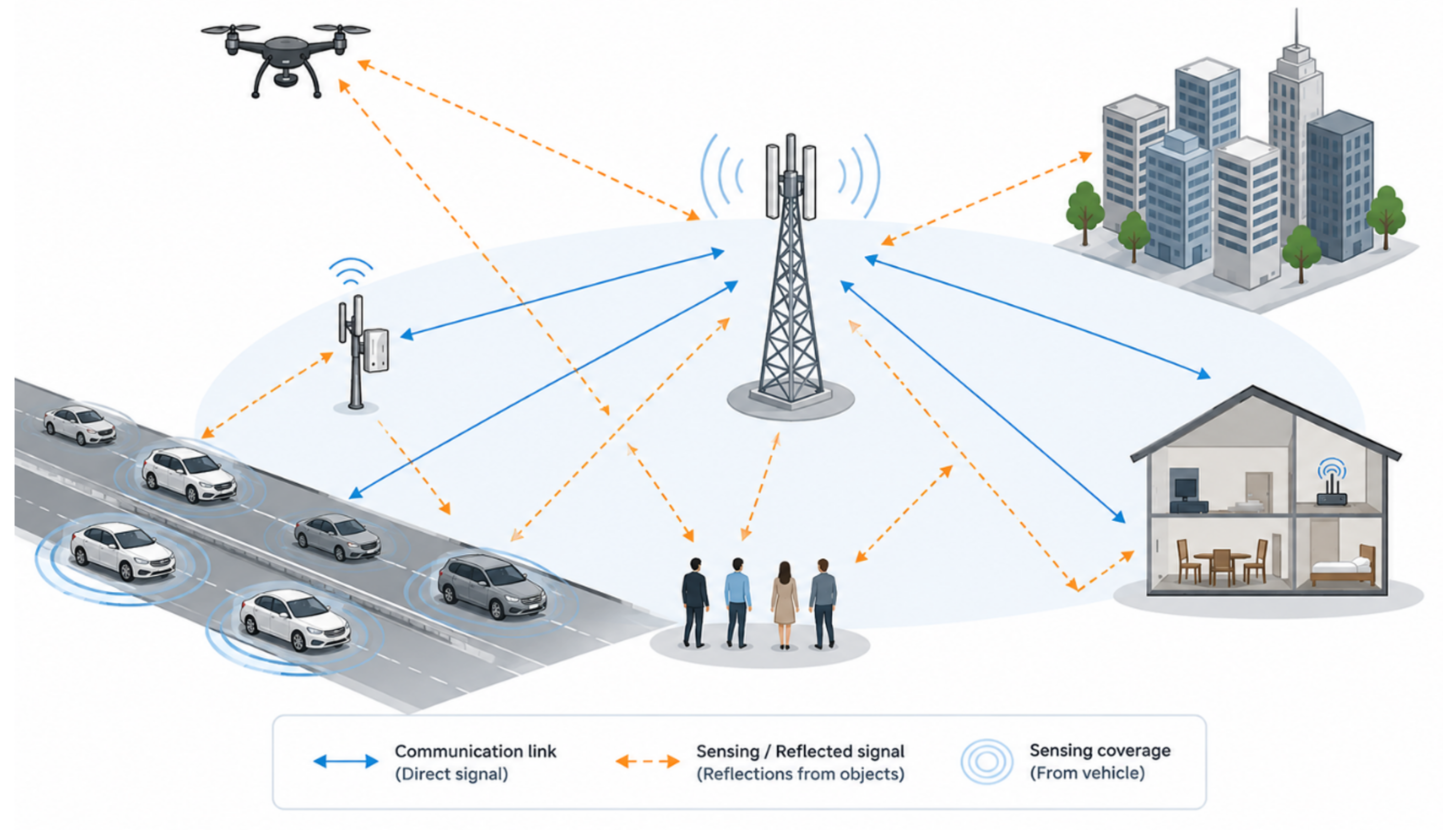
Integrated Sensing and Communication, or ISAC, is one of the key technologies behind this shift. The basic idea is simple: radio signals used for communication can also carry information about the surrounding environment. By analyzing reflections, propagation characteristics, and measurement results, the network may detect objects, track movement, or understand changes in the radio environment.
The important point is that ISAC is not just about adding radar-like functions to a base station. Its broader value lies in reusing communication infrastructure, radio resources, and signal processing capability to create a distributed sensing layer. If designed carefully, 6G ISAC can expand the value of mobile networks beyond connectivity without requiring a completely separate nationwide sensing infrastructure.
This is why ISAC is becoming an important topic in 6G. It connects several long-term directions: network intelligence, service expansion, coverage-aware operation, energy and deployment efficiency, and tighter integration between the physical and digital worlds.
What ISAC Means for 6G Networks
The value of ISAC starts from infrastructure reuse. Mobile networks already have wide-area deployment, radio coverage, synchronization, beamforming capability, and baseband processing resources. If sensing can be integrated into this existing communication framework, the network can provide sensing capability with a lower incremental deployment burden than building a separate sensing system from scratch.
From this perspective, ISAC can be understood as a new value layer on top of the communication network. A base station, a fixed wireless access device, a vehicle, or another network-connected node may contribute to sensing, depending on its capability and deployment condition. The sensing result may then be used by applications, by the network, or by other devices.
This also creates new business opportunities for 6G. Today, the main value of mobile networks is still largely tied to connectivity: data plans, broadband access, enterprise private networks, and device connections. ISAC can expand this value by enabling sensing-based services on top of the same infrastructure. For example, environmental awareness, road and traffic monitoring, industrial site monitoring, public safety support, indoor presence detection, and context-aware network operation may become new service opportunities if sensing information can be provided in a reliable and privacy-aware manner.
The business value of ISAC does not come from replacing dedicated sensors or radar systems in every scenario. Instead, it comes from enabling “good-enough and widely available” sensing capability where communication infrastructure already exists. This distinction is important. A dedicated sensing system may provide higher accuracy for a specific mission, but it often requires separate deployment, operation, and maintenance. ISAC can create value by offering scalable sensing coverage with lower additional deployment effort, especially for use cases that benefit from wide-area observation rather than extremely high sensing precision.
This can be particularly meaningful for operators and ecosystem partners. For operators, ISAC may provide a path to move beyond pure connectivity revenue and offer sensing-enabled services to enterprises, municipalities, mobility platforms, home service providers, and industrial customers. For device and infrastructure vendors, ISAC may create new requirements for sensing-capable radio design, reporting frameworks, edge processing, and service platforms. For application providers, it may open a new source of environmental and contextual information, provided that privacy, security, and data ownership are properly addressed.
This does not mean that every communication node should become a high-performance radar. A practical 6G ISAC design needs to respect the constraints of communication systems. Sensing should be implementable, as much as possible, using common RF and baseband modules. This principle is important because the real strength of ISAC is scale: useful sensing capability should be added without making the communication network significantly more complex or costly.
A dedicated radar system may provide strong sensing performance in a specific location. A communication network, on the other hand, can provide broad and continuous coverage if sensing is integrated efficiently. The design goal should therefore be to find a practical balance: useful sensing capability, reasonable system impact, acceptable cost for communication operation, and clear service value for the 6G ecosystem.
From 5G ISAC to 6G ISAC: Why the Scope Needs to Expand
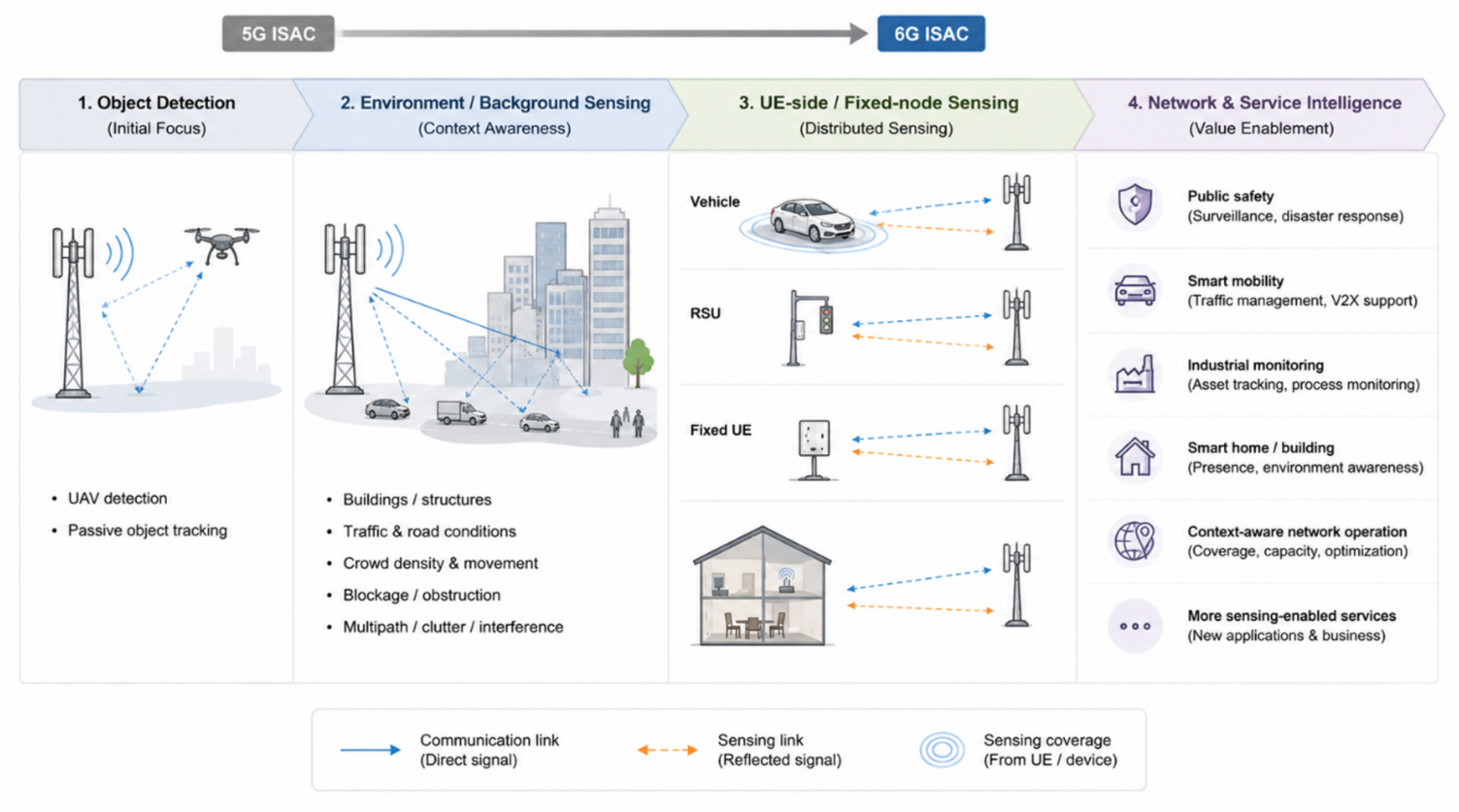
In 5G-related ISAC studies, UAV detection has often been used as an intuitive and representative example. This makes sense. UAV detection is easy to understand, and it clearly shows how a communication network may be used to detect or track passive objects without deploying dedicated radar infrastructure.
UAV detection remains an important use case for 6G ISAC. However, if ISAC is discussed only through UAV detection, its value may look too narrow. The broader opportunity for 6G is environmental awareness. A 6G network should be able to understand not only whether a specific flying object exists, but also how the surrounding environment affects communication and services.
This includes buildings, roads, vehicles, crowds, blockage, reflection, clutter, and other environmental factors. A vehicle passing through a street, a crowd forming in a public space, a moving blockage in an indoor environment, or a change in surrounding reflectors may all affect radio links. ISAC can provide an additional source of information about these changes.
In other words, 6G ISAC should move beyond object detection alone. It should become a framework for sensing the environment around communication networks.
Key Use Cases for 6G ISAC
1. Environment and Background Sensing
A practical starting point for 6G ISAC is environment or background sensing. Instead of focusing only on a specific target, the network may collect information about the surrounding radio environment. This can include static objects such as buildings or walls, non-static objects such as vehicles or people, and environmental factors such as blockage, multipath, clutter, and interference.
This type of sensing can support both services and network operation. For example, background sensing may help identify traffic congestion, crowd density, or changes in the local environment. It may also help the network understand why a link is degraded: whether the cause is blockage, mobility, interference, or a change in the propagation environment.
From a communication-assistance perspective, this type of environmental information can be useful because it is directly related to channel behavior. Environmental sensing may provide information on multipath, blockage, fading, clutter, and interference. Such information may potentially help communication-related functions, but the benefit should not be overstated.
Sensing information does not automatically improve communication performance. How the network uses such information for scheduling, beam management, mobility, or link adaptation may depend on implementation and system design. For the early stage of 6G ISAC, a more realistic goal is to define what sensing information can be measured, how it can be reported, and what level of reliability can be expected.
This is why background sensing is important. It can become the foundation for many future ISAC services without forcing the system to assume one specific application from the beginning.
2. Vehicle, RSU, and Fixed-UE Sensing
UE-side sensing is another important direction for 6G ISAC. However, not all UEs are equally suitable for sensing. A handheld smartphone has strict constraints: limited antenna size, limited transmit power, battery constraints, mobility, and uncertain position or orientation. These factors can make sensing information less reliable, especially when accurate location or angle information is required.
This is why 6G ISAC should look beyond smartphones. Vehicles, road-side units, customer premises equipment, and other fixed or semi-fixed devices may be more attractive sensing nodes.
A vehicle, for example, has several advantages over a handheld device. It can support better antenna placement, has a more stable power supply, and can continuously observe its surroundings while moving through roads. Vehicle-mounted sensing may help monitor nearby objects, road congestion, surrounding buildings, local blockage, and traffic density. This information may be useful not only for the vehicle itself, but also for broader network or service-level awareness.
Road-side units and fixed UEs can provide even more stable sensing information. Their location and orientation can be known or controlled, which improves the confidence of sensing results. This distinction is critical for 6G ISAC. “UE sensing” should not be treated as a single category. A smartphone, a vehicle, an RSU, and a fixed indoor device have different antenna capabilities, power budgets, processing assumptions, mobility patterns, and reporting feasibility. A practical 6G ISAC framework should define these assumptions clearly.
3. Indoor CPE-Based Sensing
Indoor fixed devices, such as CPEs used for fixed wireless access, may also become meaningful sensing nodes in 6G. Unlike handheld devices, CPEs are usually installed in a fixed location, connected to a stable power source, and may have a larger form factor. These characteristics make them more suitable for continuous sensing than battery-limited mobile devices.
A fixed CPE can act as a stable observation point in an indoor environment. Potential home-oriented use cases may include presence detection, indoor environment awareness, safety monitoring, or detection of unusual movement patterns. These examples should be treated carefully, because indoor sensing is closely related to privacy.
A useful ISAC system should not simply collect as much information as possible. It should define what is measured, what is reported, where the sensing function is processed, and how sensitive information is protected.
For this reason, CPE-based sensing may become a good example of the balance required in 6G ISAC. The device characteristics are favorable, the use cases are understandable, and the deployment model is practical. At the same time, privacy, reporting overhead, and processing responsibility must be considered from the beginning.
4. Communication Assistance
Communication assistance is another important use case for ISAC, but it requires careful framing. The intuitive idea is that if the network understands the environment better, it may operate communication links more efficiently. For example, sensing information may help identify blockage, moving objects, reflectors, or changes in the propagation environment.
This information could potentially support beam management, CSI acquisition, mobility handling, or interference management. However, it is not yet sufficient to assume that sensing will directly guarantee communication performance improvement in all scenarios.
A practical approach is to separate two questions. The first question is: what sensing information can be measured and reported reliably? The second question is: how should the network use that information to improve communication? In the early stage of 6G ISAC, the first question should come before the second.
This approach avoids overloading ISAC with too many communication-performance assumptions, while still allowing sensing information to become useful for future network optimization.
What 6G ISAC Needs to Address
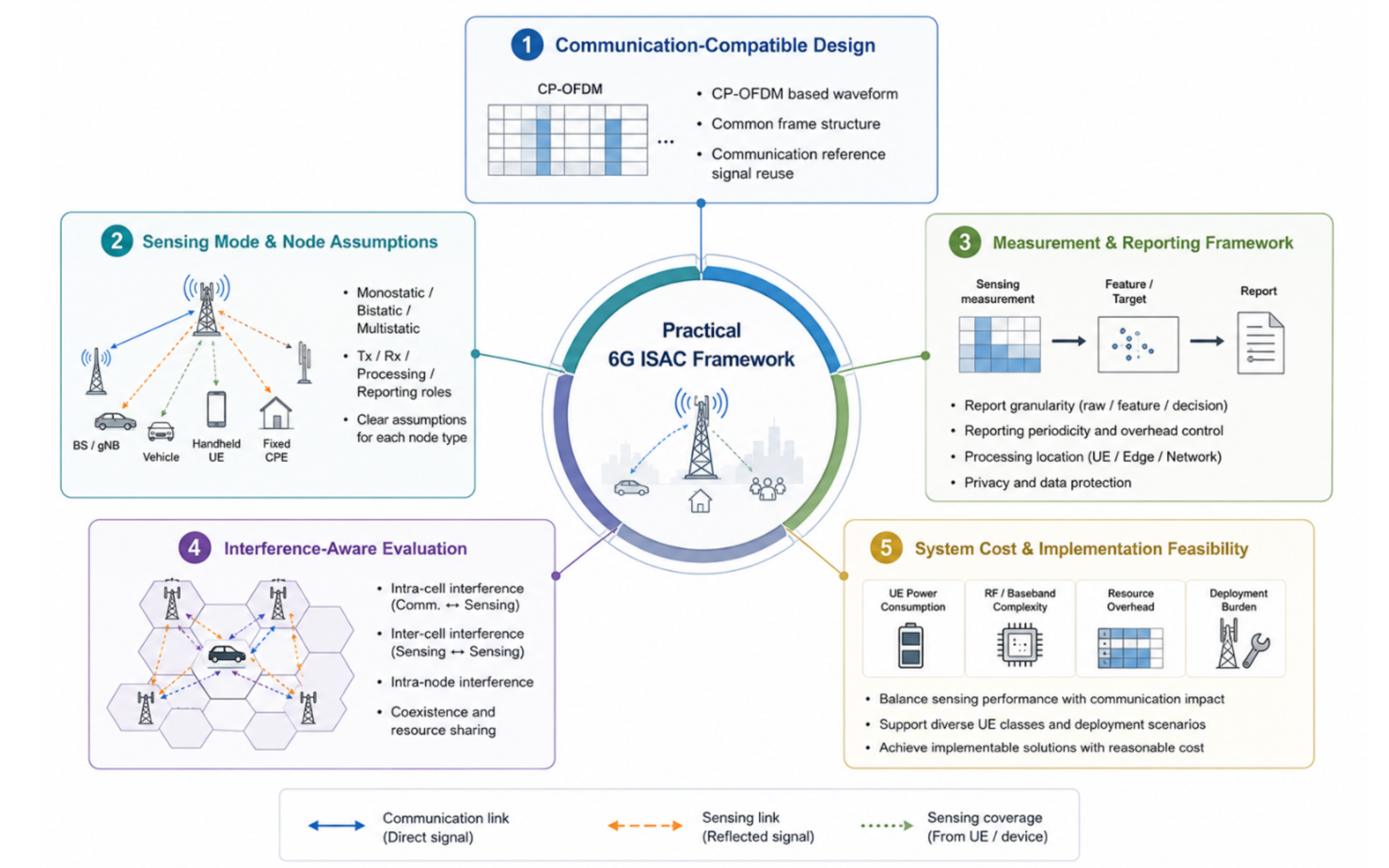
For ISAC to become a practical 6G feature, 6G ISAC needs to focus on integration with communication from day one. The key question is not how to design the best standalone sensing waveform in isolation. The key question is how to support useful sensing capability within a communication system that must also serve users, manage interference, control overhead, and remain implementable.
Start from Communication-Compatible Design
6G ISAC should start from the communication framework. CP-OFDM-based waveform generation, common frame structure, and communication reference signal reuse should be evaluated before introducing sensing-specific designs. For sensing RS based operation, the signal characteristics may be treated in a similar manner to communication RSs, since they are mainly determined by sequence design and resource mapping.
This does not mean that no enhancement is possible. If a clear sensing performance gap is identified, enhancements to reference signal design and overall procedures, including sequence design, resource mapping patterns, repetition structure for possible range extension, resource configuration, or measurement reporting procedures may be considered. For example, ZC-based sequence design or frequency domain mapping may be considered within the CP-OFDM framework if existing communication RS are not sufficient for sensing. But these enhancements should be justified by realistic evaluation and should preserve communication compatibility as much as possible.
The reason is straightforward. ISAC is valuable because it is integrated with communication. If sensing requires a separate waveform, separate frame structure, or separate hardware assumption from the beginning, the deployment benefit becomes much weaker. A communication-compatible baseline keeps the system scalable and implementable. With this baseline, necessary enhancements may be achieved by optimizing the design of communication signals within the communication framework. Such an approach can allow the network to provide meaningful sensing capabilities without requiring hardware modifications to the communication transceiver.
Clarify Sensing Modes and Node Assumptions
6G ISAC also needs clear assumptions on sensing modes and node roles. Monostatic, bistatic, and multistatic sensing have different technical implications. The transmitter, receiver, sensing function, and reporting node may be the same or different. Consequently, requirements for synchronization, beam operation, interference, and reporting paths also vary depending on the sensing mode.
For BS-centric sensing, standard constraints, such as the need for standardized waveform, should be carefully assessed. For BS monostatic sensing, introducing specification constraints can prevent vendor-specific optimizations needed to handle interference across different deployment scenarios. For BS-BS bistatic sensing, the requirement for stringent synchronization presents practical challenges when implemented across different infrastructure vendors via inter-vendor collaboration. Therefore, relying on vendor implementation might be a better approach for those sensing modes than imposing standard constrains.
On the other hand, for UE-involved sensing, the assumptions become even more important. Various UE types, such as handheld UE, vehicle, fixed CPE, and RSU, should not be modeled in the same way. Their antenna capability, transmit power, processing capability, mobility, and reporting feasibility are different. Furthermore, when both BS and UE are involved (e.g., BS-UE or UE-BS bistatic sensing), the impact on UE operation and the integration with the communication framework become more significant.
Therefore, before defining detailed signal designs, 6G ISAC needs to clarify who transmits, who receives, who processes, and who reports sensing information. Understanding these limitations and device variations can help 6G standardization focus on essential standard impacts, while leaving deployment flexibility to implementation.
Build a Measurement and Reporting Framework
6G ISAC also needs a practical measurement and reporting framework. Sensing results can have very different forms. They may be raw samples, delay-Doppler-angle profiles, detected peaks, or processed target-level metrics. More detailed information may improve sensing quality, but it also increases reporting overhead, processing burden, and privacy risk.
This is especially important for UE-side sensing. If a UE needs to report large sensing data frequently, the overhead may become too high. If the UE processes too much information locally, device complexity and power consumption may increase. Depending on the reporting form, additional post-processing may be required at the aNB side. In such cases, additional contextual information such as sensitive location or environment information, may also be requested to interpret the sensing results report. If such information is included in the report, privacy concerns become significant.
The right design point may differ by use case. A vehicle monitoring road congestion may need frequent but compact reports. A fixed indoor CPE may require stronger privacy protection and local processing. A TRP-side sensing use case may allow more network-side processing but may require stronger coordination across cells. 6G ISAC needs to define flexible but manageable reporting mechanisms that reflect these differences.
Evaluate Interference Realistically
6G ISAC needs realistic interference modeling from the beginning. Sensing signals do not exist in an empty environment. They coexist with communication traffic, neighboring cells, other sensing operations, and reflections from background objects.
This is particularly important for multi-node or cooperative sensing. For example, when BS monostatic sensing is performed simultaneously in different cells, a sensing signal transmitted by one BS may act as interference to echo reception at another BS. Similarly, different cells may operate the same or different sensing modes. In UE-involved sensing, UE transmission for sensing may also create new interference and coexistence conditions depending on how sensing reference signals are transmitted, received and reported.
Without interference-aware evaluation, sensing performance may look promising in simulation but become fragile in real deployment. 6G ISAC therefore needs to evaluate not only ideal sensing accuracy, but also sensing reliability under realistic intra-cell, inter-cell, and intra-node interference conditions.
Balance Sensing Gain and System Cost
Finally, 6G ISAC needs to balance sensing gain against communication impact and implementation cost. A sensing-specific design may improve a particular sensing metric, but it may also increase resource overhead, reduce scheduling flexibility, require additional RF capability, or increase UE power consumption.
This trade-off is especially important because ISAC is intended to be integrated with communication. A design that works well for sensing alone may not be suitable if it consumes too many communication resources or creates too much device complexity.
Therefore, 6G ISAC should evaluate candidate designs across three dimensions at the same time: sensing performance, communication impact, and implementation feasibility. Only when all three are considered together can ISAC become practical for commercial networks.
Conclusion
ISAC is one of the technologies that can expand the role of 6G networks beyond connectivity. Its value is not limited to detecting a specific object such as a UAV. The broader opportunity is to make mobile networks more aware of the physical environment around them.
For this reason, 6G ISAC should focus on practical and scalable use cases: environment and background sensing, vehicle and fixed-UE sensing, indoor CPE-based sensing, and carefully scoped communication assistance. These use cases can build on the existing strength of mobile networks: broad coverage, distributed infrastructure, radio resources, and signal processing capability.
At the same time, ISAC must be designed with realistic constraints. Sensing should be integrated with communication, not isolated from it. CP-OFDM-based waveform generation, common frame structure, communication reference signal reuse, clear UE assumptions, compact reporting, privacy awareness, and interference-aware evaluation should be considered from the beginning.
The key message is simple: 6G ISAC should not be about turning every base station into a standalone radar. It should be about making the communication network aware of its environment in a practical, scalable, and deployable way.