Communications
Distributed Multiple-Input Multiple-Output (D-MIMO) for Ubiquitous Uplink Performance
1. Introduction
Driven by the rapid surge in user-generated traffic, such as live video streaming, Extended Reality (XR)/ Virtual Reality (VR), and autonomous Artificial Intelligence (AI) agents, ubiquitous and reliable uplink (UL) performance has become significantly important in modern wireless networks [1]. UL D-MIMO is gaining attention as an enabler for addressing these requirements. UL D MIMO leverages coordinated reception from multiple transmission–reception points (TRPs) to enhance uplink performance. As illustrated in Figure 1, in conventional UL, a single user equipment’s (UE’s) signal is only processed by one TRP, causing interference to neighboring TRPs. In contrast, UL-DMIMO allows nearby TRPs to act as helpers, capturing the UE’s uplink data and sharing it with the serving TRP for combining. The joint reception enhances the received signal power strength, and transforms conventional strong inter-cell interferer into collaborating user, therefore significantly improve spatial diversity and interference suppression.
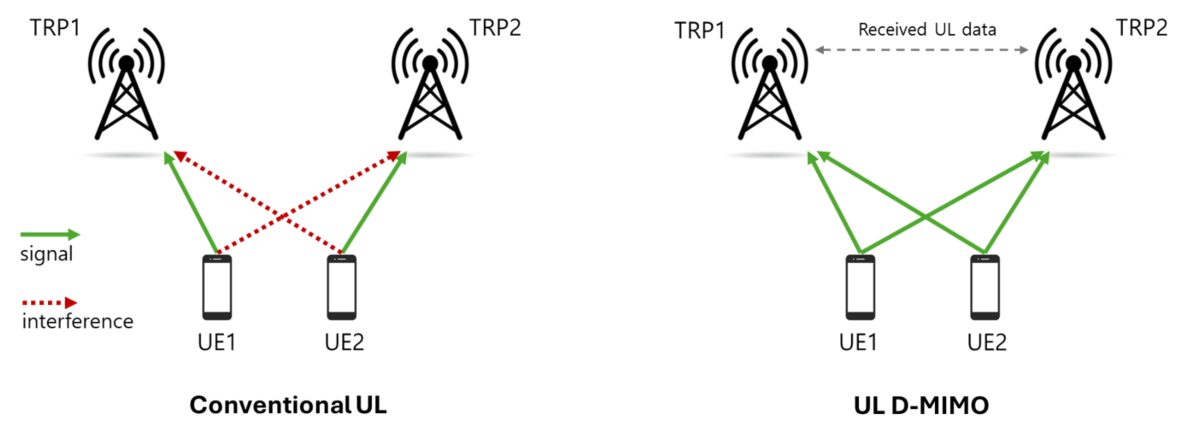
Figure 1. Illustration of UL D-MIMO system
Although UL D MIMO has not yet been standardized in 3GPP, related concepts such as uplink Coordinated Multi-Point (CoMP), multi-TRP reception, and distributed massive MIMO are being actively studied in both academia and industry. Vendors and operators increasingly regard UL D MIMO as a key enabler for achieving performance-assured connectivity and supporting uplink heavy use cases. This perspective drives further investigation into advanced UL diversity reception techniques [1-5]. Recent industry studies show that D-MIMO can significantly improve throughput and coverage in a variety of scenarios, including cell-edge users, dense deployments with strong inter-cell interference, and higher order of UL MIMO configurations.
In our previous blog, we discussed the D-MIMO technology for the downlink (DL) side [6]. In this blog, we explore the UL D-MIMO system and its various key features. Specifically, we discuss several signal combining methods, examining their trade-offs and scalability in terms of UL performance gains versus fronthaul bandwidth and computational complexity. Additionally, we present advanced scheduling schemes that incorporate dynamic UE centric clustering, adaptive resource allocation, and link adaptation to further enhance the performance of UL D MIMO systems.
2. Technical Challenges
UL D MIMO systems encounter challenges at both the physical (PHY) and medium access control (MAC) layers. Geographically distributed TRPs lead to significant variations in signal quality, interference, synchronization, and channel reliability. These variations necessitate carefully designed equalization and combining algorithms at the PHY layer to ensure robust performance. Additionally, they introduce more complex requirements for MAC layer design, such as UE scheduling and TRP selection. Below, we identify the specific challenges in more detail at both the PHY and MAC layers.
Physical layer:
Layer 2 and above:
3. Fronthaul Efficient Joint Combining with Scalable MMSE Equalization
To address the PHY layer challenges discussed above, practical UL D-MIMO systems require new architectural and algorithmic solutions that reduce both fronthaul bandwidth and centralized processing complexity. This section evaluates three combining schemes. Based on the selected combining methods, locally processed data - raw I/Q samples, log likelihood ratio (LLR), and equalizer outputs - are forwarded to the DU, where the centralized unit performs joint signal combining and decoding.
The performance of UL D-MIMO is evaluated using link-level simulations across three combining methods.
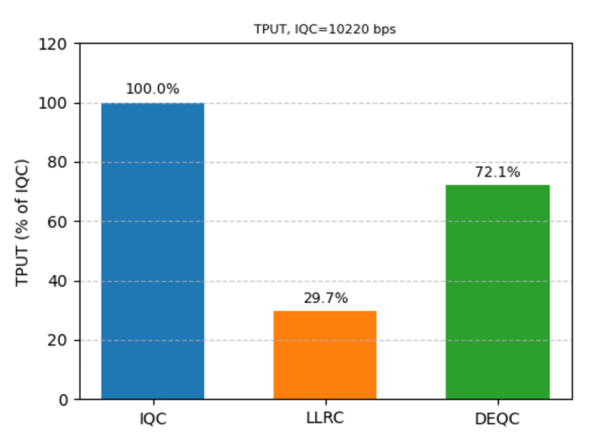
Figure 2. Throughput comparisons among three combining schemes
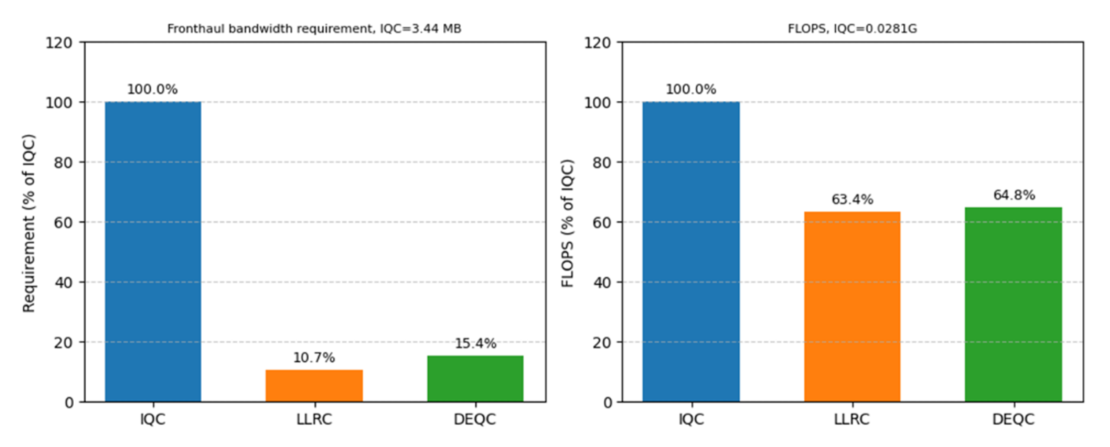
Figure 3. Fronthaul bandwidth requirement and overall computational complexity in terms of floating point operations per second (FLOPS) for Physical Uplink Shared Channel (PUSCH) operation among three combining schemes
From Figure 2 and Figure 3, it is evident that IQC delivers the best performance, albeit with the highest complexity and fronthaul overhead. In contrast, LLRC requires approximately 10% of the fronthaul bandwidth and 64% of the computation complexity of IQC, yet achieves less than 30% of IQC’s throughput performance. While LLRC significantly reduces overhead, it provides only modest performance improvement. DEQC, on the other hand, offers a balanced tradeoff, achieving 72% of IQC throughput while consuming just 15% of IQC's fronthaul bandwidth and 64.8% of its PUSCH FLOPS. This significant amount of fronthaul reduction is particularly advantageous for D-MIMO deployments, where fronthaul capacity is often the critical bottleneck – such as in indoor scenarios with high TRP density. Additionally, the 35% reduction in PUSCH FLOPS alleviates the centralized processing burden at the DU, enabling scalability to larger TRP counts. Thus, DEQC effectively balances fronthaul efficiency, scalability, and joint combining gains, closely approaching centralized MMSE performance while substantially reducing implementation complexity. This makes DEQC a practical and scalable solution for D-MIMO deployments where both fronthaul and compute resources are constrained.
In addition, Figure 4 shows the Reference Signal Received Power (RSRP) coverage benefits in an office environment. The left figure illustrates the measured RSRP of a conventional single-TRP system, which suffers from numerous coverage holes. The right figure, however, demonstrates the RSRP when four TRPs are placed to maximize overall coverage. This clearly highlights the key advantage of UL D-MIMO: uniform RSRP coverage across the operating area.
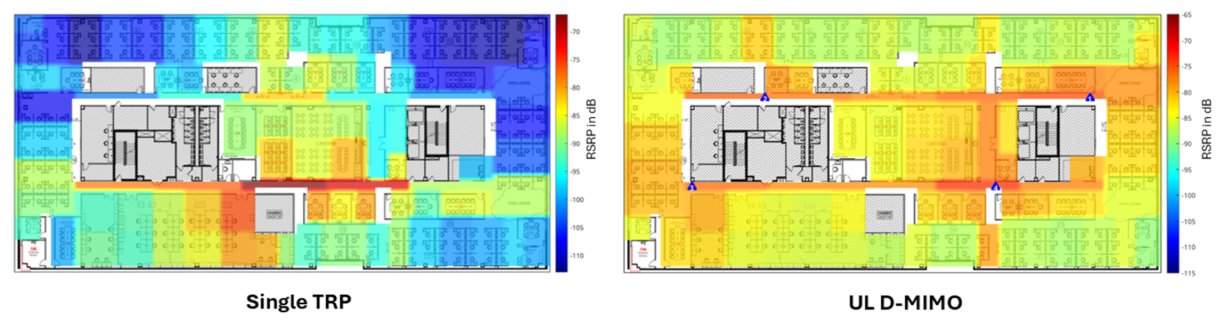
Figure 4. RSRP heatmap within an office, D-MIMO providing uniform coverage
4. UE-Centric Scheduling
4.1 Centralized Scheduler Design for UL MU-D-MIMO
In UL MU-D-MIMO, the centralized scheduler performs the MU-MIMO scheduling for UEs in a TRP group by treating the TRPs in the TRP group as a single cell with more antennas, which reduces the inter-cell interference introduced by TRP’s in the same group and increases both average cell throughput and cell edge UE throughput. Furthermore, the centralized scheduler selects the TRP’s for each UE. For instance, a two-stage approach can be applied to reduce complexity: TRP selection followed by UE pairing and resource allocation whereas a joint approach can achieve better performance with higher complexity.
4.2 Link Adaptation for Coherent Uplink Joint Reception
Since the received signal quality varies due to the dynamic changes in selected TRPs for joint reception within a TRP group, a more sophisticated link adaptation mechanism is required for UL D-MIMO to determine the optimal Modulation and Coding Scheme (MCS) level. For instance, the combining SINR for the selected TRPs can be predicted using channel quality estimates derived from UL signals, such as the Demodulation Reference Signal (DMRS) and Sounding Reference Signal (SRS). This enables the centralized scheduler to determine the optimal MCS for the selected TRP combination, ensuring efficient and reliable communication.
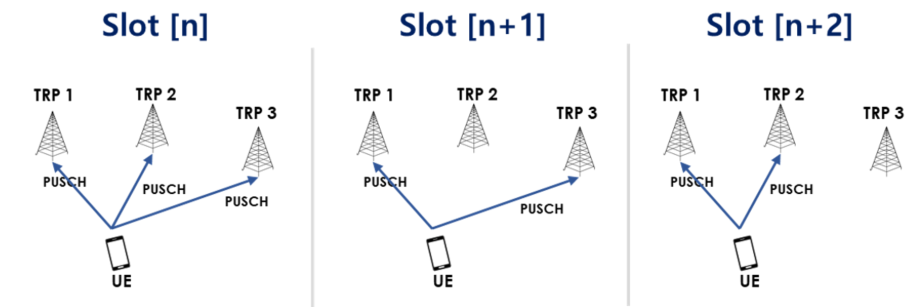
Figure 5. Example of TRP changes for joint reception
5. Conclusion
This blog explores the motivation and concept of UL D-MIMO system, trends of UL D-MIMO studies and challenges. As a practical solution that addresses the physical layer’s challenging issues, we have developed an innovative joint combing for UL D-MIMO systems, and have verified its complexity, performance, and bandwidth requirement of the fronthaul. Future work will focus on spatially varying interference, where RUs and MMUs observe different interference conditions due to local interference, neighboring cells, and asynchronous users.
References
[1] E. Björnson, J. Hoydis, and L. Sanguinetti, “Massive MIMO Networks: Spectral, Energy, and Hardware Efficiency,” Foundations and Trends in Signal Processing: Vol. 11, No. 3-4, pp. 154–655.
[2] K. S. Bondada, U. Saeed, Y. Liang, D. J. Jakubisin, L. Liu, and R. M. Buehrer, "Distributed Uplink Joint Transmission for 6G Communication," 2025 Joint European Conference on Networks and Communications & 6G Summit (EuCNC/6G Summit), Poznan, Poland, 2025, pp. 554-559.
[3] F. Kronestedt, T. Chen, A. Kaur, and A. Furuskär, “Enhancing 5G uplink performance to enable differentiated services,” Ericsson Technology Review #9, 2025.
[4] “Switched Uplink in 5G-NR: Benefit & Deployment Consideration”, Qualcomm, 2023. [Online]. Available: https://www.qualcomm.com/content/dam/qcomm-martech/dm-assets/documents/5G-Whitepaper-Switched_Uplink_in_5g_Benefits_and_Considerations-Qualcomm.pdf
[5] “The physical layer foundations powering 6G”, Nokia Whitepaper, 2025. [Online]. Available: https://www.nokia.com/asset/214991/
[6] “UE-Centric Distributed MIMO for 5G and Beyond - Benefits, Challenges, and Promising Solutions”, Samsung Research, 2025. [Online]. Available: https://research.samsung.com/blog/UE-Centric-Distributed-MIMO-for-5G-and-Beyond-Benefits-Challenges-and-Promising-Solutions
[7] “Overview of O-RAN Fronthaul Specifications”, NTT DOCOMO Technical Journal Vol. 21, 2019. [Online]. Available: https://www.docomo.ne.jp/english/binary/pdf/corporate/technology/rd/technical_journal/bn/vol21_1/vol21_1_007en.pdf
[8] O-RAN Alliance, “O-RAN WG4 Control, User and Synchronization Plane Specification,” O-RAN.WG4.TS.CUS.0-R005-v20.00, 2026. [Online]. Available: https://specifications.o-ran.org/download?id=1033