Communications
Practical AI-Driven Traffic Classification for Next Gen Service-Aware RAN
1. Introduction
Modern mobile networks are carrying increasingly diverse types of traffic, including video streaming, cloud gaming, Exteded Reality (XR) / Virtual Reality (VR) services, and emerging AI-driven applications. Each service has its own traffic characteristics and quality-of-service (QoS) requirements, making real-time analysis of traffic behavior essential for efficient Radio Access Network (RAN) operation. Traffic classification allows the network to identify service characteristics and optimize network control accordingly. For example, service-awareness, leveraging traffic pattern information, enables RAN operations to adaptively control Radio Resource Control (RRC) state. This approach can improve radio resource allocation, optimize QoS management, reduce unnecessary signaling, and enhance UE power efficiency.
With the growing diversity of mobile services and increasingly dynamic network conditions, network optimization can no longer rely solely on static configurations and predefined policies. This requires the RAN to continuously understand traffic behavior and adapt its operation accordingly. As networks evolve toward 6G, such service-aware operation is becoming an essential component of intelligent and autonomous RAN systems.
Recently, AI-RAN has emerged as a key direction for enabling self-aware and adaptive network operation [1]. By integrating artificial intelligence (AI) into the RAN, networks can dynamically analyze traffic patterns and adaptively optimize network behavior without relying on static rule-based policies. In particular, AI-based traffic classification has garnered significant attention because it can infer traffic characteristics even in encrypted traffic using statistical and temporal traffic features [2][3].
However, deploying AI-driven traffic classification in RAN systems presents significant challenges. Current methods typically depend on computationally intensive deep learning models or large-scale manually labeled datasets [4], rendering them unsuitable for real-time RAN environments with stringent latency and resource limitations. Furthermore, the continuous collection and maintenance of labeled traffic datasets become increasingly impractical as new applications and traffic patterns rapidly emerge.
To address these challenges, this blog introduces a practical AI-driven traffic classification framework for service-aware RAN operations. The proposed scheme combines clustering-based pseudo-labeling with lightweight flow-level inference to enable practical deployment in the Central Unit (CU). Furthermore, the classification results are utilized for adaptive RRC state control to reduce UE power consumption while minimizing signaling overhead. Experimental results in a testbed demonstrate the feasibility and effectiveness of the proposed approach. Beyond RRC optimization, the proposed framework can also be extended to various service-aware RAN functions that require real-time traffic understanding in future AI-native 6G networks.
2. Technical Challenges
Traffic classification systems in RAN environments encounter challenges at both the data processing and the model deployment levels. Achieving accurate, real-time classification while maintaining low computational overhead demands carefully designed algorithms and system architectures. Below we identify challenges in more detail.
Data Processing Level:
Model Deployment Level:
3. The Proposed Scheme
To address these technical challenges, we propose a lightweight AI-driven traffic classification framework designed for practical deployment in the CU. This approach integrates clustering-based pseudo-labeling and lightweight flow-level inference to enable real-time, service-aware RAN optimization.
3.1 System Overview
The overall architecture of the proposed scheme consists of two main stages as illustrated in Figure 1:
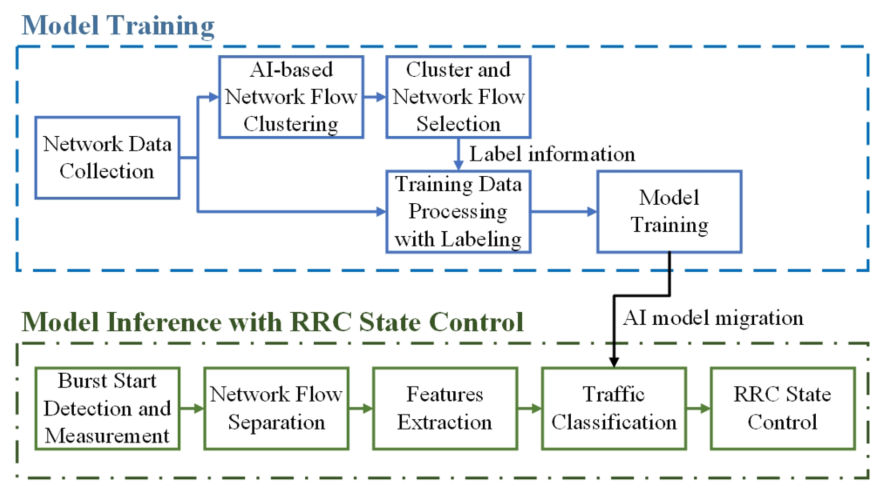
Figure 1. Overall architecture
This design enables a data-driven pipeline that eliminates the need for manual labeling and supports real-time deployment in the CU. The separation of training and inference stages allows that model updates can be performed without disrupting ongoing operations.
3.2 Clustering-based Labeling
Since manual labeling is costly and does not scale well with increasing traffic diversity, we adopt an unsupervised approach using clustering. The labeling process consists of the following steps:
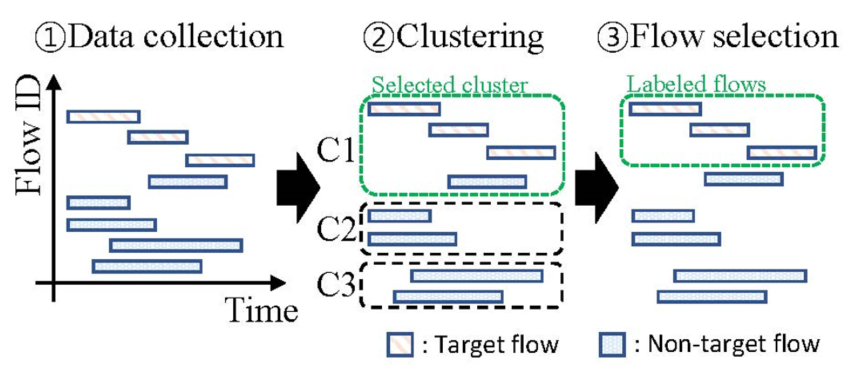
Figure 2. Clustering-based labeling process
3.3 Traffic Classification
Traffic is measured by collecting packet data within a defined measurement window, which is then segmented into flows based on 5-tupe information. Statistical features of downlink and uplink packets are extracted to capture temporal traffic patterns. The labeled dataset is used to train a lightweight flow-level classification model capable of distinguishing between:
3.4 Adaptive RRC State Control
Different traffic types exhibit distinct patterns, which can be leveraged to optimize RRC state control. The key insight is that the RRC release timing can be dynamically adjusted based on the classified traffic type. As shown in Figure 3, when traffic is classified as VoD with intermittent bursts, a shorter inactivity timer allows the UE to quickly transition to idle state during gaps, thereby saving power. For continuous traffic like live streaming, a longer timer prevents unnecessary frequent state transitions, ensuring efficient network operation. Therefore, this approach enhances UE power efficiency while minimizing the increase in signaling overhead.
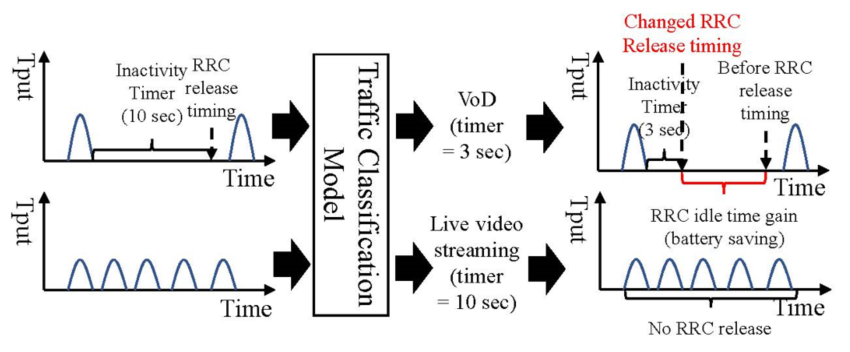
Figure 3. Adaptive RRC state control based on traffic classification showing different timer values for VoD and live streaming
Table 1. Adaptive inactivity timer based on traffic type

4. Implementation Results
4.1 Experimental Environment
Experiments were conducted in an in-house testbed using a commercial smartphone and base station. The detailed setup is shown in Table 2:
Table 2. Experimental environment specification
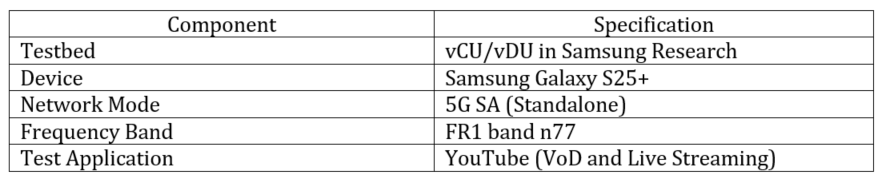
The core network and CU/DU are built on a commercially deployed CU package, reflecting practical deployment conditions. Traffic data was collected using YouTube applications on the smartphone, including both VoD and live streaming sessions, along with background traffic.
4.2 Traffic Classification Performance
Overall, the results show reliable classification performance, effectively distinguishing between target and non-target traffic. The classification accuracy of 98% demonstrates that the clustering-based labeling approach produces high-quality training data.
The UE power consumption and the classification accuracy of the proposed scheme were measured through repeated tests of the same video using a power monitoring tool in a controlled environment.
By applying adaptive RRC state control, the proposed scheme allows the UE to transition to the idle state more frequently. Despite the power consumption associated with VoD playback, the results validate that optimized RRC control is effective in reducing UE power consumption while maintaining minimal signaling overhead. The observed smartphone power saving of over 2%, though seemingly modest, translated to a significant extension in battery life when accumulated over typical daily usage patterns.
5. Conclusion
This blog outlines the motivation and concept of AI-driven traffic classification for RRC state control in 6G systems. As a practical solution addressing the challenges of real-time traffic classification in RAN environments, we have developed a traffic classification and RRC state control framework that incorporates clustering-based labeling and lightweight inference. Its classification accuracy, inference latency, and power-saving benefits have been validated through extensive experiments in an in-house testbed with commercial setup.
Key Contributions:
The future work will focus on expanding the traffic classification to support more traffic types, improving the clustering-based labeling with semi-supervised learning approaches, and integrating the framework with other RAN optimization functions that improve the actual quality of experience for each traffic type.
References
[1] AI-RAN Alliance, “AI-RAN Alliance Vision and Mission White Paper,” 2025.
[2] Aceto, Giuseppe, et al. "Mobile encrypted traffic classification using deep learning: Experimental evaluation, lessons learned, and challenges." IEEE transactions on network and service management 16.2 (2019): 445-458.
[3] Shapira, Tal, and Yuval Shavitt. "FlowPic: A generic representation for encrypted traffic classification and applications identification." IEEE Transactions on Network and Service Management 18.2 (2021): 1218-1232.
[4] Lin, Xinjie, et al. "Et-bert: A contextualized datagram representation with pre-training transformers for encrypted traffic classification." Proceedings of the ACM Web Conference 2022. 2022.