Communications
Building the Foundation for Global 6G Standardization: A Deep Dive Into ITU-R IMT-2030 Requirements and Evaluation Guidelines
Introduction
Every generation of mobile communication begins with a bold vision and culminates in a global standard that brings that vision to life. Today, we are standing at the threshold of the next great leap: 6G (officially designated by ITU-R as IMT-2030). While 6G might still feel like science fiction, the critical framework that will define it is being built right now.
This article provides an overview of the current trends in 6G technology standardization at ITU-R, with a focus on the recently developed 6G requirements and evaluation methodologies, and on how Samsung is leading the orchestra to make 6G a reality by 2030.
Understanding the Global 6G Standardization Ecosystem: ITU-R and 3GPP
The global standardization of 6G is a massive undertaking aimed at formalizing new technologies for worldwide commercialization. This intricate journey is driven by the seamless collaboration between two fundamental organizations: the ITU-R and 3GPP. Understanding their distinct but complementary roles is essential to grasping the big picture of 6G standardization.
For those unfamiliar with how global technology standards are made, the relationship between the two main organizations can be easily understood through a simple metaphor: the Architect and the Builder.
Once 3GPP and other global proponents submit their candidate technologies, the ITU-R rigorously evaluates them and grants official approval to the technologies that pass the evaluation criteria as the unified global 6G standard by June 2030.
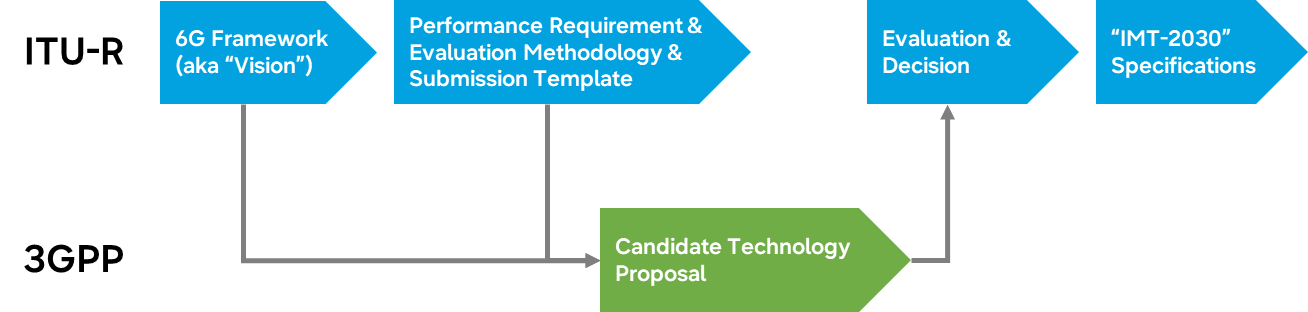
Figure 1. Collaboration framework between ITU-R and 3GPP for 6G Standardization
Charting the Course to 6G: The IMT-2030 Development Roadmap
ITU-R WP 5D has laid out a highly structured, four-stage roadmap to guide the industry from concept to commercial reality by 2030:
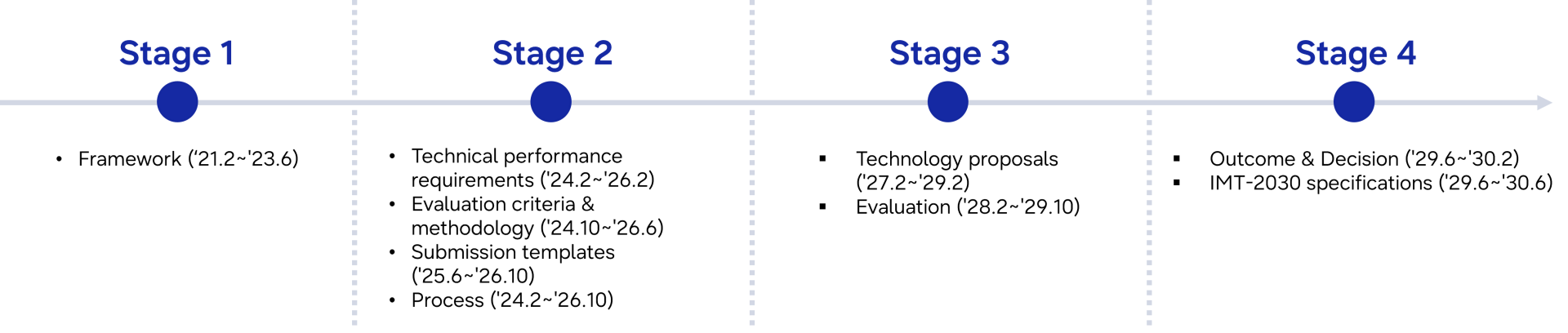
Figure 2. ITU-R WP 5D timeline for the development of IMT-2030 specifications
Six Usage Scenarios Shaping Our Future Life with 6G
What will 6G actually do for us? In Stage 1, the ITU-R identified six usage scenarios. Rather than looking at them as dry technical categories, let’s explore how they will transform our daily lives:
The 6G “Entrance Exam”
Minimum Technical Performance Requirements (TPRs)
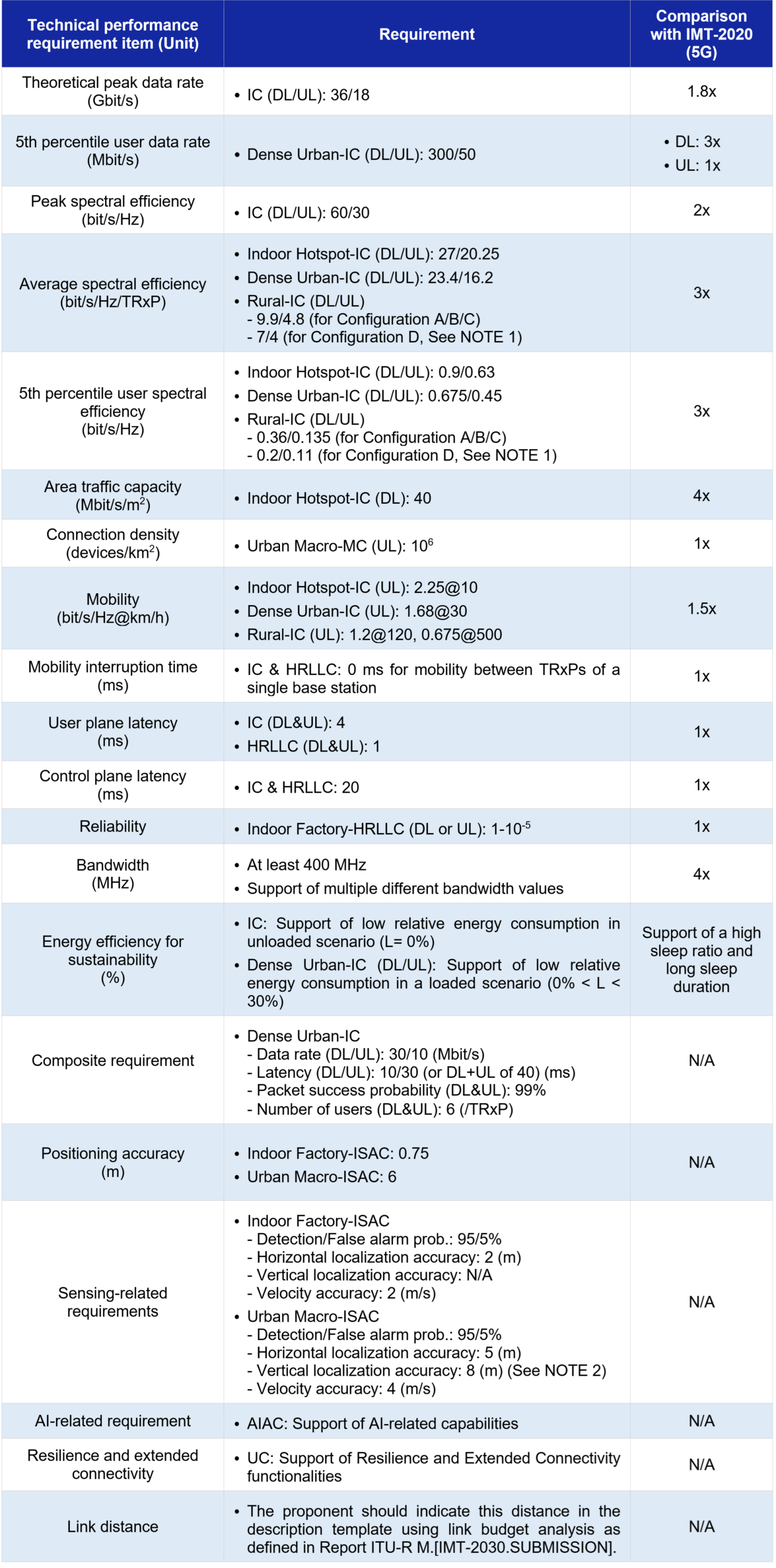
To ensure that candidate technologies can actually deliver on these six scenarios, ITU-R completed the draft new report for 6G TPRs in February 2026 [2]. If we compare this to an entrance exam, the candidate technologies must achieve or exceed these target values to be officially recognized as 6G. The requirements are split into two categories:
Table 1 outlines the complete set of 20 TPR items established for IMT-2030.
Table 1. Summary of IMT-2030 Technical Performance Requirements (TPRs)
Assessing the Candidate Technologies: Evaluation Guidelines
Having an exam paper (TPRs) is only useful if you have a fair, objective way to grade it. For this purpose, in June 2026, WP 5D finalized another critical milestone: the draft new report on 6G evaluation guidelines [4]. These guidelines outline how independent evaluation groups and technology proponents must assess candidate technologies to prove they meet the minimum requirements.
The Three High-level Assessment Methods
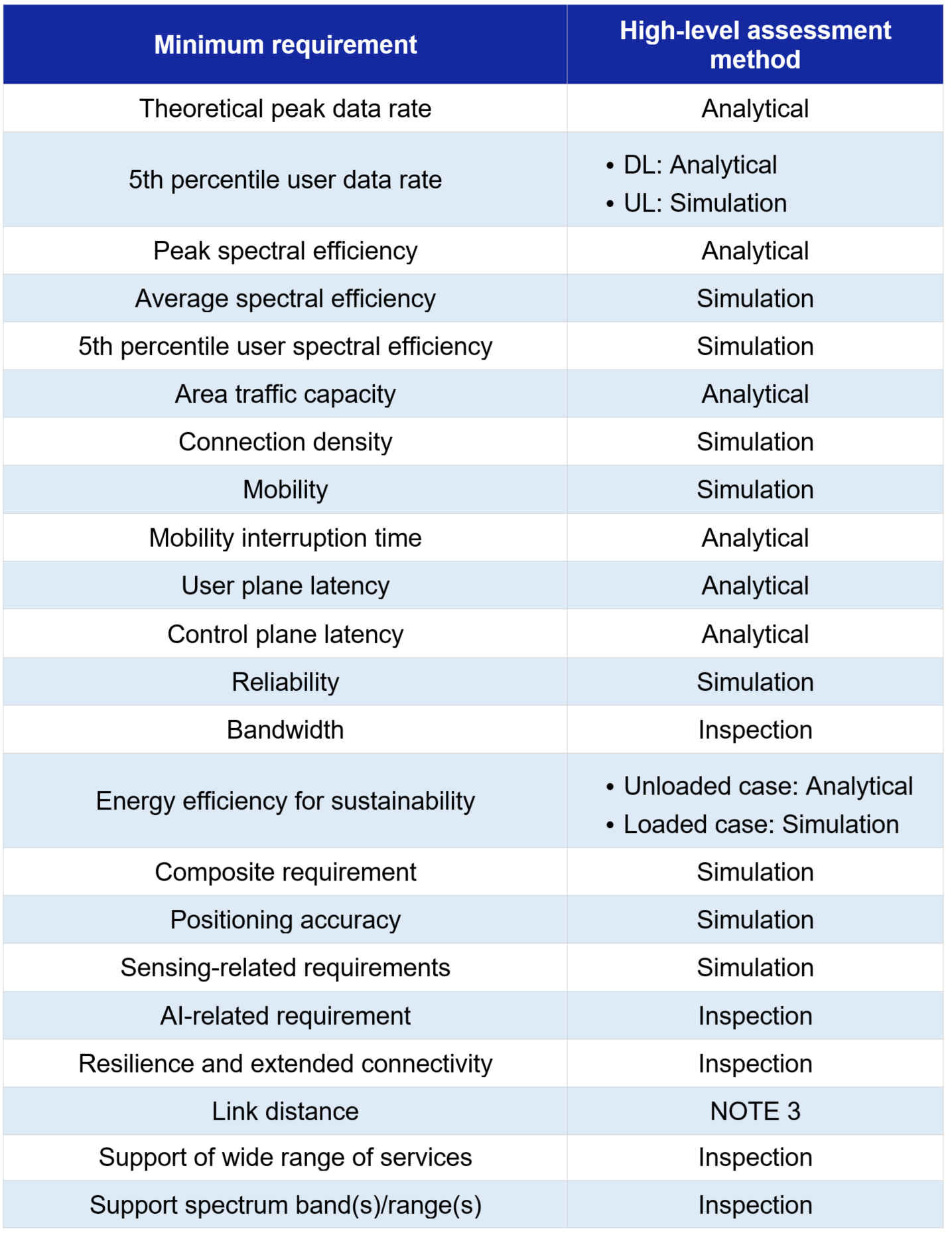
Instead of relying on a single assessment, the evaluation utilizes three complementary approaches depending on the requirement:
Table 2 outlines the high-level assessment method for each minimum requirement.
Table 2. Summary of Evaluation Methodologies
Real-world Assessing Grounds: The 7 Test Environments
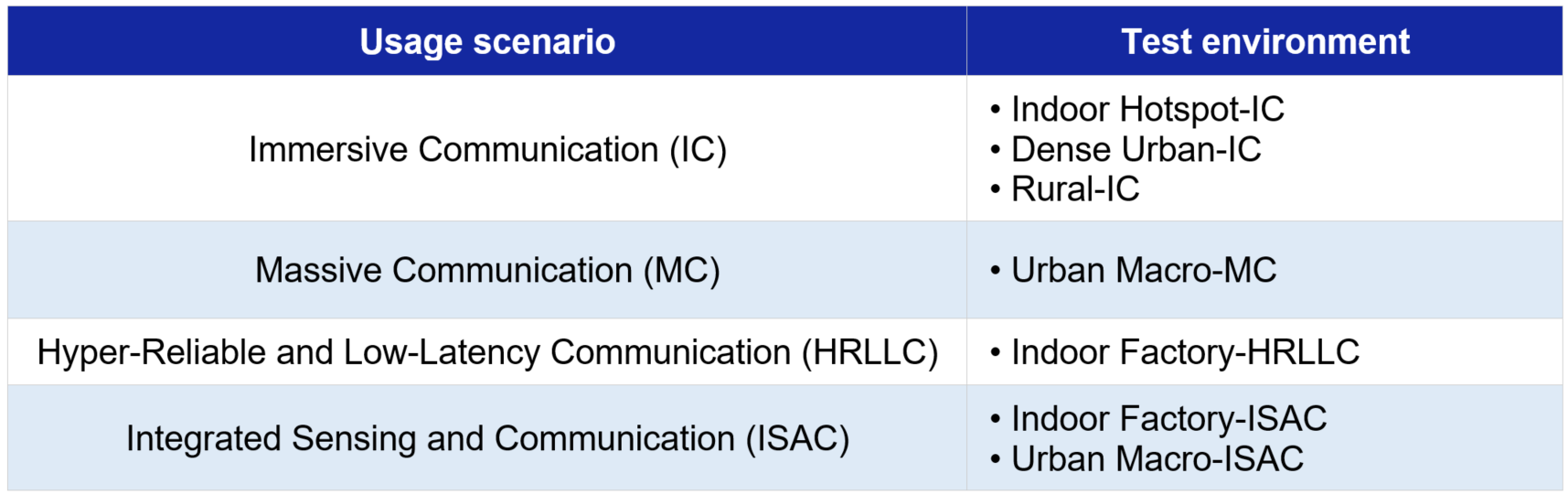
To make sure the simulations reflect the real world, the evaluation report defines seven representative test environments. These act as standardized virtual playgrounds where every technology is assessed under the exact same conditions:
Table 3 shows the mapping of usage scenarios and test environments.
Table 3. Mapping of Usage Scenarios and Test Environments
Orchestrating the Global 6G Effort: Samsung’s Leadership
Standardizing a technology that will connect billions of people and devices requires massive global consensus. Dozens of nations and hundreds of tech companies must agree on every single detail. Who ensures this colossal machine runs smoothly?
Within ITU-R WP 5D, this critical role falls upon the Sub-Working Group on Coordination (SWG Coordination). This pivotal group is responsible for managing the entire process, from resolving technical disagreements to finalizing the crucial remaining components:
Samsung is currently leading this vital effort as the Chair of SWG Coordination (Chair: Hyunjoong Lee, Staff Engineer at Samsung Research). Under Samsung's leadership, the group is bridging the gap between ITU-R, industry proponents like 3GPP, and independent evaluation groups. This leadership role is a testament to Samsung's technical expertise and its trusted standing as an objective, unifying voice in the global wireless industry.
Conclusion: The Road to 2030
With the completion of the TPR and Evaluation reports, the industry now has a rock-solid, objective yardstick to define what is—and what isn’t—true 6G. The journey ahead is structured and clear:
While we are still in the early stages, the critical groundwork is complete. As the chair of the coordination group, Samsung remains deeply committed to guiding the global community along this path, ensuring that when 2030 arrives, the world is ready to step into a seamless, hyper-connected, and truly intelligent 6G future.
References
[1] Recommendation ITU-R M.2160, "Framework and overall objectives of the future development of IMT for 2030 and beyond," November 2023.
[2] Document 5/116, Draft New Report ITU-R M.[IMT-2030.TECH PERF REQ], "Minimum requirements related to technical performance for IMT-2030 radio interface(s)," February 2026.
[3] Report ITU-R M.2410, "Minimum requirements related to technical performance for IMT-2020 radio interface(s)," November 2017.
[4] Document 5/119, Draft New Report ITU-R M.[IMT-2030.EVAL], "Guidelines for evaluation of radio interface technologies for IMT-2030," June 2026.
[5] Annex 5.5 to Working Party 5D Chair’s Report (Document 5D/1394), Preliminary Draft New Report ITU-R M.[IMT-2030.SUBMISSION], "Requirements, evaluation criteria and submission templates for the development of IMT-2030," June 2026.
[6] Annex 5.4 to Working Party 5D Chair’s Report (Document 5D/1394), Working Document towards a Preliminary Draft Revision of Document IMT-2030/2, "Submission, evaluation process and consensus building for IMT-2030," June 2026.