Communications
Large-Scale AI CSI Compression for 6G FR3
1. Introduction
In modern mobile systems, channel state information (CSI) feedback from user equipment (UE) plays a crucial role in enabling downlink operations, including beamforming, precoding, and scheduling. As illustrated in Figure 1, AI-based CSI feedback employs an autoencoder structure: the UE-side encoder compresses downlink CSI into compact feedback information, and the base station (BS)-side decoder reconstructs the CSI for downlink precoding.
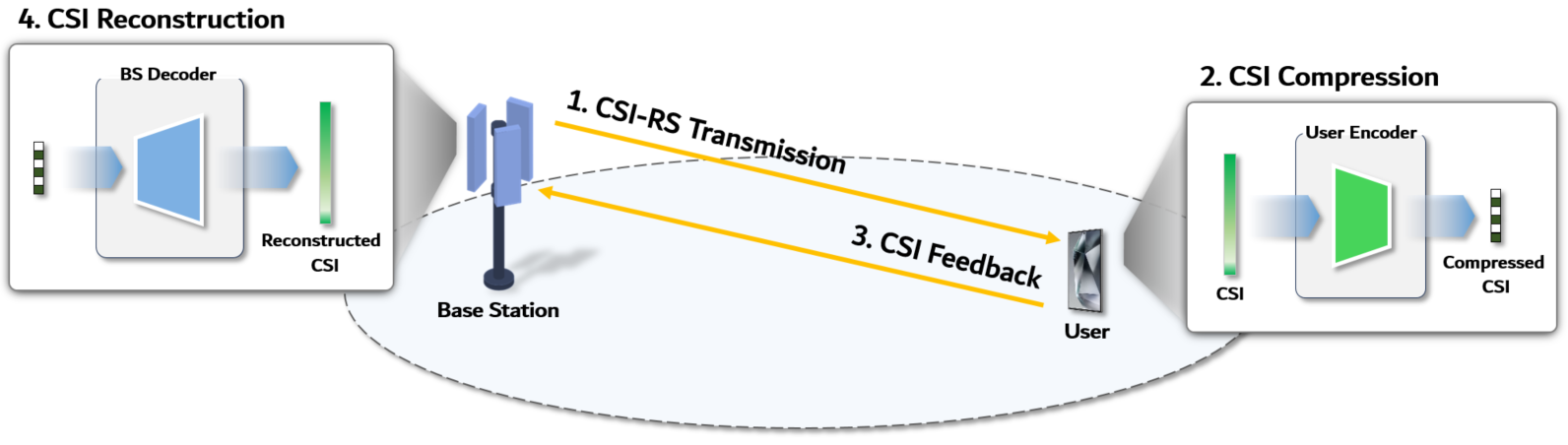
Figure 1. Overall autoencoder-based CSI feedback procedures.
AI-based CSI feedback is currently being standardized in 3GPP Release 20 as a promising technology for improving CSI reconstruction accuracy while controlling feedback overhead [1]. Its significance is particularly pronounced in the upper mid-band, or Frequency Range 3 (FR3) (7.125–24.25 GHz), where wider bandwidth and higher path loss are expected to be addressed through extreme Multiple-Input Multiple-Output (X-MIMO) arrays with hundreds of antenna ports, such as 256-port configurations.
This scale makes CSI feedback a major bottleneck. Conventional codebook-based feedback is difficult to extend to 256-port wideband channels without sacrificing accuracy, while AI autoencoders trained from scratch can become unstable under extreme compression. A practical solution must also keep the UE-side encoder extremely lightweight. The central challenge, therefore, lies in training a compact encoder to achieve an accuracy level it could not attain independently.
The remainder of this article introduces a training strategy for 1-layer encoder model under the extreme compression of FR3 X-MIMO, and analyzes its performance through angular-domain analysis. We further validate a model trained solely on synthetic data, without additional fine-tuning, through real-world over-the-air (OTA) testing.
2. A Two-Phase Training Method
As shown in Figure 2, we propose a two-phase training method designed to enable the development of an accurate yet lightweight encoder for large-scale AI CSI compression. The first phase employs hierarchical transfer learning with progressive compression (HTL-PC) [2]. Instead of requiring a deep transformer-based autoencoder to learn the final high-compression task in one step, HTL-PC gradually increases the compression ratio and transfers the knowledge acquired at each stage to the next. This progressive approach stabilizes the training process and, importantly, results in a well-trained deep decoder.
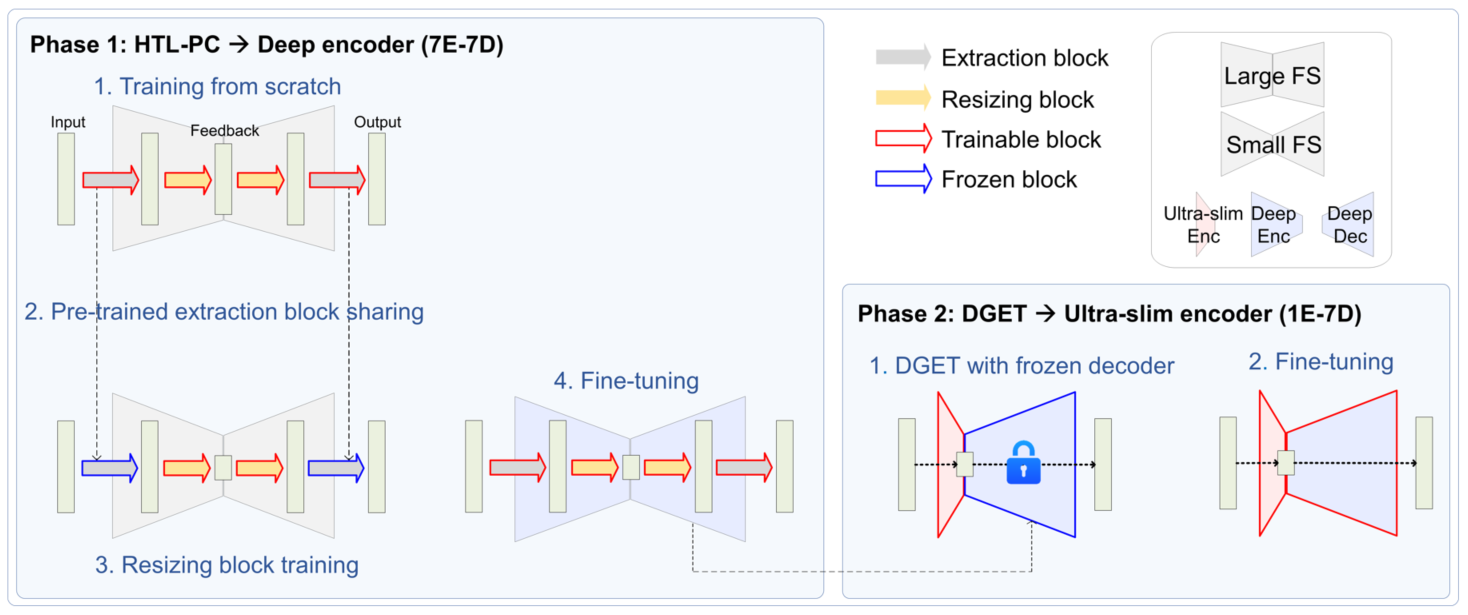
Figure 2. The two-phase training method (Left: HTL-PC, right: DGET).
The second phase is decoder-guided encoder training (DGET). DGET freezes the deep decoder trained by HTL-PC and uses it as a fixed guide for training the transformer-based ultra-slim encoder. Instead of jointly training a tiny encoder and a tiny decoder from scratch, DGET retains the expert decoder and focuses on training only the 1-layer encoder to generate latent representations that the decoder is already capable of reconstructing. A brief joint fine-tuning step then further refines the encoder-decoder pair.
The deep decoder acts like an expert translator that already understands the language of the channel; the tiny encoder merely needs to learn how to provide the appropriate cues. This transforms the problem from learning the entire compression-reconstruction process from scratch to mastering effective communication with a robust decoder.
The benefits are evident in both reconstruction performance and UE-side complexity. Under the same feedback overhead, the DGET-trained 1-layer encoder improves CSI reconstruction accuracy, measured by squared generalized cosine similarity (SGCS), by about 18% compared with the extended eType II codebook baseline. When compared with the 7-layer encoder, the accuracy gap remains only about 3.5–7.2%, while the UE-side encoder computation is reduced by 82–84%. This demonstrates that most of the performance of the deep model can be retained with a much lighter UE-side encoder.
3. Angular-Domain Analysis
At first glance, it may seem surprising that a 1-layer encoder can approach the performance of a much deeper encoder. However, this intuition becomes clearer when the reconstructed CSI is analyzed in the angular domain, where the channel is examined in terms of which beam directions carry the signal energy.
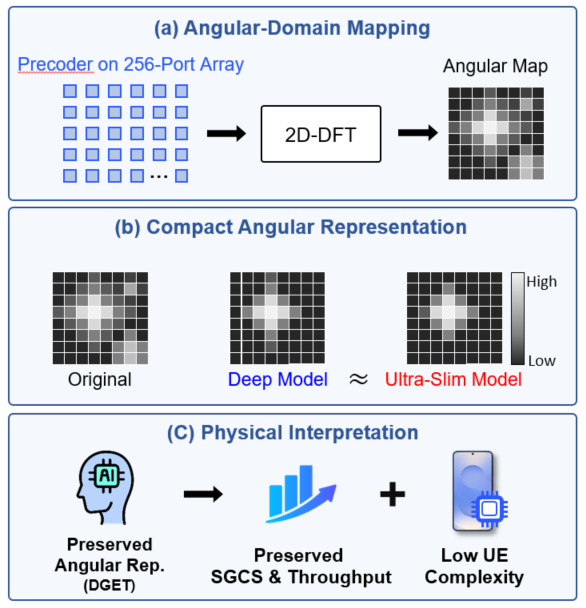
Figure 3. Angular-domain analysis.
In this analysis, the reconstructed CSI is transformed into an angular-domain representation, and the power distribution across angular directions is compared. As illustrated in Figure 3, both the 7-layer encoder and the DGET-trained 1-layer encoder concentrate energy on nearly the same set of dominant angular components. Since downlink beamforming is mainly determined by these dominant directions, preserving them is more critical than reconstructing every weak component with equal precision. This explains why the ultra-slim encoder can remain close to the deep encoder in SGCS performance while using far less UE-side computation.
4. Zero-Shot Over-the-Air Validation
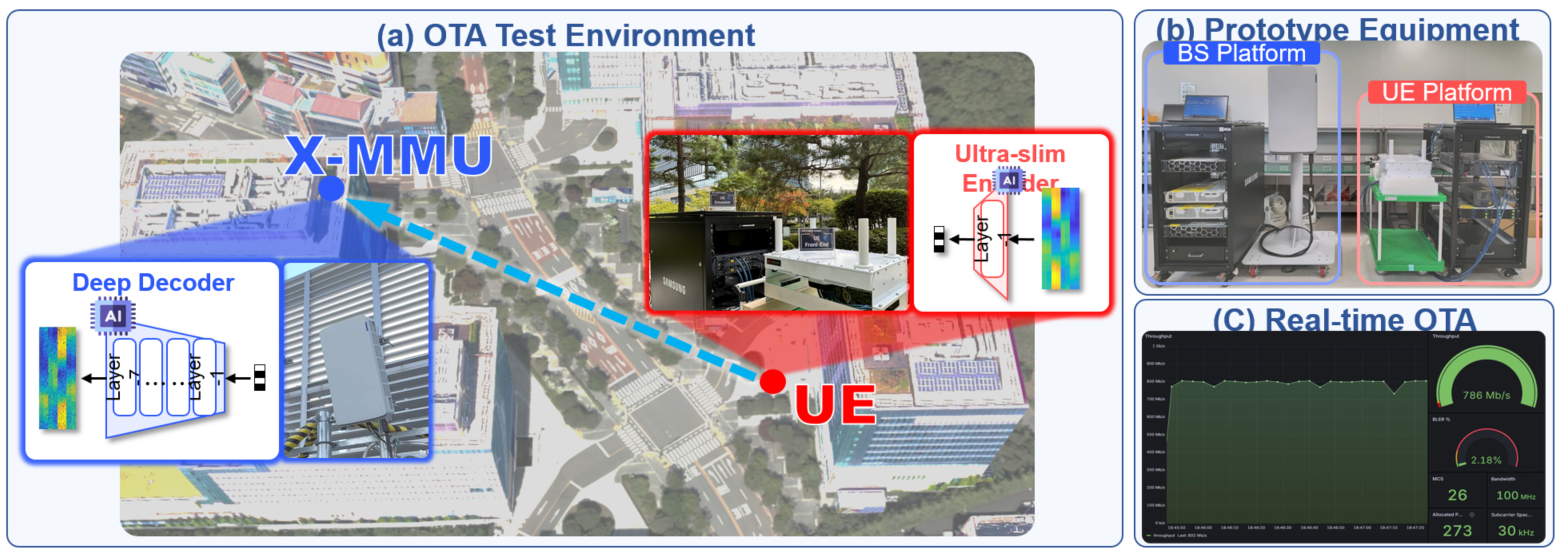
Figure 4. Zero-shot over-the-air validation on the FR3 256-port testbed at the Samsung Research campus.
We validated the proposed AI CSI compression on an FR3 256-port X-MIMO testbed at the Samsung Research campus. As shown in Figure 4, the testbed used an extreme massive MIMO unit (X-MMU) mounted on a rooftop, operated at 7.175 GHz with an 100 MHz bandwidth. A UE emulator was employed to evaluate the downlink performance of AI-based CSI feedback in a real OTA environment.
A key aspect of this validation is that the AI model was trained solely on synthetic, simulation-based channel data and deployed on the live testbed without any site-specific retraining or calibration. This zero-shot setting is significant because practical 6G systems cannot depend on costly retraining for every deployment location.
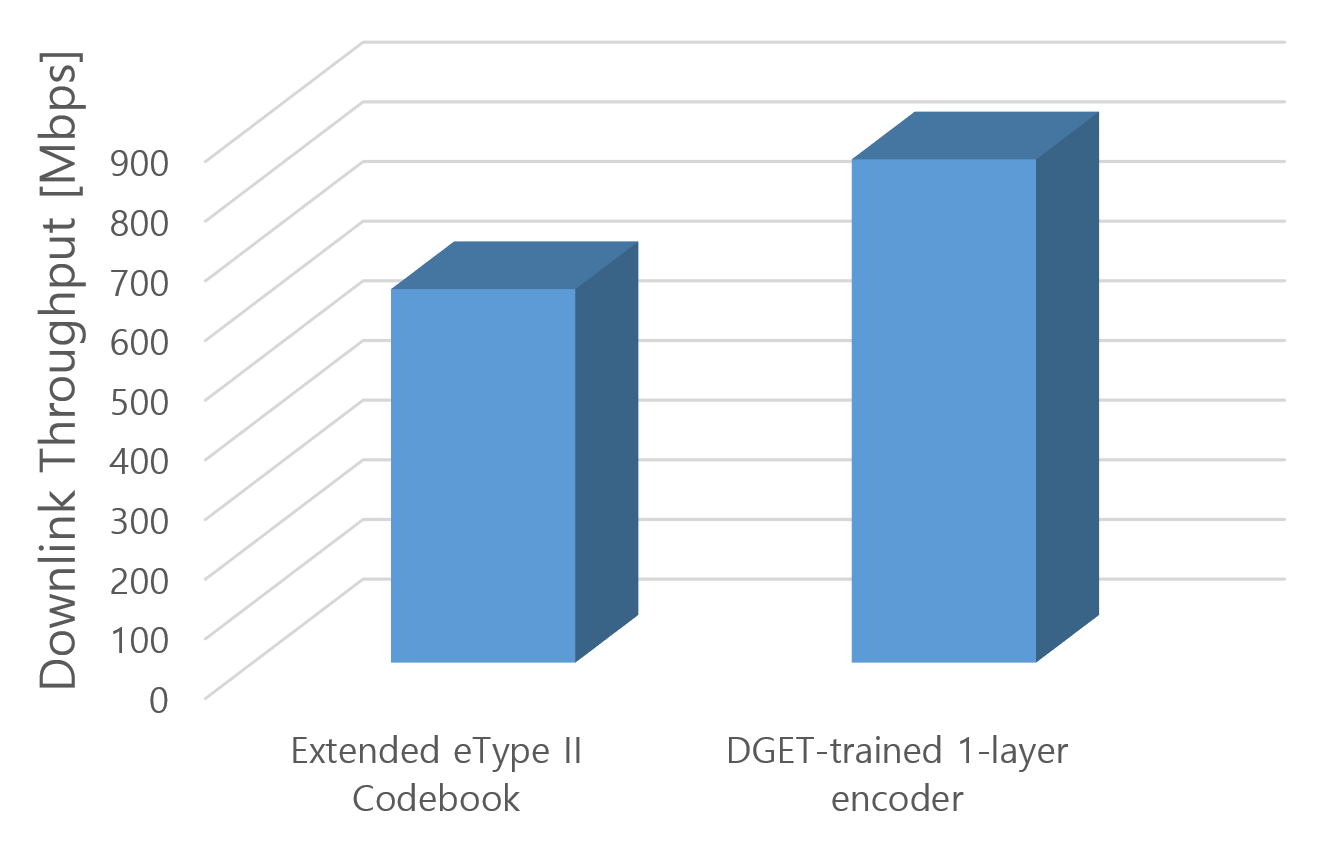
Figure 5. OTA downlink throughput comparison
To the best of our knowledge, this is the first OTA validation of AI-based CSI feedback on a 256-port FR3 X-MIMO system. The OTA test focused on a device-relevant configuration: the ultra-slim 1-layer encoder compared with an extended codebook baseline. As shown in Figure 5, the DGET-trained 1-layer encoder achieved about 34.7% higher downlink throughput than the codebook baseline under the same test configuration, without site-specific tuning.
This result confirms in a real radio link what the link-level analysis and angular-domain interpretation predicted. Even with a highly lightweight UE-side encoder, AI-based CSI feedback can preserve the dominant channel structure and translate that accuracy into measurable downlink throughput gain.
5. Conclusion
For 6G X-MIMO systems, channel feedback presents a challenge where both conventional codebooks and standard AI approaches fall short. Our two-phase training method enables the development of a lightweight encoder that would otherwise be untrainable, and the world-first OTA test on a real 256-port radio system demonstrated a 34.7% gain over the codebook baseline without requiring site-specific tuning.
References
[1] 3GPP, “New WI: Artificial intelligence (AI)/machine learning (ML) for NR air interface enhancements,” RP-251870, Jun. 2025..
[2] J. Baik, B. Hwang, B. Seo, M. Jang, J. Lee and C. J. Zhang, “Hierarchical transfer learning: A key to enabling CSI feedback for 6G extreme massive MIMO,” IEEE GLOBECOM, 2025.