Communications
CSI Feedback via Joint Source-Channel Coding and Modulation: A Comprehensive Study for 6G Realization
1 Introduction
In every 5G network, your phone and the base station are constantly whispering to each other. The phone reports back what the wireless channel looks like - this is called Channel State Information (CSI). Think of it as a real-time weather forecast for radio waves. Without it, the base station has no idea which direction to aim your signal or how to shape it so it reaches you cleanly. Here's the problem: the more antennas we add, the thicker that weather report becomes [1]. Sending the whole thing back every time would eat up precious airtime. So compressing CSI isn't optional - it's essential [2].
For a few years now, the go-to approach has been AI autoencoders. The idea is similar to image compression: a neural network learns to pack CSI into something small while keeping it accurate. It works well, but it inherits an old headache from digital communications - the cliff effect [3]. In a traditional digital pipeline, a single flipped bit can ruin the entire CSI report. Performance doesn't degrade gracefully; it falls off a cliff. This is where Joint Source-Channel Coding and Modulation (JSCM) comes in. Instead of doing things in separate steps (compress, then encode, then modulate), JSCM lets one AI model learn all of it at once, end to end. We show this softens the cliff effect and improves reconstruction accuracy, and we built actual hardware and validate JSCM in a real environment.
2 Four Hard Problems We Had to Solve
2.1 Improving AI Robustness for Real-World Radio Conditions While Maintaining Protocol Compatibility
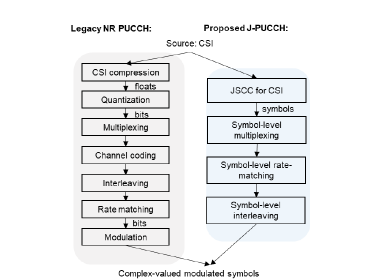
Real-world radio environments include various impairments. There's residual fading, RF hardware imperfections, all kinds of distortion that simulations tend to gloss over. So, we trained our model with these impairments baked in, forcing it to learn how to work under realistic conditions. We also redesigned the structure of the uplink control channel (PUCCH) so JSCM slots into the existing 5G protocol stack. No need to tear down and rebuild the system — it fits.
2.2 One model, any resource allocation
In a real network, the amount of airtime allocated for CSI feedback changes constantly. But an AI model's output length is usually fixed the moment you finish training it. That's a mismatch.
Our fix: organize the encoder's output by priority. The model packs CSI information into layers, with the most important content first. When resources are tight, the system keeps the high-priority layers and drops the rest. One model now handles various allocation sizes.
2.3 Taming the "spiky signal" problem
Here's an interesting side effect. When AI learns modulation on its own, it naturally produces signals that look like a Gaussian distribution. Information theory says that's wonderful - Gaussian is the shape that gets you closest to the Shannon capacity limit.
Hardware disagrees. Gaussian signals swing wildly between high and low power, which means a high Peak-to-Average Power Ratio (PAPR). Push that through a power amplifier and you get distortion.
Our solution is a modulation shaping method we call annular-Gaussian. It has a single tunable knob that gradually reshapes the constellation from "Gaussian blob" toward "clean ring" (constant power). Turn the knob one way for better accuracy, the other way for lower PAPR. Engineers can dial it to match whatever their power amplifier can handle.
2.4 Letting the phone know how good its own report is
Phones need to compute Channel Quality Indicator (CQI) to help the network pick the right data rate. In traditional systems this is straightforward. With JSCM, it's tricky — the phone has no idea how much error will creep into the CSI the base station finally reconstructs.
Our approach: let the phone simulate the base station's decoding. It takes its own compressed representation, adds synthetic noise to mimic transmission loss, and runs the decoder itself. Now it can see roughly what the base station will see, and compute CQI from that.
3 From Simulation to Practice
A hardware proof-of-concept (PoC) test-bed has been developed to validate the feasibility of the JSCC-based CSI feedback. In this section, we detail the PoC scenario, hardware specifications, configurations, and results.
3.1 PoC Introduction
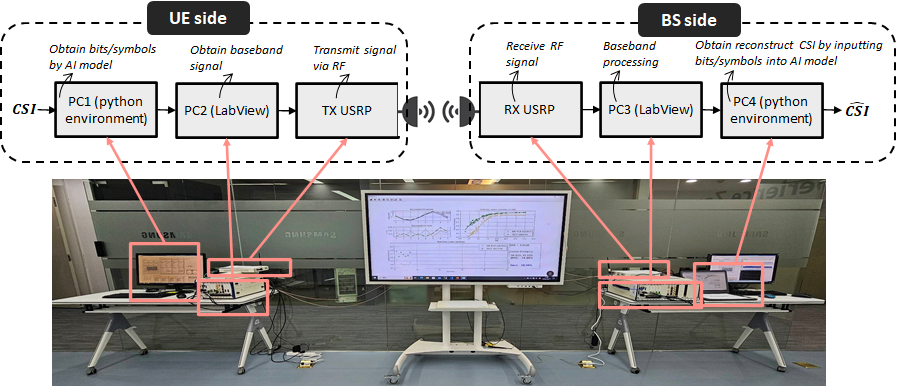
Figure 1. Architecture, signal processing procedure, and hardware illustration of the PoC.
Our test environment was a real 100-square-meter office: open workspace with partitions, desks, glass-walled meeting rooms, corridors. We ran tests during working hours with people sitting and walking around. We measured 10 different positions, covering both line-of-sight and non-line-of-sight cases with one or two walls in between. We used CSI collected from a commercial 5G network, and put JSCM head-to-head against the NR-R18 compression scheme - same neural network architecture, same transmission overhead, same channel conditions. The two approaches were evaluated under identical experimental conditions.
3.2 PoC Results
Across the entire tested SNR range (3 to 18 dB), JSCM achieved higher reconstruction accuracy than NR-R18 in the tested conditions. And the advantage grew as SNR dropped. The cliff effect was clearly softened -performance declined gently instead of collapsing.
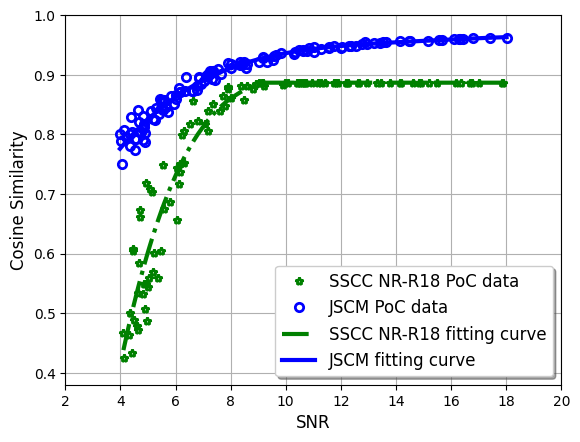
Figure 2. GCS accuracy versus SNR
The performance improvement can be attributed to two key factors. First, it optimizes compression and channel coding together instead of separately. Second, it naturally maps information into continuous, Gaussian-like symbols - mathematically the most efficient shape for an AWGN channel.
There's a deeper insight here too. Traditional digital systems can't use continuous Gaussian modulation because they demand bit-perfect, lossless transmission. But CSI doesn't need to be bit-perfect. A tiny numerical wobble in a CSI value barely affects beamforming, while a bit error can significantly affect CSI reconstruction performance. In an end-to-end AI system, the damage done by forced quantization often exceeds the damage done by channel noise. This suggests that continuous representations may provide advantages for naturally continuous sources such as CSI and audio.

Figure 3. Modulation constellation of annular-Gaussian JSCM
On PAPR, the principal benefit of this annular-Gaussian approach lies in its inherent flexibility to control the constellation’s power distribution via the parameter. Constellations generated using the annular-Gaussian approach with varying power-variance scaling factors of 0.7, 0.5, 0.3, and 0.1 are depicted in Figure 3. It is observed that the variance of the power associated with the modulated symbols diminishes as the power-variance scaling factor, spanning a range between that of the Gaussian and circle modulation. In practical deployments, the parameter can be adjusted to achieve a flexible trade-off between PAPR reduction and CSI reconstruction performance, catering to specific hardware constraints and PA thresholds of the UE.
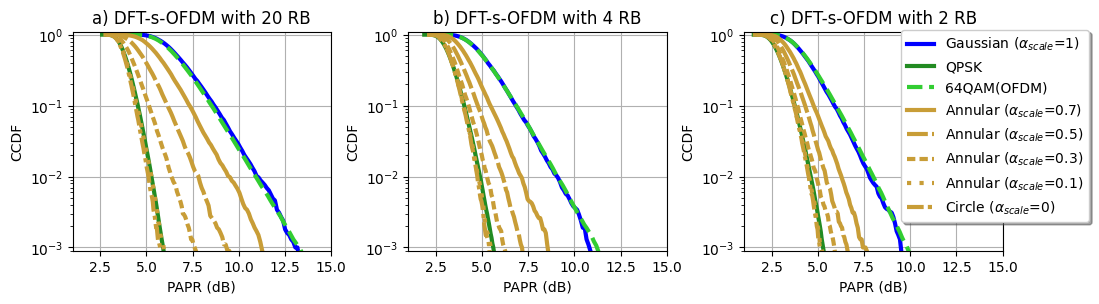
Figure 4. Comparison of PAPR CCDF for different methods
We got concrete numbers as well above. With the annular-Gaussian knob set to a middle value, PAPR came in around 6.5 dB in typical narrowband scenarios - only about 1.5 dB above QPSK, the most power-friendly option out there. That's comfortably within what real power amplifiers handle. This matters especially for cell-edge users, who get narrow bandwidth allocations and need to run their amplifiers near saturation.
4 The Takeaway
We proposed JSCM for CSI feedback. And the important point was to move JSCM out of the simulation and into a working, standards-compliant hardware system running over real air. Protocol compatibility. Flexible resource adaptation. Amplifier-friendly waveforms. Workable CQI estimation. These are the unglamorous obstacles that stand between a good research idea and a deployed feature - and we now have answers for each of them. As 6G discussions ramp up, AI-driven end-to-end communication is shifting from concept to engineering reality. This study provides a foundation for further exploration of AI-native communication technologies toward 6G.
References
[1] Samsung Research, “6G: The next hyper-connected experience for all,” 2020. [2] J.-C. Shen, J. Zhang, E. Alsusa, and K. B. Letaief, “Compressed CSI acquisition in FDD massive MIMO: How much training is needed?” IEEE Trans. on Wireless Commun., vol. 15, no. 6, pp. 4145–4156, 2016. [3] E. Bourtsoulatze, D. B. Kurka, and D. G¨und¨uz, “Deep joint source channel coding for wireless image transmission,” IEEE Trans. Cog. Commun. Net., vol. 5, no. 3, pp. 567–579, 2019.