Communications
AI in 6G network: Service and System Aspect
3GPP has been a pioneer in integrating and supporting on AI into network since early stages of 5G era. As the 5G specifications evolved, driven by the various use cases identified by SA1 Working Group (WG), the 3GPP Technical Specification Groups-including Radio Access Networks (RAN), Services & Systems Aspects (SA) and Core Network & Terminals (CT)-have been actively enabling the AI-related features across different standardization domains, aiming to improve the network performance and thereby to enhance user experiences. The RAN Working Groups focus on leveraging AI/ML to optimize performance of NR air interface and base station [1][2][3]. Meanwhile, 3GPP SA2 WG has been pivotal in leveraging AI to enable 5G Core Network automation; beyond this, SA2 also aims to provide assistance for application layer AI/ML-based services. Additionally, SA2 supports data collection for AI-based positioning to increase positioning accuracy and facilitate AI operation across different standardization domains of SA and RAN WGs [4], [5]. The cross-domain AI operation supports the involvement of User Equipment (UE), base station, core network, and application function (as a part of application server, supporting interaction with the core network). SA3 is in charge of AI/ML security related aspects. SA5 and SA6 WGs focus on AI/ML for network management and supporting AI/ML services at application layer, respectively. The CT WGs are responsible for specifying the protocols to fully enable AI/ML features over different interfaces, such as those between UE and the network, as well as between Core Network Functions.
Looking ahead to 6G era, 3GPP will further leverage cutting-edge AI technologies to design AI-native and AI-friendly wireless communication system, significantly enhancing network performance and user experience while supporting a wide array of new use cases. This article will primarily focus on AI in the Core Network within the domains of the 3GPP SA2. By delving into the details of key enablers of 6G AI, based on the objectives outlined in 6G Work Item Description (WID) [6] and documented in 6G Technical Report (TR) [6], this article aims to provide a comprehensive understanding of the future direction of AI in 3GPP Core networks.
Review and Limitations of 5G Standardisation Related to AI
5G Core Network Automation
SA2 initiated the standardization work related to core network automation by leveraging AI/ML since Release 15 and has continuously pursued to further deploy AI/ML techniques for enhancing core network intelligence over the later 5G releases.
The specified core network automation features aim to provide various network data analytics to their services consumers, Core Network functions (NF), OAM and even Application Functions (AF). The consumers can use the analytics information to decide and optimise their operations; and therefore, to enhance network performance and customer experience. SA2 specified a dedicated NF, Network Data Analytics Function (NWDAF) that produces the analytics as an output, which can be exposed to the service consumers. The 5G core network supports diverse use cases, for example, enhancement of QoS determination and QoE improvement, insight of UE mobility and behaviours, network signalling storm, etc. The corresponding analytics services are identified on the basis of Analytics IDs, noting that the NWDAF supports 23 analytics services in Release 19 [4].
The Analytics outputs, in the form of statistics and/or prediction, are derived by NWDAF by performing inference via trained ML models. The ML models are trained by NWDAF by collecting specified types of data from different data sources, for example other NFs, OAM and AFs, directly or via DCCF (Data Collection Coordination Function). To ensure the implementability, interoperability and flexibility of Core Network automation, ML models can be shared between different NWDAF vendors.
To protect user and network data privacy, and reduce the overhead and load of AI/ML operation, Federated Learning (FL) was introduced to 5GC. FL protects user and network privacy by keeping the raw data on local entities, instead of sending the raw data from different entities in different areas to a central server. Given the advantages of FL algorithm for communication system, in Release 18, the Horizontal Federated Learning (HFL) algorithm has been supported for ML model training and inference among multiple NWDAFs on a per Analytics ID basis. To further protect sensitive network and user information and enhance data efficiency, in Release 19, Vertical Federated Learning (VFL) was standardised to support more efficient ML operation with the involvement of NWDAF(s) and AF for different Analytics ID(s).
Other Aspects of AI in 5G Core Networks
• 5G Core Assistance to Application-Layer AI/ML Service
The fast development of AI/ML services has led to a significant increase in the amount of AI/ML-based services delivered to users via wireless communication networks. This evolution has introduced new commercial opportunities for Mobile Network Operators (MNOs), as the core network plays an important role in providing assistance to application-layer AI/ML services. By assisting these services, the MNOs can optimise the network resource scheduling and configuration optimisation for the massive and frequent transfer of AI/ML-related service data, while ensuring a high-quality user experience.
To enable Core Network’s assistance to AI/ML-based application functions, during Release-18, SA2 worked on 5G System architectural and functional extensions that facilitate more efficient monitoring of network resource utilization and expose the relevant information to AFs. Additionally, standardized 5QI to QoS characteristics mappings were specified for the AI/ML-based service data traffic. For instance, 5QI 6 can be used for AI/ML model download for image recognition. Furthermore, the Core Network provides APIs externally so that the AFs can provision AI/ML service-related requirements (e.g., time window for the AI/ML service transfer and the required QoS) to the Core Network. As a result, the 5GC can preconfigure resources for the corresponding AI/ML services through negotiation with AF to provide the application-layer AI/ML services in a service quality-guaranteed approach.
• Cross-domain AI Operation in 5GS
To explore full support of AI/ML for NR air interface in 5GS, close collaboration between SA and RAN WGs was pursued during Release 19 and 20. The major purpose of this work is to facilitate frequent and high volume of AI model training data transfer, while ensuring MNOs can potentially own the visibility and controllability of AI/ML-related data. In Release 19, SA2 specified architectural impacts and procedures for data collection from UE and gNB to location management function (LMF), located in the Core Network, to support AI/ML-based positioning (for LMF-side model and gNB-side model cases). In Release 20, SA2 has conducted a study on transferring AI model training data collected by the UE to an AI model training server (inside or outside 3GPP system) via user plane (UP) to support UE-side model training. However, the fundamental design of 5G UP, which is intended for transferring user data from the UE to the Data Network (DN) with the data load remaining transparent to the Core Network, poses significant technical challenges. Another significant challenge is lack of unified data collection and transfer mechanism among different domains within 3GPP. These inherent limitations of the 5GS architecture hindered the realization of cross-domain AI data transfer and cross-domain AI operation in the 5G era. Note that SA2 has studied potential mechanisms for data collection over UP, but decided not to pursue this normative work. More flexible and unified solutions are expected in 6G to support more comprehensive AI operation across different 3GPP WGs.
• Limitation of AI in 5G Core Network
In the current 5GC architecture, AI-based network automation is only supported in a centralised manner by NWDAF. Despite the LMF having the capability for AI-based positioning since Release-19, its application is limited to specific positioning scenarios.
The NWDAF-centralized approach of 5G Core network AI design also introduces certain limitations in terms of data collection, network flexibility and scalability. For instance, input data for ML model training has to be transferred from different NFs as data sources to NWDAF over control plane, which also results in a significant load for data collection. Furthermore, from a standardisation perspective, the NWDAF is an optional NF, resulting in the AI capability in 5G Core Network is an optional feature rather than a fundamental design. The 5G Core Network Architecture is shown in Figure 1.
The 5G Core network automation framework primarily focuses on NWDAF performing ML model training for given input data and output analytics. However, the framework is narrowly tailored to NWDAF-centric workflow, limiting its applicability as a general automation framework. Within this approach, introducing new AI-empowered NFs or AI algorithms will involve significantly standardisation work, which limits the development or adaptation of Core network to more diverse use cases. More importantly, the current design of 5G AI lacks extensibility to support the AI operations and use cases that require collaboration across different 3GPP WGs, in particular between Core Network and RAN WGs, often referred to as cross-domain AI operation.
To address these limitations and support more flexible and scalable AI operation within the 3GPP network, the 6G era is expected to introduce an AI-decentralised and AI-friendly network. This approach will provide native support to different AI technologies and AI operations. A unified data framework across the 3GPP system will be also introduced to facilitate comprehensive and flexible data transfer among users, networks and application servers. By leveraging advanced AI technologies and unified data frameworks, 6G networks will move beyond the traditional role of transferring data, evolving into active enablers of next-generation services. This transformation will allow the Core Network for 6G to play a more integral role in delivering value-added services, optimizing resource utilization, improving network management, and enhancing user experiences.
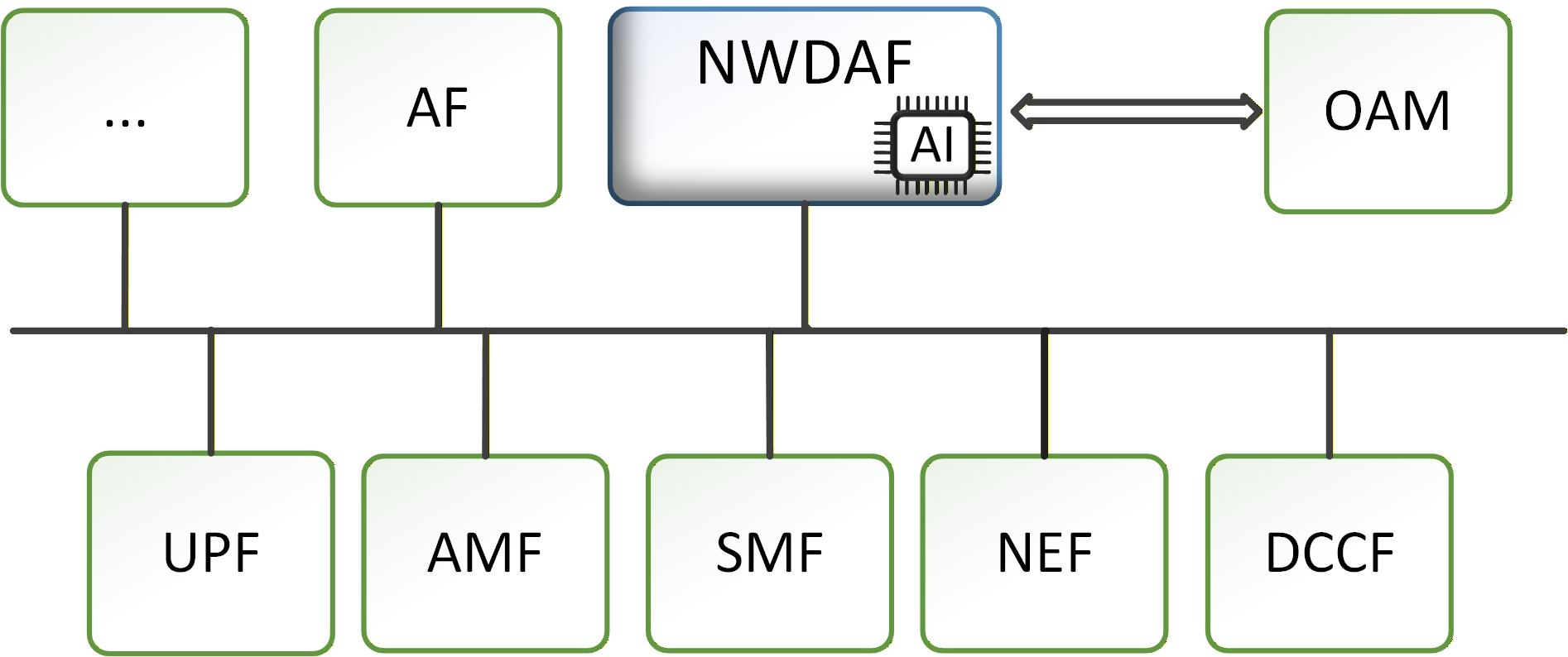
Figure 1. 5G System Architecture with centralised AI design
Introduction of 6G AI
As more AI services emerge, the AI-related service data being transmitted through communication systems is increasing rapidly. At the same time, AI is now being widely adopted in various industries, transforming workflows and improving system efficiency. This trend has made AI a key focus in 6G discussions from the very beginning, with the support and interests from mobile network operators, mobile vendors and network vendors. To address this, 3GPP SA2 WG has agreed to study AI in the Core Network as a major key issue starting from 6G day 1. The detailed key issue description is documented in 3GPP TR 23.801-01 [7]. Building on the limitations of 5G highlighted earlier, this section will explore the potential key enablers of 6G AI that can not only overcome the existing challenges but also meet new requirements for 6G.
AI for 6G Core Network
• AI-Enabled Core Network Functions
One of the fundamental enablers for 6G Core Network is to support the AI-powered core Network Functions (NFs). In 5G, the NWDAF is the main NF supporting network automation; the analytics provided by NWDAF based on ML inference is mostly only used as assistance information by the consumer NFs for decision-making. For instance, the Policy Control Function (PCF) determines QoS parameters based on the NWDAF analytics of network conditions, service requirements, user status and plenty of other information such as QoS monitoring. However, such a complex procedure, multiple entities – including different NFs, base station, AFs, UE – are all involved. Each entity operates its own the information and their internal logic to decide the standardised actions based on different triggers and interactions with others, which can lead to inefficiencies. To address this, 6G aims to support AI-enabled network functions that allows each NF to make independent decisions using AI, considering complex and comprehensive information. Additionally, the AI-enabled NFs can collaborate or federate with other entities in a distributed manner to solve complex tasks.
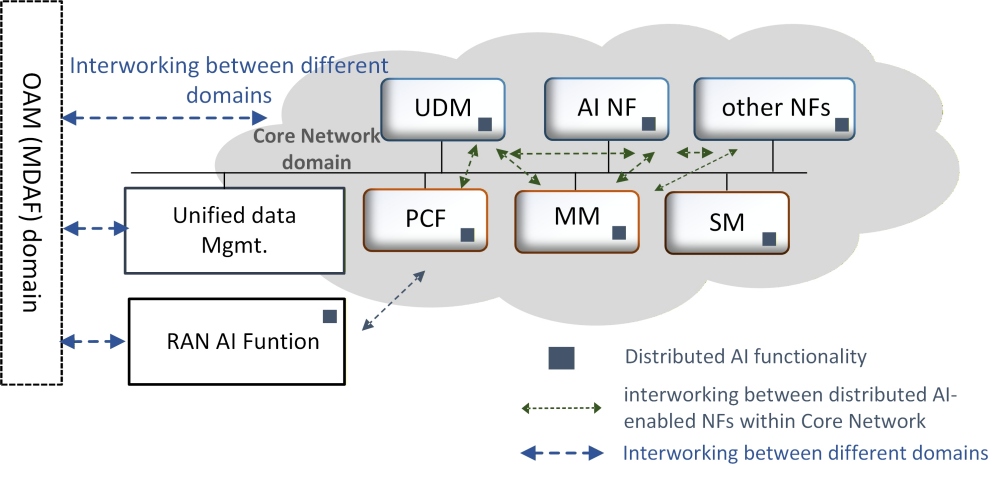
Figure 2. Distributed AI design in 6G System
AI-powered network functions is the fundamental enabler of supporting AI-native network and providing AI as a service. The AI-powered network functions will be capable of performing AI operations such as AI model training, inference, performance monitoring and model update, and even model provisioning to other entities. Unlike the 5G centralised AI-design, the distributed AI in the 6G Core Network reduces the need for massive data collection and high-computing power by a single NF. The AI-powered 6G network functions are able to leverage local data and require minimal data from other sources to leverage AI on making decision locally and in real-time.
The AI-powered NFs can also collaborate with other entities to solve complex tasks within Core Network or across different domains. For instance, for QoS determination, instead of requiring extensive information from the multiple involved entities, AI-powered NFs (e.g. PCF, SMF, UPF, etc.), RAN node and OAM can work in conjunction to train joint AI model and perform joint inference. To enable this type of AI-native operations, enhancements to the network architecture are necessary in 6G, such as standardised interaction between AI-enabled entities including interfaces and the information to be transferred. The existing interface, like SBI or NGAP, could potentially support control information exchange. The potential enhancement to the interfaces or whether new AI- related protocols are required will be further studied by SA2. The enhancements will also facilitate efficient data collection and transfer for AI operations across different domains, as well as seamless interaction between AI-powered functions and non-AI entities. The exchange of contextual information to optimize AI-driven decisions should also be supported to ensure the system performance.
The distributed AI-powered NF design in 6G Core Network will enable a flexible way of working between AI and non-AI entities, optimizing network performance and delivering high-quality services to customers. At the same time, the AI capabilities of the network will also allow it to provide AI as a service to its consumers.
• Agentic Core Network
In 3GPP SA2, one of potential ways of utilizing AI technology for network is to introduce AI Agent as a part of the 6G core network. In AI academia, ‘agentic’ in general refers to autonomous, planning, and decision-making capabilities to achieve complex goals with minimal or without human guidance. The term AI agent in the Core Network refers to an entity that autonomously performs tasks on behalf of UE, systems and/or applications. There is growing interest in integrating advance AI technologies, such as AI agents, to enable automated core network operations by comprehending the varied and dynamic requirements of subscribers, as well as considering situational factors like network congestion status. Moreover, each subscriber’s UE would be in different context with respect to, e.g., application service in use, mobility status, and subscribed charge plan, which leads to necessity of satisfying subscriber-customized service requirement.
The 5G core network has limitations in addressing the aforementioned subscriber-customized service requirement. It processes service requests based on predefined or semi-dynamically generated rules with operational flows between core network components executed sequentially. In 6G, given that the service requirements of each subscriber would be more diverse, the operation mode that adheres to non-flexible rules becomes limited when a subscriber's service needs change as its context. Additionally, it is anticipated that not only traditional connectivity connection services but also a broad range of services, i.e., beyond connectivity, leveraging network infrastructure, such as sensing or computing services, can be provided. The requests are not limited to the 3GPP specified requests in 5G and earlier release, e.g. a registration request, PDU session request, etc.; in addition, the request may include more general information or user intent, for instance the user would like to play a VR game with a high expected QoE (Quality of Experience). The complexity in network control, driven by the delivery of diverse services, is expected to become higher. This has brought heightened interest in leveraging AI technologies to effectively address this challenge.
Based on the above discussion, SA2 has agreed to study the following major aspects on enabling 6G core network to leverage AI capabilities:
For the aforementioned study in SA2, it has been established as a requirement that the AI for the 6G architecture shall be multi-vendor interoperable, reliable, and sustainable.
Enabling an agentic core introduces new challenges to 6G standardization. Unlike 5G and earlier generations, where the Core Network operates based on predefined procedures and MNOs configurations, ensuring stable operability with autonomous AI agent decisions becomes a critical issue. In this regard, performance monitoring, governance and stability aspects are expected to become more important topic. This can be also entangled with how to support lifecycle management of agentic core from OAM perspective. Additionally, modularizing predefined procedures and enabling dynamic composition of these ‘modules’ represents a different logic in specifying 3GPP procedures compared to previous generations. SA2 will assess the feasibility of agentic core network proposals for 6G Day1, incorporating detailed technical inputs from supporting companies during the 6G study phase in 2026.
6G Network for AI Services
• AI Agent-Communication
As more AI-powered equipment or systems and AI-related service emerge, some MNOs identified the new commercial opportunities to support the more advanced communication scenarios, such as the communication and interactions between robots or AI agent on UE. The MNOs expect to support the large scale, distance and flexible and dynamic scenarios for the communication between the AI agent on UEs. The communication between AI agent on UEs is not only limited to the proximity scenarios and requires dynamic control and broader connectivity that cannot be met by ProSe (Proximity-based services) and 5G-LAN (Local Area Network) that have been specified in 5G and earlier generations. Furthermore, instead of only using the 3GPP system as data pines for data transfer, the 3GPP network can play a much more significant role in controlling, managing and configuring the AI agent communication services, leveraging its rich information related the UEs, network and the application server.
The key issues to explore in 6G include:
For AI agents on UEs, the goal is to develop robust protocols that facilitate efficient and secure communication between AI agents, leveraging the advanced capabilities of 6G networks. The above key aspects involve understanding the mechanisms for enabling the AI agent discovery based on the required criteria of the discoverer, ensuring identification and authorisation of the discovered AI agent on UEs in various scenarios, and establishing secured communication connections between AI agent on UEs. One of the challenges is to study how to identify and authorize AI agents on UEs. Unlike the typical UEs, the AI agent on UE may have dynamic identification information. Ensuring that only the legitimate agents are allowed to be discovered and connected is critical for network and communication security. Another critical aspect is enabling communication between AI agents on different UEs via the 6G network, for example by allocating resources and determining appropriate policies and configuration for better support of the communication between AI agents on UEs.
Additionally, enhancing network capability exposure functionalities to AI agents on Application Functions (AFs) is another important aspect that proposed by some MNOs. This involves studying what the key network capability information will be the most beneficial for AI agents on AF and how to effectively expose this information to the AF. It is assumed that the network capability information will be potentially help the AF to understand whether the Core Network is capable to provide additional support for AI agents operation, information related to dynamically access and network resource utilisation and operation status, etc. By providing this information to the AF, the AF can optimise and plan its tasks; the network might be more informed of the AF decisions that is helpful for optimising network organisation and efficiency.
• Network for AI Model Training and Inference as Services
Another key focus on 6G is to support the 6G network to provide AI as a service. Particularly for AI model training and inference for various application-layer AI use cases. As highlighted earlier, the 6G network will be AI integrated and natively AI-enabled thanks for to the support of AI-enabled NFs. and therefore, the fundamental 6G architectures is assumed to be capable to facilitate efficient model training and inference natively. Providing model training or inference as a service to subscribers/users or application servers will enhance the utilisation of 6G network capabilities and also enhance the diversity of the services can be provided by MNOs.
The growing volume and diversity of AI traffic in 3GPP network raise questions about whether special handling required in 6G based on network awareness of AI traffic. The AI traffic characteristics are potentially different from most traditional services, and there might be further differences among various AI traffic. For instance, the requirements for the traffic of tokenised communication, AI model training, inference can be different. In general, inference traffic might be delay-sensitive, while model training traffic might be high volume and frequent transmission. Additionally, different tokens for the same service may have varying error tolerance. However, considering 5G already supported XR traffic and specified basic support of application-layer AI service (such as enhanced 5QIs), whether additional special handling is required or not in SA2 domain will be based on the further identification of the AI traffic characteristics by other 3GPP WGs. This analysis will help SA2 to determine whether necessary enhancements in 6G will be required or not.
Data Framework for AI Use CasesGiven the high data volumes in general associated with AI services, transferring such data over the existing control plane (CP) could lead to congestion. While the current user plane, although capable to handle relatively high volume data, lacks the data controllability and visibility at core network required by MNOs cannot be effectively achieved. Additionally, UP mechanism struggles to transfer the data from UE or base station to NF, which is critical for some use cases such as UE data transfer for UE model training and sensing data transfer from RAN (e.g., RAN node-based sensing).
To address the limitations of 5G that create obstacles for the cross-domain AI standardization and better support the AI enablers highlighted for 6G, it is essential to enable a flexible and unified data transfer framework. This data framework will enable seamless data transfer between entities within 3GPP system and other entities inside or outside 3GPP system. This approach can help resolve existing bottlenecks of cross-domain data transfer in 5G.
The 6G Data framework will be significant topic in SA2 6G study. While we will not explore the detailed technical aspects of the data framework in this article, it is worth highlighting its potential support for AI-related use cases. The data framework aims to provide flexible data or related information collection and transfer across different domains, including the core network in SA2 domain, the physical and radio layer in RAN1 and RAN2 domain, the network management data in SA5 domain, etc. By facilitating the streamlined collection, transfer, and sharing of AI-related data, the data framework ensures efficient and secure communication among distributed AI-enabled NFs, AI-powered RAN node, different types of user device, and 3rd party servers. This approach will play a crucial role in enabling AI services in 6G networks.
Summary, Challenges and Future Work
This article delineates the key enablers of AI in 6G Core Network that address the highlighted 5G limitations while paving the way for more efficient and intelligent communication systems for new services and future challenges.
Although AI-related traffic will be transferred via 6G system, whether specially handling of the AI traffic is necessary will depend on the analysis on AI traffic to be done by other WGs.
Several issues remain to be addressed for 6G AI implementation, including charging models for AI traffic, validation of AI performance, and ensuring stability and reliability of AI-based operations.
Among these, AI traffic charging represents a particularly critical concern for MNO. Unlike traditional traffic, AI traffic often has unique characteristics, such as high data volumes for model training or low-latency requirements for inference tasks. Furthermore, AI might be used by the MNOs for improving network performance which requires UE to transfer data or information to support the MNOs operation. Developing a fair and efficient charging mechanism for AI traffic will required. This work will mainly fall into the SA5 domain.
Ensuring the stability and reliability of AI-based operations is one of the most challenging issues in 6G. AI systems must operate consistently and predictably, even when faced with dynamic network conditions or unexpected events. This requires developing mechanisms to monitor and manage AI performance in real-time, ensuring that models remain accurate and effective. Techniques such as reinforcement learning can be helpful. Models should be updated when they fail to meet accuracy and other performance criteria. Additionally, robust security measures should be considered to protect AI operation from potential threats, which will fall into SA3 domain.
Validation of AI performance is essential to ensure that AI-based solutions meet the required standards for accuracy, efficiency, and reliability. From a standards perspective, the performance validation may involve integrating AI into network operations, ensuring that AI-based decisions and actions align with specified policies and procedures. From an implementation perspective, this may involve developing methodologies to test and verify the performance of AI models in real-world scenarios, particularly in complex and dynamic environments, by both vendors and MNOs.
In conclusion, the 6G AI represents a transformative step forward, enabling more intelligent, efficient, and flexible communication network. By addressing key enablers such as distributed AI-enabled network functions, unified data frameworks, and support of advanced AI agent communication, 6G is positioned to overcome the limitations of 5G and support a wide range of advanced AI-driven scenarios. However, challenges such as charging for AI traffic, stability and reliability of AI-based operations, and AI performance validation must be carefully addressed. 3GPP SA2 WG will continue investigating detailed solutions for each single technical issues.
References
[1]. RP-251870, New WI: Artificial Intelligence (AI)/Machine Learning (ML) for NR air interface enhancements. Prague, Czech Republic, June 9-13, 2025, 3GPP TSG RAN Meeting #108
[2]. RP-251864, Artificial Intelligence (AI)/Machine Learning (ML) for mobility in NR. Prague, Czech Republic, June 9-13, 2025, 3GPP TSG RAN Meeting #108.
[3]. RP-213602, New WI: Artificial Intelligence (AI)/Machine Learning (ML) for NG-RAN. Dec. 6 - 17, 2021, 3GPP TSG RAN Meeting #94e
[4]. 3GPP TS 23.288, Architecture enhancements for 5G System (5GS) to support network data analytics services..
[5]. 3GPP TS 23.273, 5G System (5GS) Location Services (LCS).
[6]. SP-250806, Study on Architecture for 6G System. 10 - 13 June, 2025, Prague, Czech Republic, TSG SA Meeting #108.
[7]. 3GPP TR 23.801-01, Study on Architecture for 6G System; Stage 2, V0.3.0 (2025-11).