Communications
6G AI/ML for Physical-layer: Part II - CSI Compression with JSCM
Introduction
In modern wireless systems, the efficient acquisition of Channel State Information (CSI) has become increasingly critical, driven by the deployment of massive antenna arrays and the demand for higher spectral efficiency. Traditional non-AI approaches primarily rely on quantizing CSI into bits; however, the ever-increasing number of antenna ports significantly inflates the feedback payload. To mitigate CSI feedback overhead while enhancing reconstruction accuracy, 3GPP has actively explored the integration of Artificial Intelligence (AI) for CSI compression and reconstruction with two-sided model [1][2].
Although AI driven schemes can substantially reduce CSI feedback overhead and boost throughput, they still suffer from several practical issues:
The concept of semantic communication sheds light on a promising direction to address these challenges by shifting the focus from raw signal fidelity to the meaning of the transmitted information. By extracting and delivering only the task relevant semantics, the required payload can be drastically reduced and robustness against channel impairments enhanced. This motivated us to propose studying Joint Source Channel Coding and Modulation (JSCM) framework originally for AI-CSI feedback use case in 3GPP 5G-Advanced [3]. In this regard, a key aspect of JSCM is that the corresponding CSI feedback seamlessly adapts to UL channel conditions and uplink resources availability, while the feedback accuracy follows a best-effort distortion minimization principle. Along with the technical promotion and more comprehensive exploration, JSCM is gaining momentum in 3GPP 6GR AI study and is extended to more use cases beyond CSI. Unlike the conventional framework that first quantizes the CSI and then encodes it separately, JSCM operates directly on the unquantized signal and jointly optimizes source and channel coding as well as modulation, breaking-through the conventional equal-bit protection and square-QAM limitations.
This joint operation offers the following benefits:
More importantly, JSCM was conceived for 6G research as a new paradigm for transmitting and receiving signals where physical layer has full autonomy. Such paradigm can be systematically extended to incorporate semantic aware encoding, learning based modulation, and cross module optimization. If designed properly, JSCM can eliminate the need for unnecessarily cumbersome procedures (such as source coding, transport level, packet data unit formation) thereby offering a future-proof, low-complexity, resource-efficient, and lightning-fast communication. Consequently, this effort positions JSCM not only as a practical solution to address the CSI pain point of today’s 5G Advanced systems, but also as a foundational building block for the next-generation semantic driven wireless networks.
CSI compression with JSCM
AI‑driven CSI compression is crucial because it can learn compact, task‑optimized representations of high‑dimensional channel data that outperform manual quantization designs. Conventional bit‑wise compressors rely on fixed transforms and uniform quantizers, which become inefficient as the required number of antennas grows to hundreds for massive‑MIMO and beyond‑5G. In contrast, deep neural networks can jointly exploit spatial, temporal, and frequency correlations and dynamically adjust the compression rate to current channel conditions/environments and reconstruction requirements. This yields much lower feedback overhead, and higher reconstruction fidelity, leading to better beamforming gain, spectral efficiency, and reliability. In addition, AI‑based compressors can be trained end‑to‑end with downstream PHY modules (such as precoding and scheduling) so that the compressed CSI preserves the information most critical to network performance.
Building on this AI foundation, our Joint Source‑Channel Coding and Modulation (JSCM) framework advances the idea by integrating semantic communication. Instead of simply compressing raw CSI samples, JSCM learns to retain channel features that matter most for downstream tasks. Further model, leveraging the direct processing of the unquantized estimated channel signals allows AI-based decoders to robustly reconstruct information with simple compression. This paves the way for low-complexity compression schemes—such as linear projection-based compression—thereby further reducing terminal complexity and power consumption. Through end‑to‑end joint optimization of source coding, channel coding, and modulation, JSCM preserves the efficiency of AI‑based CSI compression while adding semantic awareness to provide a smarter, more robust feedback mechanism for emerging 6G systems.

Figure 1. JSCM based CSI compression in inference
As shown in Figure 1, the UE compresses the CSI either using a UE-side model or a simple matrix-based projection. The resulting complex-valued coefficients are then directly mapped onto the allocated resource elements (REs), thereby avoiding conventional quantization and preserving more information at the receiver. For example, if $I_{raw}$ and $I_{compress}$ denote the entropy of the raw DL channel and the compressed output, respectively, an effective compression scheme can yield $I_{raw}≈I_{compress}$.
In contrast, conventional methods including AI and non-AI codebook-based schemes, as well as SSCC (separated source and channel coding)/JSCC (joint source and channel coding)-based compression—rely on quantization, which introduces irreversible information loss at UE side. Even with error-free channel coding of the quantized bits, this initial fidelity loss remains unrecoverable due to the quantization error. Our proposed scheme integrates source coding (CSI compression) with channel coding at UE side, aligning this use case with the Joint Source-Channel coding and Modulation (JSCM) framework [4].
To mitigate the impact of uplink fading channel on UCI transmission, Demodulation Reference Signals (DMRS) are integrated to facilitate equalization at the Network (NW) side. The output of this equalization process is the unquantized, compressed CSI, albeit affected by noise and potential distortions. Consequently, this equalized output preserves maximum amount of the information entropy, denoted as $I'_{compress}$ . At the receiver, a NW-sided AI/ML model is employed to reconstruct the DL CSI from the received signals. Leveraging the robust representation capabilities of AI, the reconstructed channel achieves the maximum entropy $I'_{compress}$.
By applying standard equalization techniques, the received signal can be transformed into an equivalent AWGN channel, thereby greatly simplifying the AI training process. In line with the design shown in Figure 2, the compression matrix may either be predetermined and fixed (Scheme#1) or jointly optimized together with the NW-side model (Scheme#2), so as to attain a desirable trade-off between the amount of feedback required and the accuracy of the reconstruction.
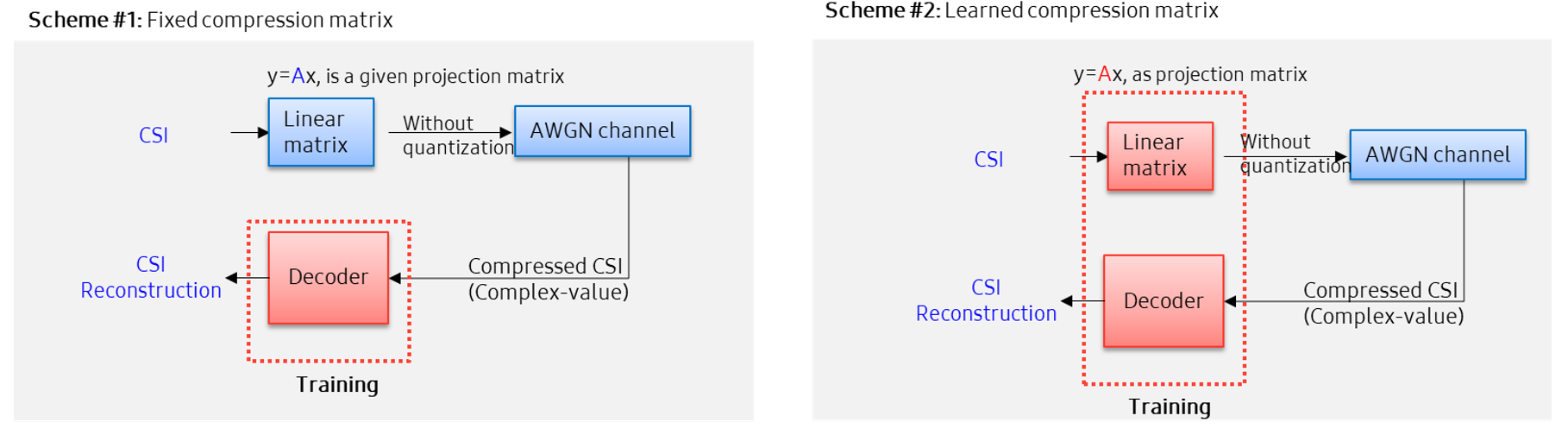
Figure 2. Training procedure for projection matrix for one-sided (NW-sided) model based JSCM
Performance benefit of JSCM
This section presents simulation results demonstrating the efficacy of the proposed JSCM approach. For evaluation, the same model structure is considered for both the NW-sided model based approach and the two-sided model based approach. Our comparative analysis evaluates the following distinct schemes:
Figure 3 presents a comparison of the square generalized cosine similarity (SGCS) and the corresponding spectral efficiency (SE) for different schemes over a range of PUCCH SNR values. For JSCM (including both the NW-sided and 2-sided models), the explicit channel representation of size 32×4×13 is first compressed and then mapped onto 480 REs. In contrast, the NR codebook, ie., e-Type II CSI, is considered as baseline with 123-bits payload mapped to 410 REs with QPSK modulation at a coding rate of 0.15. The SE metric is computed from the precoding matrix obtained from the reconstructed CSI.
In the high-SNR region, Scheme#2: Gaussian/Gold-based exhibits a 12.1% degradation in SGCS and a 15% SE reduction compared with the 2-sided JSCM baseline. Nevertheless, it still offers a 71.1% SE improvement over the e-Type II scheme. The learnable unilateral configuration (“one-sided (Learn)”) further reduces this gap, limiting the SE deficit to only 3.6% relative to the 2-sided model based approach, while providing a substantial 94.4% SE gain with respect to e-Type II.
Tables 1 and 2 report SGCS, SE, and UE-side complexity for Rank = 1 and Rank = 4 cases, respectively. The main benefit of the NW-sided model based approach (scheme#1 and Scheme#2) is significant reduction in UE inference complexity. By substituting computationally intensive AI model inference at the UE with simpler matrix multiplications. Note here, these schemes require only about 2.9% of the e-Type II codebook’s computational cost for Rank = 4, and under 40% for Rank = 1. Importantly, the NW-sided model based approach not only surpasses e-Type II in SE, but also maintains performance on par with the 2-sided model based JSCM, because of the direct processing on unquantized CSI and the compression matrix-aware training of the NW-side model.
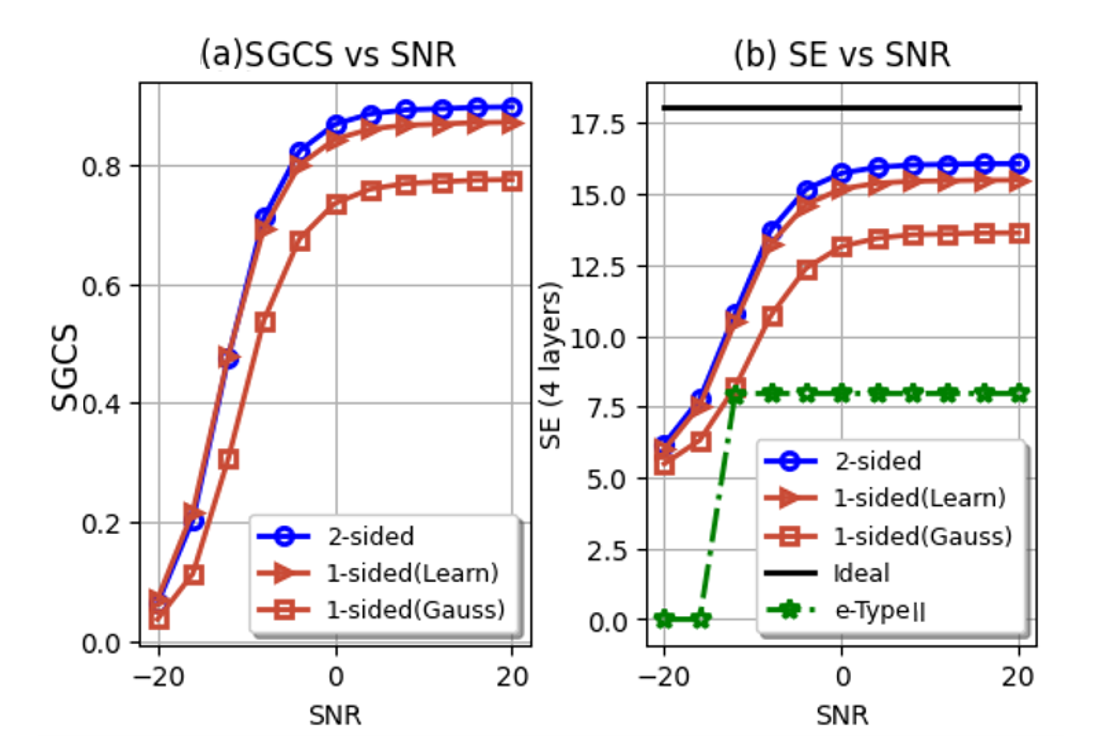
Figure 3. Performance in AWGN channel
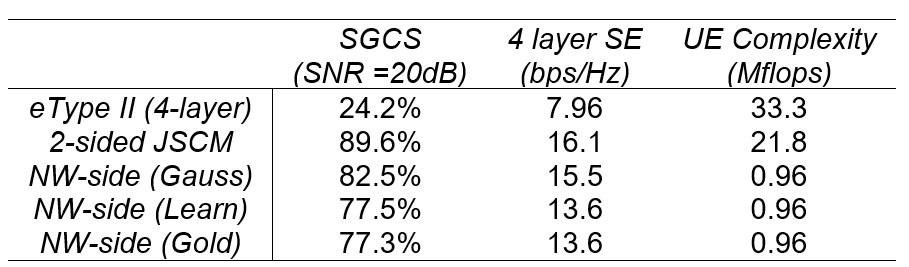
Table 1. Performance comparison for Rank =4

Table 2. Performance comparison for Rank =1
Figure 4 presents the SGCS performance in a fading channel environment. The model is trained solely over an AWGN channel, with the uplink SNR varying from -20 dB to 10 dB. For inference, however, the channel is switched to a CDL-A fading channel. The distortions induced by the fading channel are mitigated through NW-side equalization that relies on a practically estimated channel, obtained using a frequency-domain Least Squares (LS) approach. While a noticeable performance loss arises in the low-SNR region due to imperfect channel estimation, the proposed aproach still consistently outperforms the e-Type II codebook (configured with 62 feedback bits, QPSK modulation, and 1/2-rate Polar coding) over the entire SNR range.
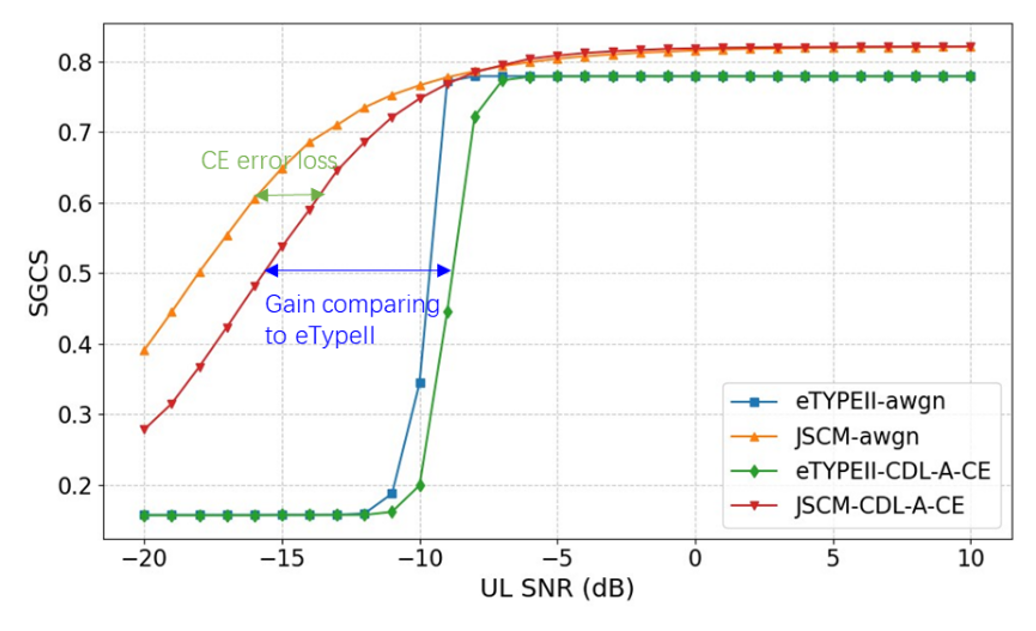
Figure 4. Performance in fading channel with LS-based channel estimation
System-Level Simulation (SLS) is performed to assess the benefits of JSCM over the 5G e-Type II codebook. Here, UPT (user perceived throughput) performance under realistic, non-full-buffer traffic and Multi-User (MU) MIMO scheduling operation is assessed for a single-TRP (sTRP) scenario with $N_p=64$ antenna ports and for a multi-TRP (mTRP) coherent joint transmission (CJT) scenario with 4 TRPs, with each TRP equipped with $N_p=32$ antenna ports, respectively. Figure 5 illustrates comparison assuming a network-side (NW-side) model for JSCM; further details on the simulation configuration are given in [5]. In these scenarios, the JSCM compression matrix has size of $K×2N_{p}N_{SB}$. For each scenario, several compression dimension values of K are considered. After compression, adjacent elements are combined into a single complex value and mapped onto Resource Elements (REs), leading to a total signaling overhead of K/2 REs corresponding to each point in x-axis for JSCM. For comparison, the SSCC method (derived from Rel-16 eType-II CSI) is also evaluated, with its Uplink (UL) overhead determined by the average UL MCS, assumed to be QPSK with a coding rate of 1/2.
The simulation results indicate that the proposed JSCM solution consistently yields better performance than the SSCC benchmark, in terms of UPT and overhead tradeoff. In particular, JSCM delivers an average UPT improvement of up to 3% for an overhead of 60 REs and is capable of achieving as much as 70% reduction in overhead while still sustaining a UPT level of 102%, thereby demonstrating its effectiveness in realistic MU scenarios. Furthermore, it is shown that a higher UPT gain (around 6% UPT gain with 60% overhead reduction) of JSCM over the SSCC benchmark can be achieved in the mTRP CJT scenario. This is because the compression and reconstruction via JSCM becomes more efficient by learning and adjusting the mTRP scenario than the fixed-codebook approach, where the antenna array’s structure of the mTRP and its channel environment becomes more irregular than the sTRP scenario.
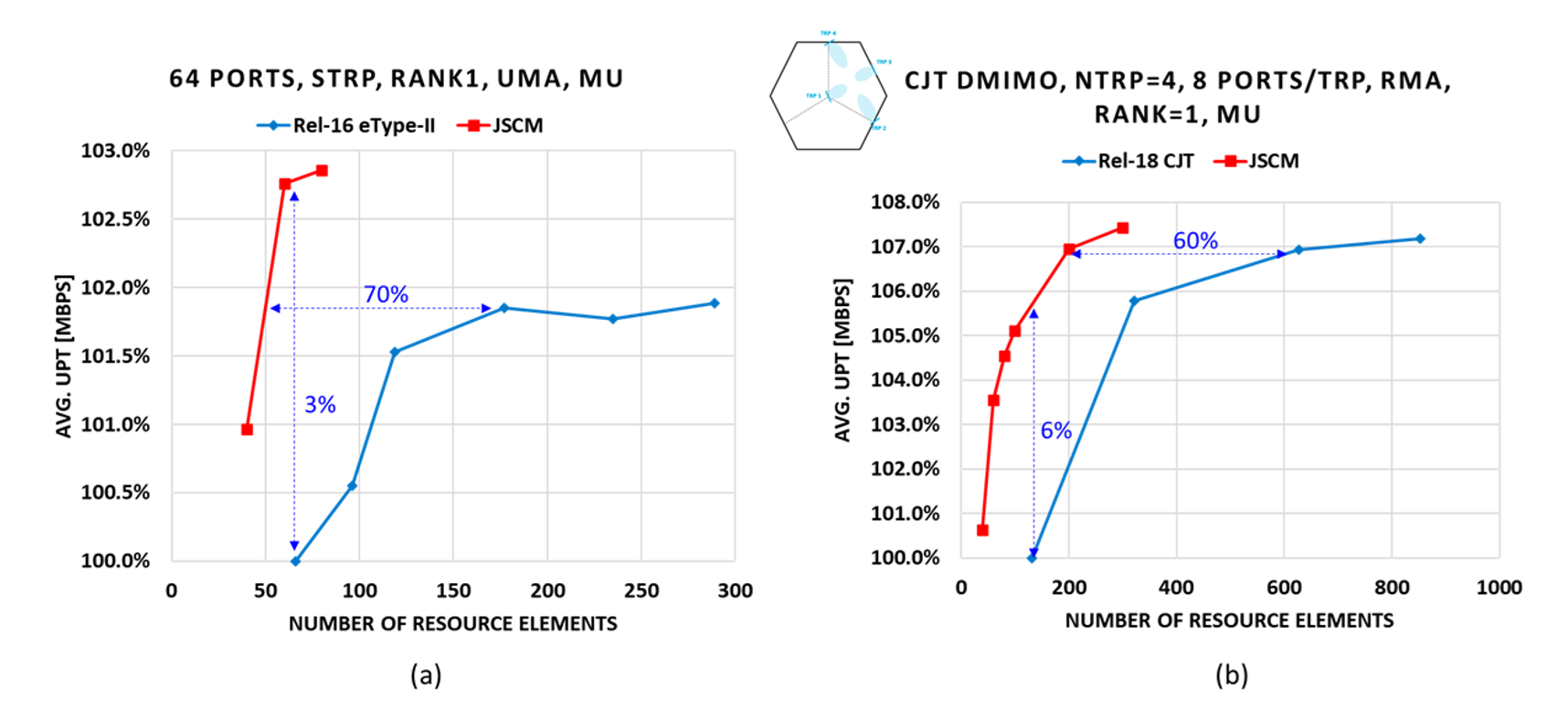
Figure 5. User perceived throughput (UPT) vs Rank 1 overhead (number of REs) (a) sTRP and (b) mTRP CJT scenarios
Conclusion
This blog tackles an efficient CSI acquisition in modern wireless systems by turning the Joint Source-Channel Modulation (JSCM) concept into a practical solution. We introduce a low-complexity, resource-efficient, and future-proof JSCM-based CSI feedback framework that covers system architecture, learning methods, and an uplink transmission scheme resilient to real-world channel impairments. Its performance is confirmed via both Link-Level simulations (LLS) and System-Level (SLS) simulations. The work also considers the complexity of models at both nds and at the UE, as well as the potential standard implications. While the JSCM is gaining interest and being studied in 3GPP, joint effort of the standardized framework and the practical implementation solution support should be made in the coming years within industrial community, to bring it into real-life networks.
Together with this blog, our prior research and PoC results can be found in here:
https://research.samsung.com/blog/Enable-JSCC-based-CSI-Feedback-for-B5G-6G-Design-Standardization-and-Prototype
Also, part I of AI/ML for 6G Physical-layer can be found in:
https://research.samsung.com/blog/6G-AI-ML-for-Physical-layer-Part-I-General-Views
References
[1] RP-221348, Revised SID: Study on Artificial Intelligence (AI)/Machine Learning (ML) for NR Air Interface
[2] RP-251870, New WI: Artificial Intelligence (AI)/Machine Learning (ML) for NR air interface enhancements
[3] R1-2400723, Discussion for further study on AI/ML-based CSI compression, Samsung
[4] R1-2505588, AI/ML Use cases and framework for 6GR, Samsung
[5] R1-2509516, AI/ML Use cases and framework for 6GR, Samsung