Communications
6G NTN: Making Mobile Networks Reachable Beyond Terrestrial Coverage
Introduction: From Satellite Access to Mobile Continuity
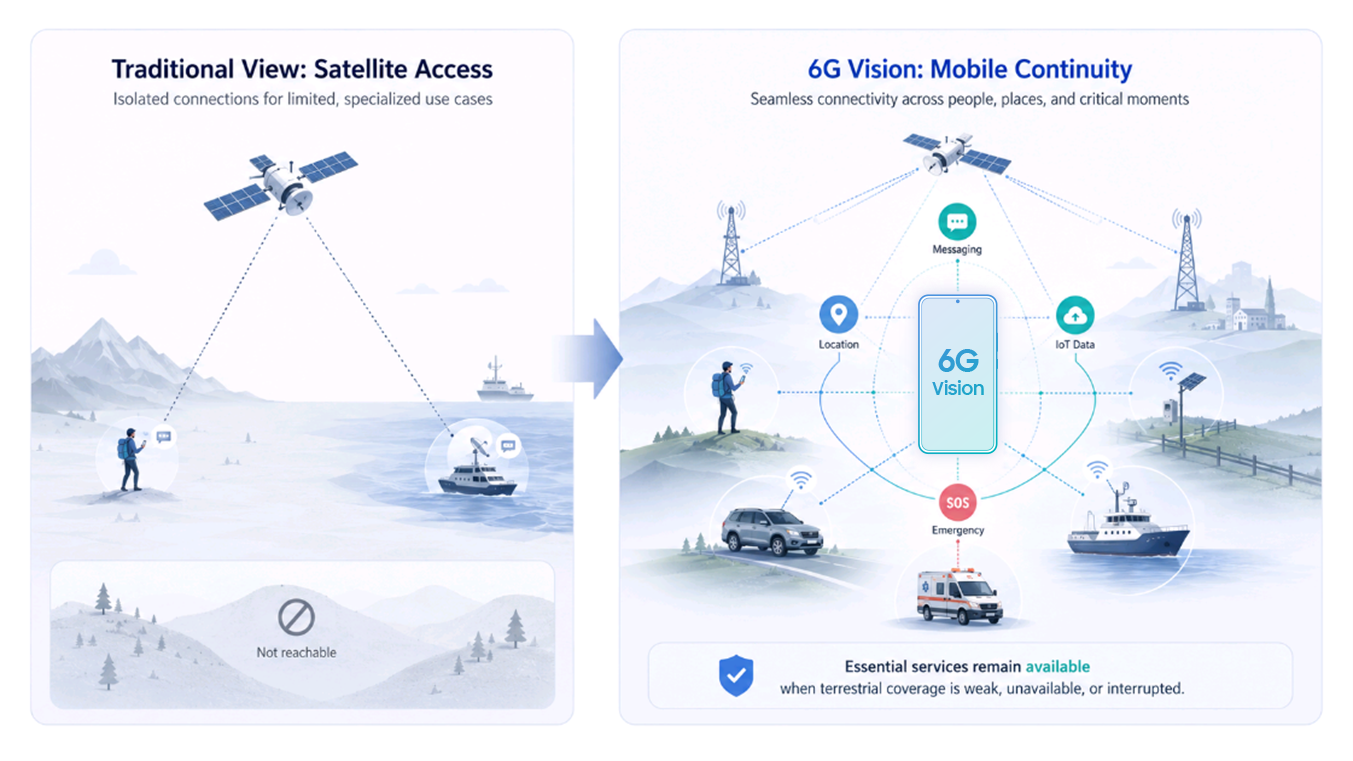
Mobile networks are often characterized by the language of performance: higher throughput, lower latency, wider bandwidth, denser capacity, and more reliable coverage. While these metrics remain important, the most essential capability for a user in many real-world situations is the fundamental ability to remain reachable.
A hiker outside coverage of terrestrial networks (TN), a vehicle on a remote road, a ship near the edge of coastal networks, an industrial sensor in an isolated field, or a community affected by a natural disaster may not need terrestrial-like broadband service. Their immediate and critical need may be simply to establish a connection – to send a short message, share a location, report a small amount of data, or request help. In such situations, ubiquitous connectivity matters more than peak performance.
This is why non-terrestrial networks (NTN) are becoming strategically important for the mobile ecosystem. The momentum is already visible. Direct-to-device satellite services are making satellite connectivity more familiar to mainstream users while emergency connectivity underscores NTN’s clear value proposition: when terrestrial coverage is unavailable, even a short message or location update can be critical. At the same time, the convergence between the telecommunications and satellite industries is accelerating as mobile operators, satellite operators, device makers, chipset vendors, infrastructure vendors, and application providers explore how satellite connectivity can seamlessly fit into ordinary mobile service models.
The above advancements demonstrate how NTN is evolving beyond being a specialized satellite service for dedicated terminals. However, TN and NTN should not be jointly regarded as a single uniform market and NTN is not a solution for terrestrial-like broadband everywhere. Applications such as emergency messaging, direct-to-device low-rate communication, satellite IoT, portable broadband, and operator-satellite partnerships have respective distinct requirements that result to different demands for device capability, antenna size, power consumption, coverage availability, regulation, and business model.
For 6G, the goal is not only to enable a device to connect to a satellite. Mobile continuity goes one step further: it asks whether essential mobile services can remain available with minimal disruption when terrestrial coverage becomes weak, unavailable, or interrupted. This shift in perspective changes the design objective from simply extending radio access to ensuring dependable service continuity for users, devices, and vehicles.
This article explores how 6G NTN can become a practical continuity layer for mobile networks. It begins by examining the lessons learned from current industry momentum, then explains why 6G terrestrial and non-terrestrial operation cannot simply share the same radio assumptions, and finally outlines the minimum future-proof foundations that can make NTN useful, scalable, and deployable.
What NTN Means for the Mobile Ecosystem
The value of NTN does not come from competing with TN in every scenario. TN will remain the main engine of mobile capacity, user experience, and economic scale. Instead, NTN adds value by extending the service boundaries of TNs into places and instances where terrestrial infrastructure is absent, damaged, uneconomical, or temporarily insufficient.
From this perspective, NTN can be understood as a continuity layer on top of TN for the mobile ecosystem. It can leverage many elements that have already made mobile networks valuable: standardized devices and chipsets, subscription models, authentication, emergency-service handling, roaming, network operation, and application integration. This reuse is important because mass-market mobile NTN is unlikely to scale as a standalone satellite service. Instead, it needs to fit into the operational and user-experience model of TN.
At the same time, NTN must account for the physical realities of satellite communication. Propagation delays are longer, coverage areas may shift or vary over time, and link budgets are constrained due to the large propagation loss. Satellite visibility can be intermittent, and factors such as device power, antenna size, user orientation, and thermal behavior can dominate performance, especially for handheld devices. A credible 6G NTN design must therefore strike a balance between leveraging TN elements and addressing satellite-specific constraints.
The current NTN opportunity is evolving through several related service models. Emergency and safety connectivity resonates with users because its value becomes clear when ordinary coverage is not available; everyone can imagine emergency situations without TN access. Direct-to-device connectivity bridges satellites with the smartphone subscription ecosystem, although early services may prioritize low-rate communication such as messaging, location sharing, or selected data transmission. Satellite IoT remains a natural opportunity because many applications for sensors need reachability in remote areas, long lifetime, and cost-effectiveness more than high throughput. Finally, portable satellite broadband addresses a need to provide services requiring higher data rates, often with larger terminals, more favorable antenna assumptions, and different power budgets.
The diversity of service models is best served by individual designs for respective devices. For example, while both handheld direct-to-device services and portable broadband terminals may utilize satellites, their designs require different device, radio and power assumptions. Similarly, narrowband NTN should not be understood only as an IoT story because coverage-oriented narrowband techniques can also support low-rate continuity for selected mobile services. The broader value of NTN lies in supporting a wide range of services.
Why 6G NTN Needs More Than a Terrestrial Extension
The first phase of 3GPP-based NTN has been essential because it brought satellite access into the mobile standards ecosystem and did so with minimal additional NTN-specific functionalities. NR-NTN provides an NR-based satellite access path, while IoT-NTN extends cellular IoT technologies such as NB-IoT and eMTC toward satellite operation. Together, they create a foundation for satellite connectivity that can be aligned with mobile devices, networks, and service models. However, NTN was not introduced from the beginning of NR and a consequence is that some functionalities are not optimally supported due to the requirement to maintain backward compatibility.
6G provides an opportunity to harmonize TN and NTN designs from the beginning and broaden the integration of TN and NTN. A device capable of connecting to a satellite needs to identify coverage requirements, acquire system information, manage timing and frequency alignment, access the network, exchange essential signaling, conserve battery, tolerate delay, and move between TN and NTN connectivity without disrupting the service experience or creating undue network burden.
This is where the 6G TN and NTN integration becomes important. Although 6G TN and 6G NTN should be part of a common mobile framework, they cannot simply be deployed as if they shared the same radio assumptions. TN typically benefits from dense infrastructure, short propagation delay, predictable cell planning, frequent control interactions, and stable coverage in populated areas. In contrast, NTN operates under some fundamentally different conditions than TN, including long propagation delay, large Doppler variations, moving or intermittent coverage beams, tight link budgets due to large pathloss, and imperfect positioning.
The challenge, therefore is to integrate TN and NTN under the same specification framework while catering to distinctly different communication requirements with minimal differentiation in operational designs. The practical 6G direction is to define a mobile-compatible NTN foundation, one that is sufficiently common to ensure interoperability across devices and operators, yet realistic enough to accommodate the aforementioned NTN-specific conditions.
The broader opportunity for NTN in 6G is to design satellite access, terrestrial interaction, device capability, signaling, scheduling, mobility, and service behavior around a same practical goal: keeping essential mobile services available when terrestrial coverage is insufficient. This framing also helps avoid overclaiming. 6G NTN should not be presented as a guarantee that every ordinary handheld device will receive terrestrial-like broadband everywhere from the initial deployment phase as that would overlook NTN-specific limitations. Instead, a more credible and valuable target would be to prioritize dependable reachability, with richer services that scale over time as the ecosystem evolves to support them.
Four Design Directions for Practical 6G NTN
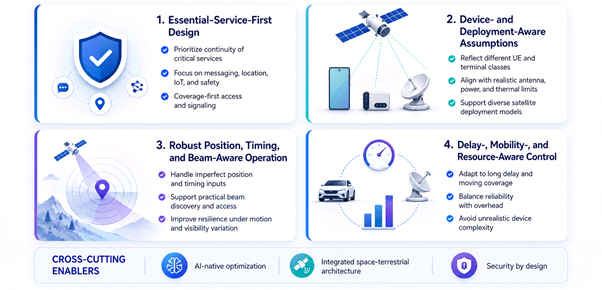
1. Start with Essential-Service Continuity
The first design direction is to make essential service continuity the objective instead of treating NTN as a general broadband overlay. In TN, broadband performance is often the primary differentiator. However, in NTN and especially for handheld and low-power devices, the primary differentiator may simply be whether basic service can be provided under weak coverage and constrained power.
When a user is outside TN coverage or when TN service is disrupted, the successful delivery of a small message can be more important than supporting a high-throughput session. Consequently, NTN should consider service behavior that ensures emergency messaging, location sharing, selected low-rate applications, IoT reporting, and critical status updates.
The technical direction is coverage-first access and signaling. The NTN and device design should be based on the evaluation of the entire chain including satellite discovery, system information acquisition, random access or access assistance, uplink timing, essential downlink control, message delivery, and service maintenance. Improving only one component is not sufficient if another component remains a bottleneck.
The NTN value lies in user trust and service resilience. A user does not need to understand the satellite link. The user needs to know that the most important services remain available, everywhere and at any time. At the same time, from a system design perspective, that objective should be achieved without consuming excessive radio resources and without requiring an unrealistic device capability or excessive implementation complexity. Essential-service-first design should therefore be lean, robust, and measurable.
2. Use Device – and Deployment – Aware Assumptions
The second design direction is to make device and deployment assumptions specific to NTN operation, not just to classify devices by general mobile-market categories. In TN, device diversity is important, but dense infrastructure and stable cells can often compensate for devices with reduced capabilities. In NTN, the same device properties can determine whether the satellite link is feasible: antenna aperture and gain, maximum transmit power, receiver sensitivity, battery and thermal headroom, device orientation, sky visibility, Global Navigation Satellite System (GNSS) availability, and the ability to wait for or track satellite coverage.
This means that NTN service targets should be matched to realistic device assumptions. A handheld or wearable service for emergency messaging may need robust discovery, compact control signaling, low duty-cycle operation, and tolerance to poor orientation or intermittent visibility. By contrast, vehicles, fixed customer-premises equipment, and portable satellite terminals may use larger or more directional antennas, higher power, better thermal conditions, and more stable installation, enabling higher data rates or more demanding service continuity. A credible 6G NTN design should therefore avoid a single baseline that either assumes high-end terminals and excludes ordinary devices, or assumes ultra-constrained devices and prevents stronger platforms from using their capabilities.
Deployment assumptions are also more than ordinary network-planning choices in NTN. GEO, MEO, LEO, and high-altitude platform station (HAPS) deployments can differ in propagation delay, Doppler behavior, coverage duration, elevation-angle statistics, beam footprint, and frequency of beam or satellite transition. Transparent and regenerative payloads, sparse and dense constellations, and Earth-fixed or Earth-moving beams can change what information the device needs for discovery, timing/frequency alignment, random access, measurements, paging, mobility, and link maintenance. These differences should be reflected in the evaluation assumptions used for 6G NTN rather than hidden behind a single satellite deployment model.
The expected value is scalable commercialization without unnecessary fragmentation. 6G NTN should define a lean common baseline where interoperability depends on it, such as device capability signaling, assistance-information validity, timing and frequency alignment behavior, and essential measurement/reporting principles. At the same time, constellation-specific beam management, scheduling, power allocation, and service optimization should remain flexible for implementation and network planning. A modular design can keep mass-market handheld NTN affordable while allowing enhanced devices and richer satellite deployments to add capability in a controlled way.
3. Robust Operation for Positioning, Timing, and Beam Management
The third design direction is to provide robust operation under imperfect positioning, timing, and beam conditions. Due to high Doppler shifts and large cell sizes, satellite connectivity depends strongly on timing and frequency alignment. In LEO scenarios, satellite motion can introduce fast variations in delay and Doppler. Even when a satellite trajectory is predictable, the device may not always have accurate position information or ideal sky visibility.
Existing NTN designs use assistance information such as satellite position, timing-related information, and device location via GNSS to help compensate for long propagation delay and frequency shift. 6G should build on this direction with a more robust handling of imperfect inputs. GNSS or other positioning information may be unavailable, degraded, delayed, or inaccurate. A practical design needs to offer robust performance in all operating conditions and exhibit graceful behavior across good, degraded, and temporarily unavailable positioning conditions.
Beam operation should also be addressed as a practical coverage challenge. Satellite beams may move, change availability, or be used according to payload capabilities and service demand, particularly considering transmission power limitations of a satellite that in turn impose limitations in the number of simultaneously active beams. Although the device does not necessarily need full knowledge of satellite beam usage, it may need sufficient information to discover coverage by a satellite, access the NTN, and maintain essential service.
The expected value is dependable access. If the device can be provided positioning, timing, and beam information, and if the network can manage timing and beam association for the device with manageable complexity, satellite connectivity becomes more seamless for ordinary devices. A design tradeoff is that although assistance, measurement, and reporting can improve robustness, they can also consume NTN resources, increase device power, expose location-related information, or create implementation burden. 6G should standardize only the information exchange that provides clear interoperability or performance value while avoiding complexities associated with marginal benefits in practice.
4. Make Control Delay-, Mobility-, and Resource-Aware
The fourth design direction is to accommodate satellite delay and mobility in the communication link with a device. Satellite links can have much longer round-trip time than terrestrial links. This affects scheduling, retransmission, buffering, feedback timing, and service responsiveness. NTN-specific considerations that can still be supported under a common framework with TN operation are therefore required in order to have uniform specifications.
6G is required to support different services that have different tolerance to delay and propagation loss. Emergency messaging, sensor reporting, vehicle status updates, and richer data services do not necessarily require the same reliability, latency, or data rates. A practical system should therefore be scalable to support reliable operation under long delay and large propagation loss under a same framework without requiring separate and complex mechanism for each service type.
Mobility support is also challenging for NTN and needs a realistic functional baseline. Mobile continuity may require a device to move between terrestrial and satellite coverage, between beams of a satellite, or between satellites. However, this should not require that ordinary handheld devices maintain multiple simultaneous links as that may require additional RF chains, multiple timing references, more complex frequency compensation, and higher power consumption. For mass-market devices, one primary satellite link at a time is the practical baseline assumption.
The expected value is efficient service continuity. The system can reduce interruption, avoid unnecessary retransmission delay, and maintain essential services without requiring every device to support satellite diversity. However, although increasing measurement reports, feedback, buffering, or retransmission flexibility can improve performance in some scenarios, that also consumes device power and NTN resources. 6G NTN should evaluate such mechanisms using realistic traffic, delay, link-budget, and device-power assumptions while targeting robust link maintenance with reduced overhead and power consumption rather than only peak-throughput.
What 6G NTN Needs for a Future-Proof Radio Foundation
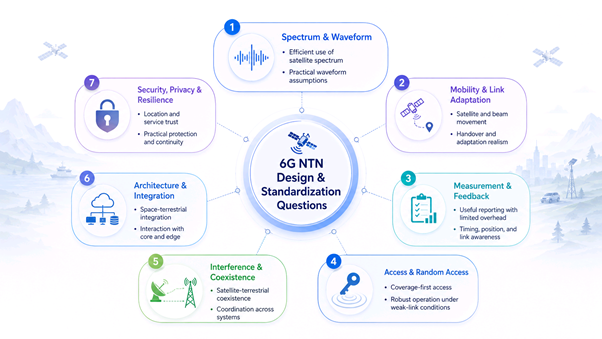
For 6G NTN to become a practical mobile continuity layer, it is essential to make satellite connectivity work naturally inside the broader mobile network while supporting the radio conditions that make NTN generally more challenging than TN.
At the radio-interface level, 6G NTN needs a minimum future-proof foundation. “Minimum” means that early NTN support by a device should not require a heavy satellite-specific baseline. “Future-proof” means that the foundation should be flexible to expand support in a simple and scalable manner beyond one early service model, one orbit type, or one device category. An effective NTN foundation should enable a device to reliably find, access, and maintain an NTN link under realistic satellite conditions, while being forward compatible in order for richer services and constellation-specific optimizations to be introduced in a compatible manner over time.
This requires careful scope definition and control. Some satellite-specific behaviors should be standardized because common device behavior, interoperability, and service reliability depend on them. Other behaviors should remain implementation-specific because they can depend on constellation design, payload capability, spectrum strategy, deployment density, vendor implementation, or operator policy. An efficient 6G NTN design should distinguish between radio functions that need common support by specification and ones that depend on deployment choices and should remain flexible.
Several priorities are especially important.
The overall design principle for TN-NTN integration can be summarized as follows: use TN wherever possible, add NTN support only when the value is clear, and avoid requiring mainstream devices to support complexity that only targets one specific deployment case.
What Early Deployments Already Teach
Early 3GPP-based NTN deployments and commercial direct-to-device services are valuable because they provide insight to requirements and shortcomings of NTN, to useful enhancements, and to potential future applications. They reveal services that users understand and adopt, device constraints that limit performance, how much delay is acceptable, where coverage gaps remain, and how operators can package NTN connectivity inside TN service offerings.
A first lesson is that low-rate basic service can have high value. Emergency messaging, text messaging, location sharing, asset reporting, and sensor updates are small in data volume yet critical in user or enterprise value. This is consistent with the mobile-continuity framing: the basic issue is not whether the system can deliver unlimited capacity, but whether it can preserve continuous and useful reachability.
A second lesson is that device and ecosystem readiness matter as much as radio capability. A satellite link that works only with specialized devices may be addressing an important market, but that may not be as important as direct-to-device continuity for mainstream users. Conversely, handheld-compatible NTN services should be designed around limited throughput and intermittent coverage availability, reflecting the antenna, power and battery constraints of real-world devices.
A third lesson is that commercial availability is not same as universal service. Device support, operator partnerships, spectrum rights, regional regulations, satellite visibility, and application integration can all determine where and how the service works.
In future trials, simulations, or measurement campaigns used to validate 6G NTN concepts, the evidence should align with practical continuity metrics. Useful demonstrations could include message delivery under weak-link conditions, access success time under varying satellite visibility, battery impact for supporting emergency messaging, performance under degraded location accuracy, or interruption time during terrestrial-to-satellite transition.
Conclusion: The Continuity Layer of 6G
NTN is becoming an essential part of the mobile ecosystem and it is important that its value is framed carefully considering practical implementations. Emergency connectivity, direct-to-device messaging, satellite IoT, portable broadband, and telco-satellite convergence are related trends and they address a wide ecosystem of service models, each with different assumptions for device capabilities, battery constraints, transmit-power limits, antenna size, service behavior, and business model.
The broader opportunity for 6G NTN is mobile continuity – ensuring that essential mobile services remain available when terrestrial coverage becomes weak, unavailable, or interrupted. To achieve this opportunity, 6G NTN should focus on harmonized TN-NTN design to allow for economies of scale, realistic device and deployment assumptions, robust positioning and timing support, coverage-first access, practical beam operation, long-delay-aware scheduling, and service continuity with cost-effective device complexity.
The key takeaway is that 6G NTN should not be about making satellites compete with terrestrial-like broadband everywhere but about allowing mobile services to be reachable, useful, and natural when TN is not present.
The next race in NTN is not only about connecting devices to satellites. It is about making satellite connectivity a dependable part of everyday mobile continuity, integrated with terrestrial connectivity.