AI
Respecting Underlying Biosignal Structure: Cross-Biosignal Pretraining for Wearable Health AI
1. Introduction
Wearable photoplethysmography (PPG) has become one of the most widely available physiological signals in modern health devices. A wrist-worn optical sensor can capture pulse dynamics continuously and unobtrusively, making PPG attractive for daily health monitoring. However, PPG observes the cardiovascular system only after each heartbeat has been initiated and the resulting pulse has traveled through the body.
Electrocardiography (ECG) provides a complementary view. It captures the heart’s electrical activity with precise beat timing and morphology, but continuous ECG monitoring usually requires electrodes and is less practical for everyday use. Importantly, ECG and PPG are not interchangeable signals. ECG reflects the upstream electrical event, while PPG reflects the downstream peripheral response. The delay and coupling between them carry health-relevant information shaped by cardiac mechanics, vascular tone, and pulse propagation [2].
These observations motivate xMAE [1], a physiology-aware masked cross-modal reconstruction framework for biosignal representation learning. During pretraining, xMAE uses paired ECG and PPG signals to teach the model how cardiac electrical activity is reflected in wearable PPG. After pretraining, the model can operate using PPG alone, enabling stronger representations for practical wearable health applications.
This post introduces xMAE and explains how cross-biosignal pretraining can use ECG as a training-time scaffold to improve PPG representations. Rather than treating ECG and PPG as interchangeable views, xMAE uses their temporal relationship to guide representation learning for wearable health AI.
2. Methods
xMAE starts from synchronized ECG and PPG segments. In our setting, each sample is a 10-second window sampled at 100 Hz. PPG remains fully visible during pretraining, while ECG is partially hidden using continuous temporal masks. The model is trained to reconstruct the masked ECG regions from the visible PPG and the remaining visible ECG context.
This design differs from standard masked autoencoding in an important way. If random points are masked in a smooth physiological signal, a model can often reconstruct them by interpolating nearby samples from the same modality. That shortcut does not require learning the relationship between ECG and PPG. xMAE instead masks continuous blocks of ECG so that local interpolation becomes much harder. To succeed, the model must exploit cross-modal structure from PPG.
The model also uses directional cross-attention. Masked ECG tokens act as queries, and PPG tokens act as keys and values. This makes the reconstruction direction explicit: the model is encouraged to infer upstream cardiac timing from a downstream peripheral pulse. The directionality reflects the physiological dependency between the two modalities, rather than treating them as symmetric signals.
A curriculum masking strategy further stabilizes training. Early in training, the model can use more visible ECG context to learn stable alignment. Later, as the mask becomes more challenging, successful reconstruction increasingly requires learning from PPG. This gradually strengthens the intended cross-modal inductive bias.
Importantly, xMAE is not designed as a PPG-to-ECG generation model. Reconstructed ECG is not the final product. ECG reconstruction is a training-time objective that shapes the PPG encoder. After pretraining, the ECG branch can be removed, and the learned PPG encoder can be transferred to downstream wearable health tasks using PPG alone.
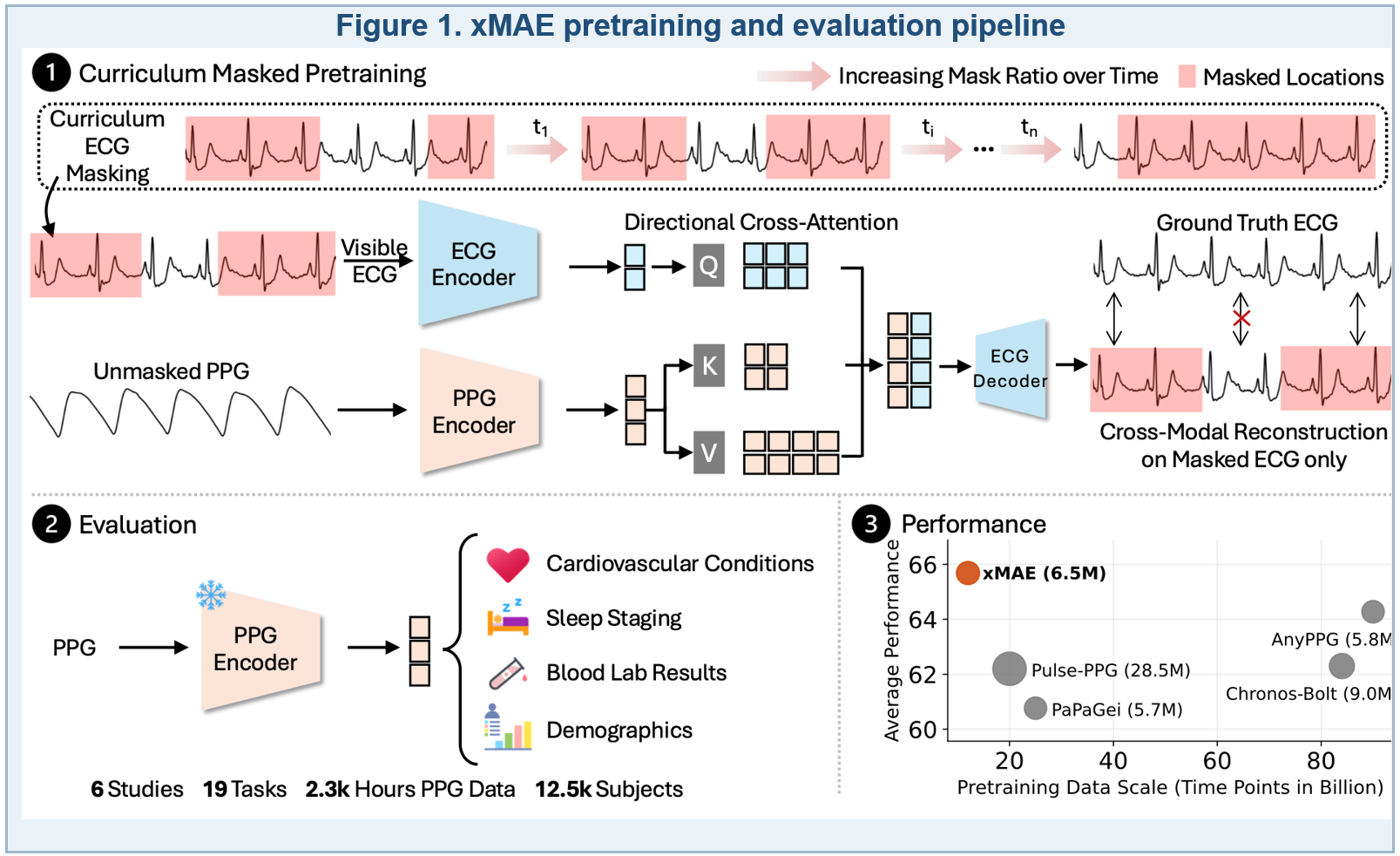
Figure 1. Overview of xMAE. (1) Pretraining: the model learns physiological structure by progressively reconstructing continuously masked ECG segments from synchronized PPG via directional cross-attention, encouraging the PPG encoder to capture underlying cardiac dynamics. (2) Evaluation: the PPG encoder is transferred to downstream tasks spanning cardiovascular conditions, sleep staging, blood lab results, and demographics across 6 studies (19 tasks; 2.3k hours of PPG; 12.5k subjects). (3) Performance: Despite a smaller pretraining data scale, xMAE achieves higher averaged classification performance compared to prior open-source foundation models.
3. Results
We pretrained xMAE using approximately 3.4 million synchronized 10-second ECG and PPG recordings. This corresponds to about 9.4k hours of paired physiological data from approximately 2.4k subjects. We then evaluated the learned PPG representations across six studies, covering 19 downstream tasks, 2.3k hours of PPG, and 12.5k subjects.
Across classification tasks, xMAE improved over strong unimodal and multimodal baselines on a broad set of outcomes. These tasks included hypertension prediction in both laboratory and free-living settings, premature ventricular contraction detection, ectopic beat detection, abnormal laboratory test prediction, and sleep stage classification. The improvements suggest that xMAE captures cardiovascular structure that generalizes beyond a single task or dataset.
Regression results show a similar pattern. xMAE reduced error on most continuous-valued outcomes, including systolic and diastolic blood pressure estimation and age prediction. These results are particularly important because regression tasks are sensitive to subtle physiological variation and real-world variability. Strong performance in both lab and free-living settings suggests that the learned representations are not limited to controlled data collection conditions.
We also compared xMAE with open-weight physiological and time-series foundation models. Although these models vary in architecture, size, and pretraining scale, xMAE remained competitive or superior across multiple tasks while using fewer parameters and less pretraining data than several alternatives. This supports a key takeaway: in wearable health AI, the pretraining objective and physiological inductive bias can be as important as model scale.
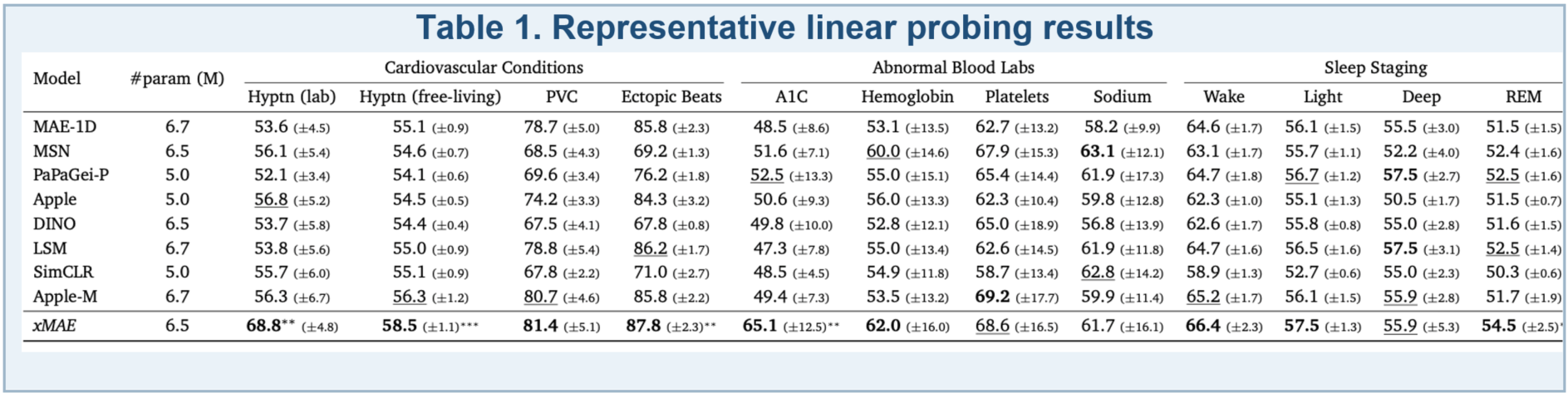
Table 1. Linear probing classification performance comparison. The numeric values represent AUROC (±std). The best performance is bold, the second-best model is underscored. We conducted a t-test comparing xMAE with the second-best model. ∗ denotes p<0.05, ∗∗ denotes p<0.01 and ∗∗∗ denotes p<0.001.
Beyond downstream performance, xMAE provides evidence of physiological grounding. We examined heart rate variability features computed from reconstructed ECG. Across metrics such as MedianNN, RMSSD, pNN20, and pNN50, xMAE-reconstructed ECG produced lower errors than PPG-based feature calculation alone. These metrics are widely used in sleep, stress, and cardiovascular analysis, so improved recovery of beat-to-beat temporal structure suggests that xMAE learns physiologically meaningful information in its PPG representation space.
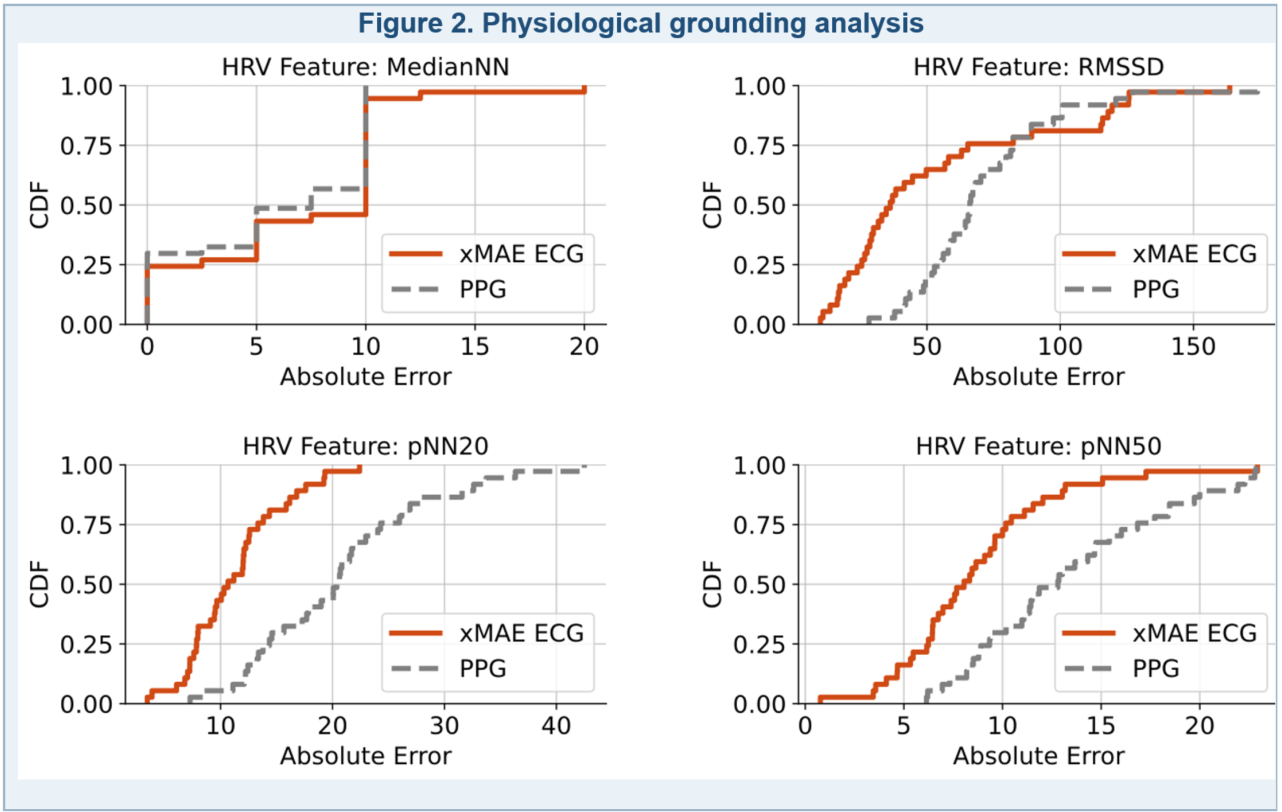
Figure 2. Evaluating ECG reconstruction quality via HRV features. CDFs of absolute error for HRV metrics computed from xMAE-reconstructed ECG and from PPG signals. Across all features, xMAE exhibits consistently lower error compared to PPG-based HRV feature calculation with NeuroKit2, a state-of-the-art Python toolbox for neurophysiological signal processing. Overall, the beat-to-beat timing and temporal structure of ECG–PPG is preserved in xMAE.
4. Conclusion
xMAE demonstrates that wearable health AI can benefit from respecting the physiological structure. By using ECG as a training-time scaffold, the model learns PPG representations that better capture cardiovascular timing and transfer across diverse health tasks. This points to a broader direction for biosignal foundation models: future models should combine scale with physiological knowledge, so that wearable representations become more data-efficient, interpretable, and robust in real-world health settings.
References
[1] Zhou, H., Lee, S. A., Tanade, C., Chun, K. S., Lee, J., Gwak, M., Thukral, M., Sung, J., Hwang, E., Bin Morshed, M., Zhu, L., Nathan, V., Rahman, M. M., Venkatraman, S., and Desai, S. A. Physiology-Aware Masked Cross-Modal Reconstruction for Biosignal Representation Learning. ICML, 2026.
[2] Mukkamala, R., Hahn, J. O., Inan, O. T., Mestha, L. K., Kim, C. S., Töreyin, H., & Kyal, S. (2015). Toward ubiquitous blood pressure monitoring via pulse transit time: theory and practice. IEEE transactions on biomedical engineering, 62(8), 1879-1901.