AI
From Automation to Autonomy: How AI Agents Are Reshaping 6G Network Management
Introduction: Why Automation Alone Is Not Enough
Mobile networks have always required careful management. The traditional FCAPS framework — Fault, Configuration, Accounting, Performance, and Security management — defines the core operational domains that keep a network running. Over the past generations, automation has helped reduce manual effort in each of these areas. In 5G, two notable developments marked progress toward more intelligent network operations.
In 3GPP, the working group responsible for network management — SA5 — standardized Management Data Analytics (MDA) [1], giving the management system a built-in way to turn raw operational data into actionable insight. In O-RAN, the RAN Intelligent Controller (RIC) and its AI/ML-based applications (xApps and rApps) brought intelligence into RAN management, enabling near-real-time and non-real-time optimization of radio resources.
However, today’s approach to network automation has fundamental limitations. Current management systems rely on predefined procedures and static integration logic. When a management service is updated, a new network function is introduced, or equipment from a different vendor is added, manual reconfiguration or custom development is often unavoidable. Each change in the environment brings its own integration effort. The difficulty grows where management spans different domains (such as the radio access networks, the core, and transport), different generations of technology (4G, 5G, and eventually 6G), and equipment from different vendors. Fragmented management interfaces along these boundaries have made true end-to-end (E2E) automation difficult to achieve in practice.
As the industry moves toward 6G, this complexity will only grow. More diverse services, denser deployments, and the continued coexistence of multiple radio access technologies (multi-RAT) —4G (LTE), 5G (NR) and 6G — will demand a fundamentally different approach. The network of the future needs to go beyond rule-based automation toward autonomous decision-making.
This is where AI agents enter the picture. Rather than executing predefined scripts or relying on fixed integration paths, AI-powered agents can reason about operational goals, discover available management capabilities, and autonomously decide how to fulfill tasks. This shift — from automation to autonomy — is becoming a central topic in 6G standardization, and it raises both promising opportunities and important challenges.
What Is Agentic Network Management?
The term "agentic" in the context of network management refers to the ability of AI-powered entities to autonomously perform tasks on behalf of operators, systems, or applications — with minimal or no human guidance. Unlike traditional automation, which follows predefined workflows, an agentic system can interpret high-level intents, plan multi-step actions, decide which management capabilities to use, and adapt its behavior based on feedback.
To understand the distinction, consider how a network fault is handled today. When an alarm is triggered, a human operator or a predefined script follows a fixed sequence: check the alarm, identify the affected component, consult performance data, and apply a known remedy. If the situation deviates from what the script expects, the process breaks down and requires human intervention.
In an agentic approach, an agent receives a high-level intent — such as "restore service quality in this area" — and autonomously determines which management services to consult, which diagnostic steps to take, and what corrective action to apply. If the initial action does not resolve the issue, the agent can reason about the outcome and try an alternative approach. The agent continuously learns from feedback and adapts its behavior for future scenarios.
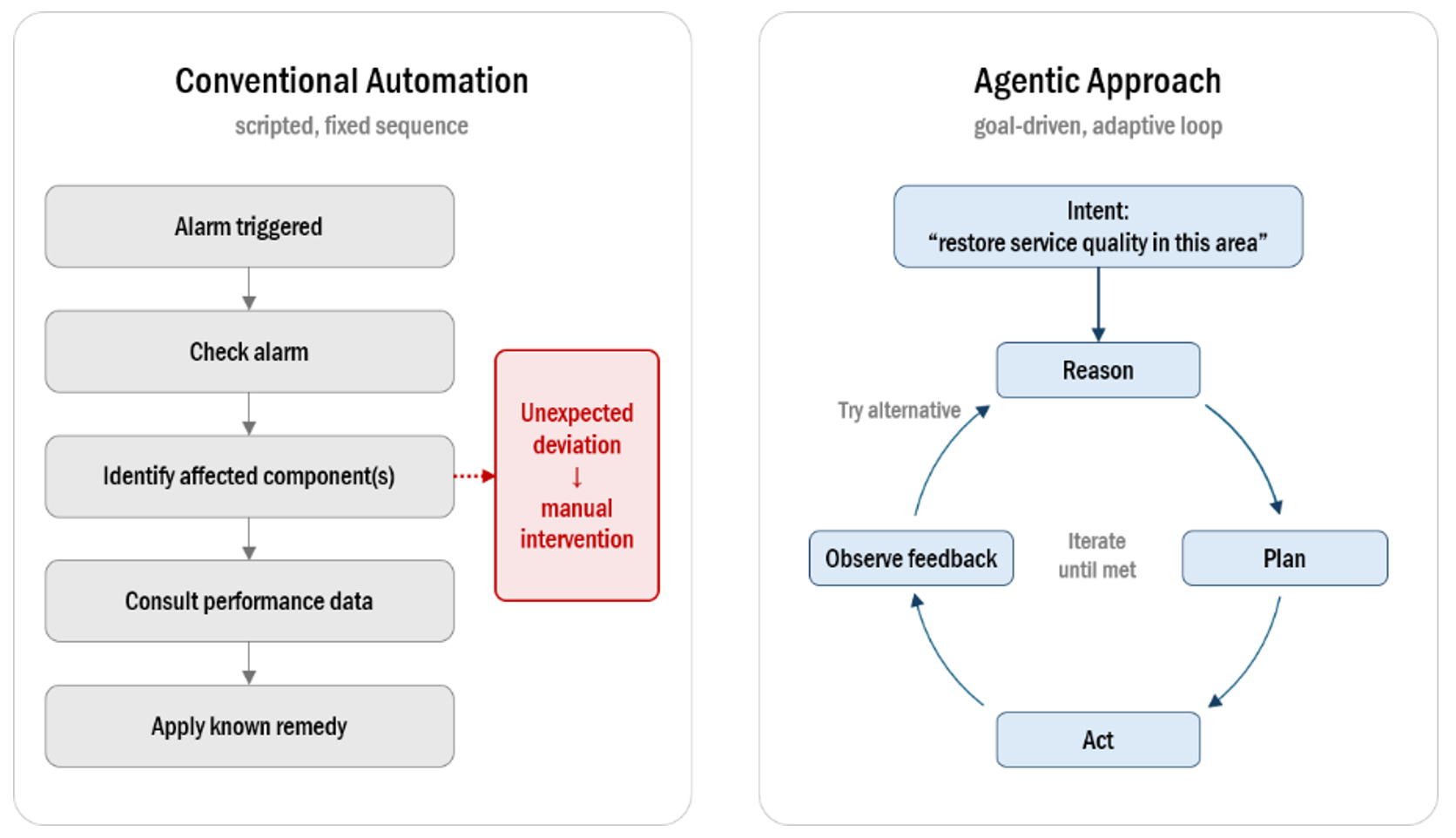
Figure 1. Comparison between traditional automation (fixed rule chains) and agentic automation (intent-driven reasoning loop with adaptive execution)
This capability can be understood through four characteristics that distinguish agentic operation from conventional automation:
These four characteristics correspond to the fundamental loop of autonomous operation: understanding what is needed, discovering what is available, deciding what to do, and adapting based on what happens. The value of this approach grows across network operations wherever tasks involve cross-domain coordination or rapidly changing conditions.
The Technology Stack Behind Agentic Network Management
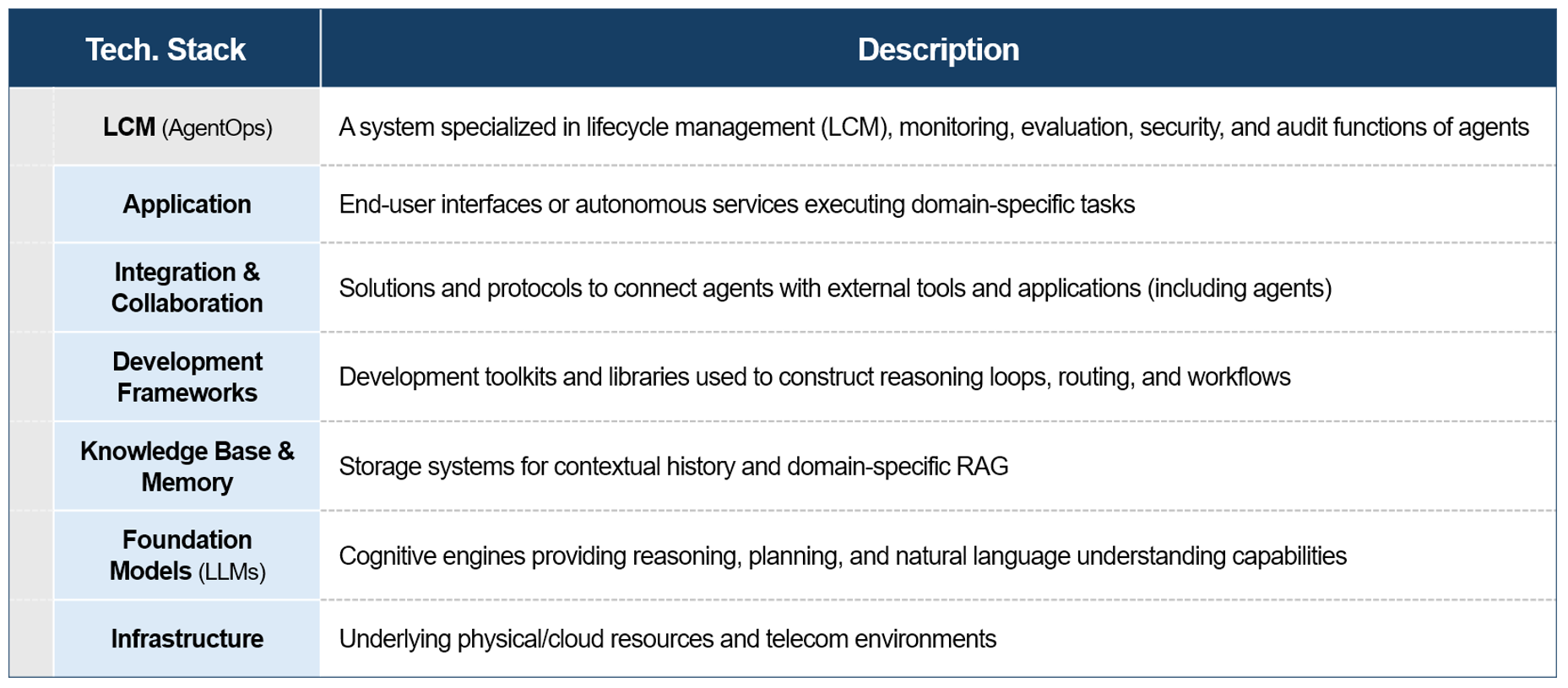
Building an agentic management system requires a layered technology stack (Table 1). At the foundation, large language models (LLMs) and other foundation models — such as multimodal models or specialized reasoning models — provide the cognitive capabilities that underpin agent behavior, including natural language understanding, reasoning, and planning. On top of this, development frameworks — such as LangGraph, LlamaIndex, or proprietary agent builders — are used to construct reasoning loops, routing logic, and workflows that govern how agents operate.
One layer in this stack — the Integration and Collaboration layer — deserves particular attention because it directly affects how agents interact with the network and with each other. Two protocols are emerging as the key enablers here: the Model Context Protocol (MCP) [2], which governs how an agent reaches the tools and resources it needs, and the Agent-to-Agent (A2A) protocol [3], which governs how agents communicate and collaborate with one another.
Table 1. Technology stack for agentic network management
MCP and A2A: Enabling Agent Integration and Collaboration
For an agent to be useful in network management, it must be able to access and operate the management services exposed by the network [4]. In a multi-vendor, multi-generation environment, those services often expose different interfaces, data schemas, and degrees of standardization, which makes them hard for an agent to access in a uniform way.
MCP, originally introduced by Anthropic as an open protocol for connecting AI applications with external tools and data sources, gives agents a standardized way to discover the available management services (exposed as tools), understand their capabilities through structured schemas, and invoke them through a consistent interface. In effect, MCP can act as a bridge between an agent and the diverse management services offered across different vendors and network generations.
The key advantage is that the agent does not need to be pre-programmed with knowledge of every interface it might encounter. Instead, it can dynamically browse the available management services, understand each one through its semantic annotations and structural schemas, and select the most appropriate one for the task at hand. This also brings forward compatibility: when a management service is updated or replaced, the agent adapts on its own, because it relies on capability discovery rather than on fixed interface definitions.
As networks grow more complex, a single agent is unlikely to manage everything effectively. Different domains — RAN, core, and transport — each require specialized knowledge, and the most challenging operational scenarios often involve cross-domain coordination. This is where A2A communication becomes particularly useful.
A2A enables multiple agents to collaborate on a complex task, each handling the part it knows best. A service management agent, for instance, may need to coordinate with a RAN management agent and a core network management agent to assure end-to-end service quality. The service management agent decomposes the overall requirement into domain-specific tasks, delegates them to the appropriate agents, and coordinates their execution.
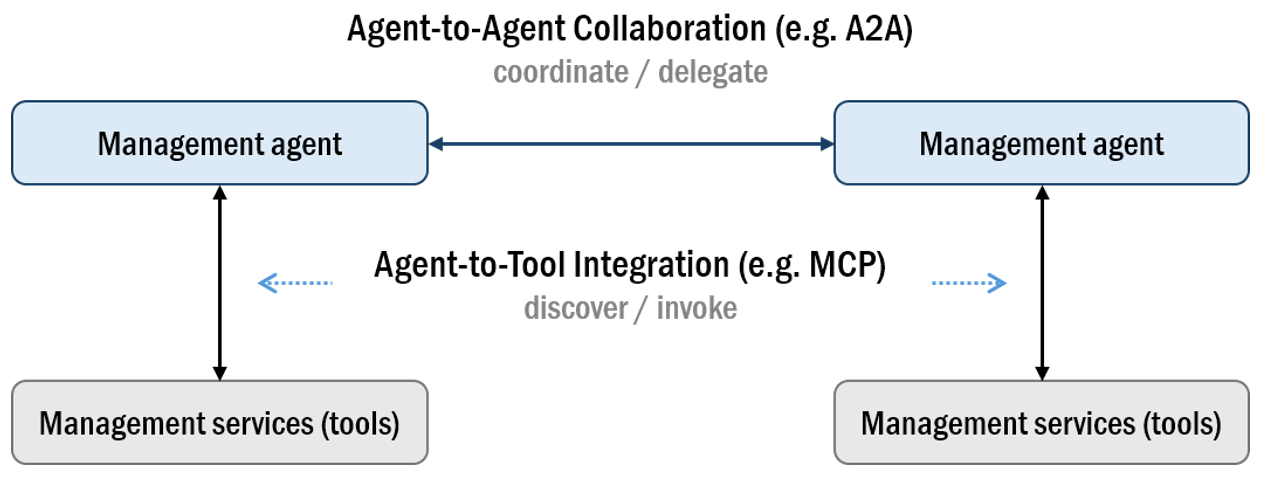
Figure 2. MCP and A2A interaction patterns in agentic network management
Both MCP and A2A are actively being discussed in 3GPP SA5 and O-RAN as candidate protocols for a standardized integration and collaboration framework. Supporting both protocols may provide architectural flexibility, as each addresses a different communication pattern: MCP for agent-to-tool integration and A2A for peer-to-peer agent collaboration.
Deployment Options: Centralized, Domain-Specific, or Distributed?
One of the key architectural questions for agentic network management is how agents should be deployed. Three broad options can be considered, each with distinct trade-offs (Figure 3).
Centralized Super Agents deploy a small number of powerful agents with a holistic view of the network. This simplifies management and enables global optimization, but it concentrates processing load in one place, may run into context-window limitations, and requires massive tool integration and schema mapping. Central processing can also introduce delay that may be unacceptable for time-critical operations.
Domain-Specific Agents assign specialized agents to individual domains — for example, a RAN management agent and a core network management agent. This leverages domain expertise and spreads the processing load, at the cost of moderate management complexity: tasks that span domains now require coordination between agents.
Distributed Agents deploy agents whose management scope is a single network function — for example, an individual CU, DU, or UPF. This enables low-latency processing and suits localized optimization. The trade-off is a high overall resource footprint, a heavier management burden from fragmentation, and the need for extensive orchestration and coordination among a large number of agents.
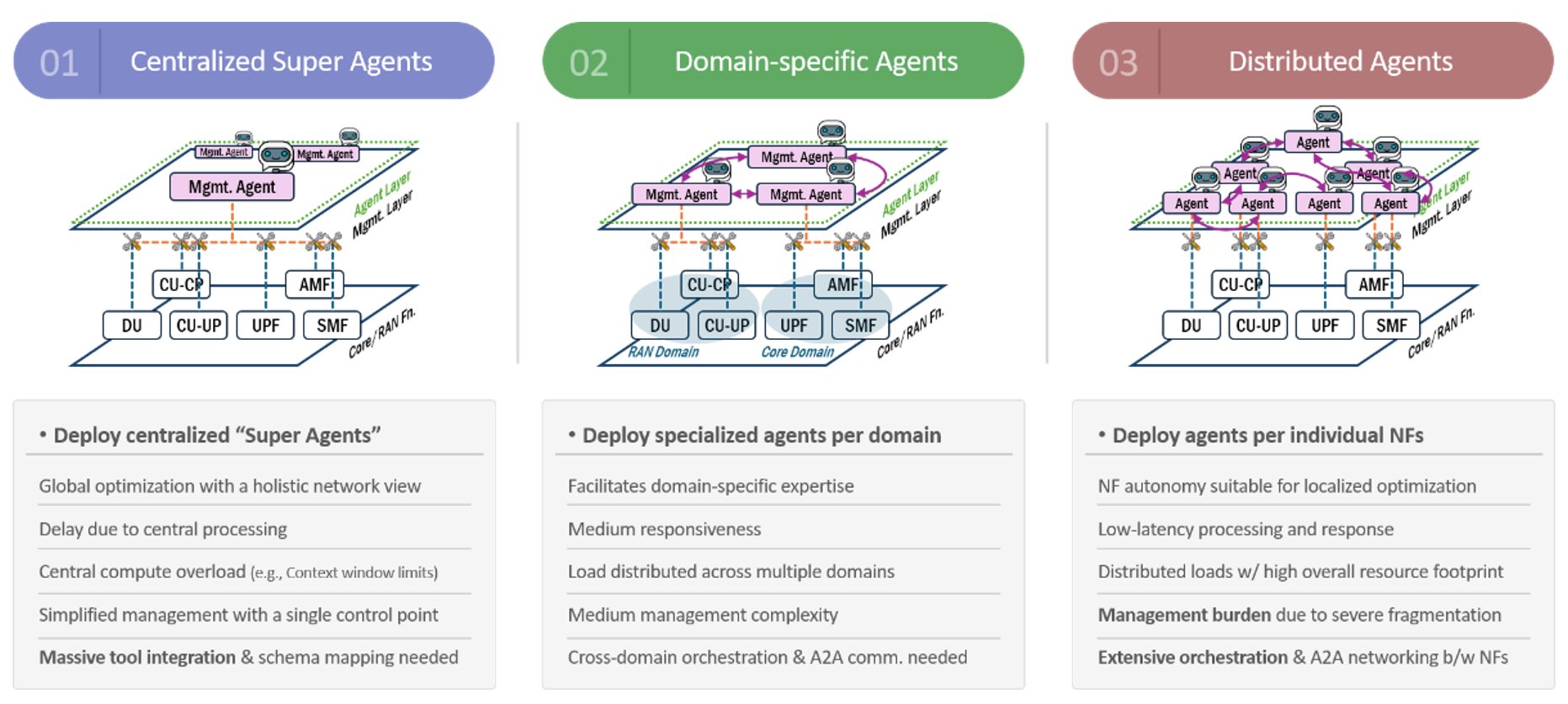
Figure 3. Deployment options for agentic network management
Each option presents different challenges in terms of autonomy, complexity, and interoperability. In practice, a hybrid approach is likely, where some functions are handled by centralized agents while others are delegated to domain-specific or distributed agents depending on the operational requirements.
Potential Use Cases for Agentic Network Management
The agentic approach can be applied to various network management scenarios. Below are representative use cases that illustrate the value of agent-based automation.
The common thread is the shift from predefined, static logic to dynamic, adaptive decision-making carried out by autonomous agents.
Governance and Oversight: Keeping Autonomous Agents Accountable
The deployment models above all rest on one premise — that agents can be trusted to act on their own. That trust has to be earned. As agents take on more responsibility, the potential for unintended consequences grows. An agent acting on incorrect reasoning, drifting from its expected behavior, or reaching beyond its intended scope could disrupt the network, degrade service, or violate operator policy.
This is a widely shared concern. For operators to rely on them, agentic systems need to be explainable, accurate, reliable, secure, and auditable. Three capabilities are particularly important for governing how agents operate — each addressing a different aspect.
Together, these capabilities reframe the operator's role rather than remove it. Routine execution moves to the agents; the human shifts to setting goals, drawing boundaries, and reviewing the exceptions that get escalated — keeping autonomous operation accountable.
Standardization Landscape and the Path Forward
The development of agentic network management is progressing through two complementary tracks: formal standardization, where standards bodies define interoperable interfaces and architectures, and industry collaboration, which provides reference implementations and accelerates adoption.
In 3GPP, SA5 began a study on 6G management and orchestration at the end of 2025 [5]. The early discussions have centered on basic principles, terminology, and the scope of the 6G management architecture. Among the management features under study are autonomous agents, intent-driven management, AI/ML management, semantic and knowledge-based management, data management, energy efficiency, and Network Digital Twins [6] — with the study explicitly tasked to coordinate with other SDOs and forums to keep the resulting standards lean.
In O-RAN, work is underway to refresh its AI/ML technical report — which dates back to 2021 — and align it with more recent developments, such as generative and agentic AI and emerging protocols like MCP. This includes early work on a management framework that would let AI agents reach management capabilities across different network generations and domains.
No single organization owns this space. The 6G management architecture is being designed to reuse and integrate work from across the wider ecosystem — including bodies such as ETSI, TM Forum, and the IETF — rather than in isolation. The closest example is the relationship between 3GPP and O-RAN: the two are studying overlapping topics. At a dedicated 6G Management and Automation workshop organized by industry stakeholders in April 2026, participants converged on treating 3GPP SA5 and O-RAN as complementary standards, agreeing to reuse 5G foundations and avoid duplications [7]. Without early alignment there is a real risk of duplication and fragmentation, and a practical way forward — mapping, reusing, and adapting specifications between organizations — has been discussed as a basis for coherent implementations.
Beyond formal standards bodies, open-source projects and industry forums are also contributing to the ecosystem. The Linux Foundation Networking (LFN) ecosystem plays a significant role in bridging standardization and implementation. A recent LFN white paper, "Architecting Autonomy: Why Agentic AI and Open Networking Belong Together," [8] articulated the vision that agentic AI connects two transformations — "AI for Networks" (using AI to optimize and automate networks) and "Networks for AI" (evolving networks to support AI workloads).
Several LFN projects are relevant to agentic network management: ONAP offers a production-grade automation platform with intent-driven closed-loop capabilities; Nephio serves as the execution layer for intent-driven deployment; and CAMARA exposes network capabilities through standardized telco APIs. Essedum brings LLM-based agents into networking with governed autonomy and standardized data access. In the wider Linux Foundation — beyond LFN — the Agentic AI Interoperability project (AAIF) provides a neutral home for agent-interoperability standards centered on MCP.
Conclusion
Agentic network automation represents a paradigm shift in how mobile networks are managed. Moving from rule-based automation to autonomous, intent-driven agents can address the limitations that today's management systems have struggled with — fragmented interfaces across domains, generations, and vendors, the recurring integration effort each change demands, and the difficulty of achieving true end-to-end automation.
The building blocks are taking shape. MCP gives agents a standardized way to discover and use management services. A2A lets specialized agents collaborate. And a governance layer — lifecycle management, supervision against behavioral bounds, and performance monitoring of the agents themselves — provides the guardrails that make autonomous operation trustworthy rather than reckless.
Significant challenges remain. Standardization is still at an early stage, and open questions will need sustained collaboration: whether to adopt MCP and A2A as they are or define telecom-specific extensions, how to reconcile the fast pace of AI innovation with the stability that telecom standards demand, and how to guarantee interoperability at the level of agents themselves.
The path forward depends on close coordination — between standards bodies such as 3GPP and O-RAN, and with the wider AI and open-source communities. If that coordination holds, 6G can deliver on a real promise: not just automating what operators already do, but letting networks reason, adapt, and operate with a degree of intelligence that was not within reach before.
References
[1] 3GPP TS 28.104, Management and orchestration; Management Data Analytics (MDA).
[2] Model Context Protocol (MCP). https://modelcontextprotocol.io
[3] Agent-to-Agent (A2A) protocol. https://a2a-protocol.org
[4] 3GPP TS 28.533, Management and orchestration; Architecture framework.
[5] 3GPP SP-251653, New SID: Study on 6G Management and Orchestration (FS_6G_OAM), TSG SA #110, December 2025.
[6] 3GPP TR 32.801-01, Study on 6G Management and Orchestration (Release 20).
[7] 3GPP & O-RAN, 6G Management & Automation Workshop — Summary, Paris, 20–21 April 2026.
[8] Linux Foundation Networking (LFN), White Paper: Architecting Autonomy: Why Agentic AI and Open Networking Belong Together.