AI
LittleBit-2: Maximizing the Spectral Energy Gain in Sub-1-Bit LLMs via Latent Geometry Alignment
1. Introduction
Large Language Models (LLMs) continue to deliver remarkable capabilities, but their memory footprint remains a rigid barrier to deployment. A 70B model requires roughly 140 GB of VRAM in FP16, and even a fully 1-bit version still demands around 15 GB — too large for many edge and consumer-grade devices. This is why the sub-1-bit regime (less than one bit per parameter on average) has become the next frontier of extreme model compression.
In our previous post, we introduced LittleBit [1], a NeurIPS 2025 method that made sub-1-bit compression practical through a Low-Rank Binary architecture, compressing models down to 0.1 bits per parameter (bpp). However, one question remained open: despite its theoretical potential, LittleBit still trailed the best 1-bit baseline, OneBit [2], at the 1-bit operating point (e.g., 9.08 vs. 8.36 perplexity on Llama-2 7B). Why does an architecture with a provable information-theoretic advantage fail to realize it in practice?
This post introduces LittleBit-2, presented at ICML 2026, which answers that question. We identify the culprit as Latent Geometry Misalignment: the singular vectors used to initialize LittleBit have a “spiky”, highly coherent geometry that is the worst case for binary quantization. LittleBit-2 fixes this with Internal Latent Rotation and Joint Iterative Quantization (Joint-ITQ), a geometric preconditioner that aligns latent factors with the binary hypercube — with zero inference overhead. The result is a new state-of-the-art across the entire sub-1-bit regime (1∼0.1 bpp) on Llama-2 and Llama-3, matching or surpassing leading 1-bit baselines.
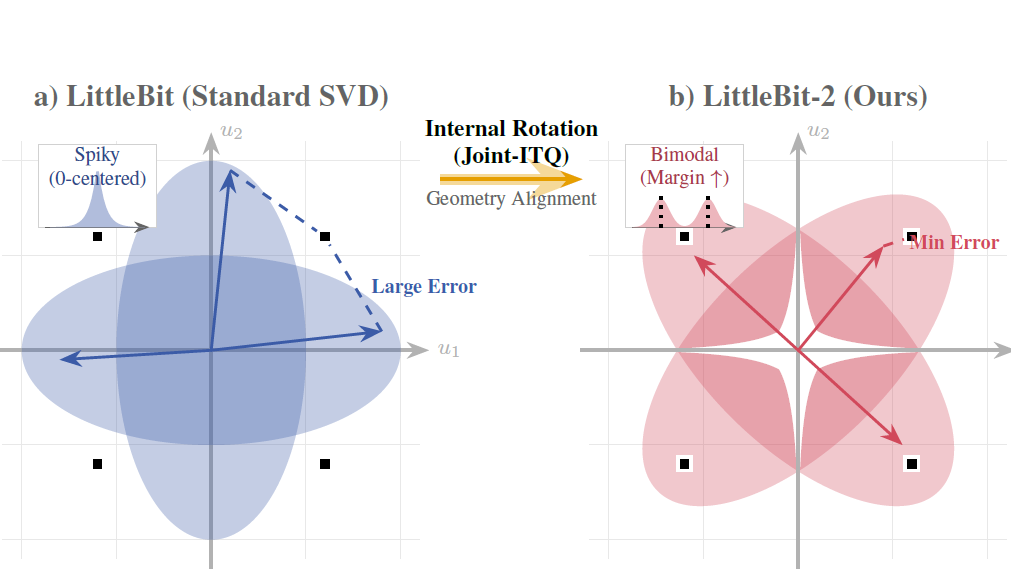
Figure 1. Latent Geometry Alignment. (a) Standard singular vectors cluster along the coordinate axes (spiky), a geometric mismatch with the binary quantization targets. (b) LittleBit-2 applies Internal Latent Rotation via Joint-ITQ, aligning the latent factors with the binary hypercube diagonals and producing a quantization-friendly bimodal distribution.
2. Background: Why Does LittleBit Leave Performance on the Table?
2.1. A Quick Recap of the LittleBit Architecture
LittleBit sidesteps the 1-bit-per-parameter floor of conventional quantization by factorizing the weight matrix W into low-rank binary latent factors. The effective weight is reconstructed with a symmetric Scale-Binary-Scale-Binary-Scale structure,
$ \hat W = diag(h) · Uᵇ · diag(l) · Vᵇᵀ · diag(g),$
where Uᵇ and Vᵇ are binary (±1) factors of rank r, and h, l, g are FP16 row, latent, and column scales. Because the parameter count is decoupled from the matrix dimensions, fractional bit-rates below 1 bpp become possible simply by controlling the rank. Training relies on Quantization-Aware Training (QAT) with knowledge distillation, initialized by Dual-SVID: the binary factors start from the signs of truncated SVD factors, and the scales are extracted by a Rank-1 approximation of their magnitudes.
2.2. The Problem: Latent Geometry Misalignment
LittleBit-2 does not propose a new architecture. Instead, it refines the initialization — and this turns out to matter enormously. The latent factors produced by standard SVD inherit the spiky, highly coherent structure of LLM weight distributions: information concentrates in a few dominant outlier coordinates while most values sit near zero. For binary quantization with sign(x), this is the worst-case geometry. Values near zero flip signs under tiny perturbations, and outliers force the shared floating-point scales to overestimate the dynamic range for everyone else.
Analyzing Llama-2 7B (15th layer, q_proj), we found that standard singular vectors exhibit a highly skewed distribution (kurtosis ≈ 16.8) with a maximum local distortion of λₘₐₓ ≈ 0.88 — empirically close to the theoretical worst case (λ ≈ 1.0), where binary quantization fails completely. Aggregated over all 225 linear layers of Llama-3 8B, 0% of layers satisfy λₘₐₓ < 0.4 under standard SVD initialization, confirming that this misalignment is systematic rather than an isolated artifact.
3. Methodology: How LittleBit-2 Works
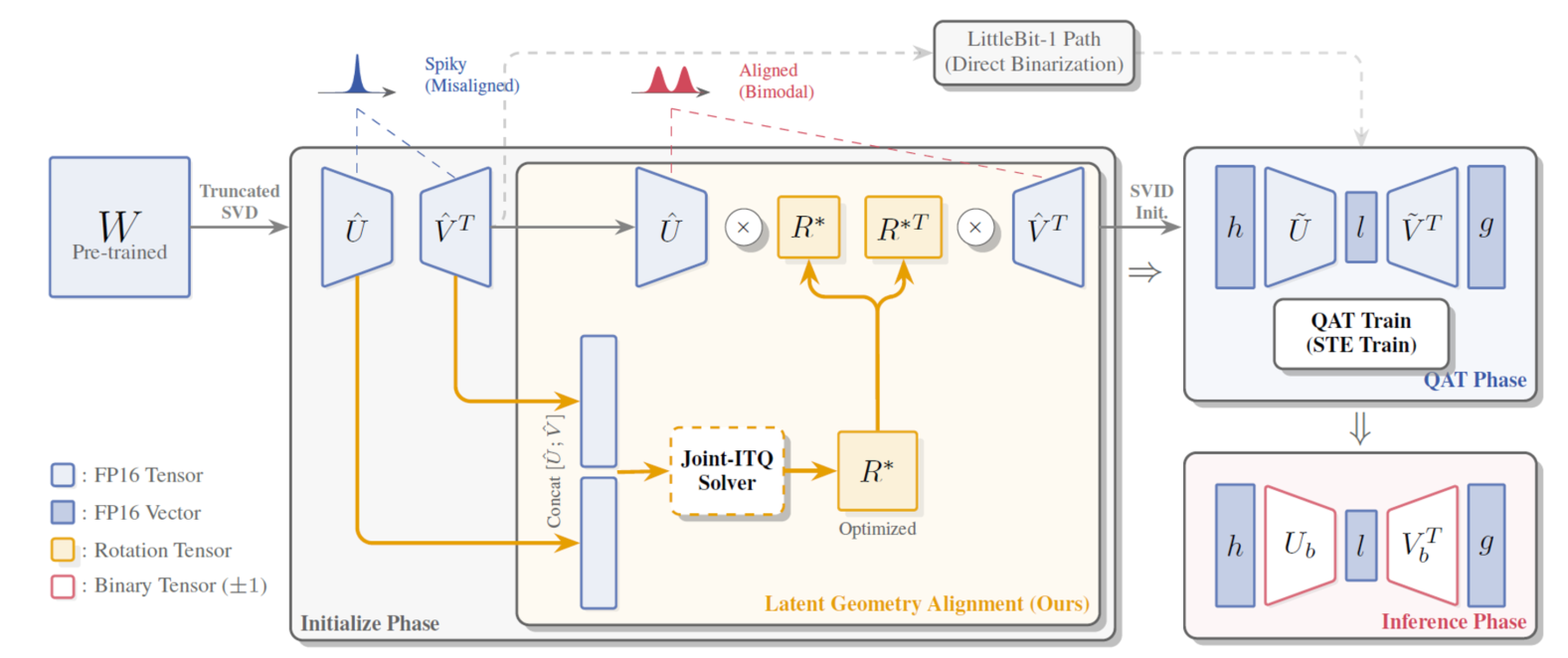
Figure 2. The LittleBit-2 framework pipeline. Starting from a truncated SVD of the pre-trained weight, the latent factors are concatenated and fed into the Joint-ITQ solver to optimize an orthogonal rotation R. The rotation transforms the spiky latent distribution into an aligned bimodal one; Dual-SVID and QAT then extract the FP16 scales and learn the binary factors.
3.1. Why Low-Rank Binary? The Spectral Break-Even Condition
Before fixing the geometry, LittleBit-2 first establishes when the Low-Rank Binary strategy should win at all. Under a fixed bit budget, there are two competing strategies: Strategy A (Tiny-Rank FP16), which keeps a minimal rank in full precision, and Strategy B (Low-Rank Binary), which expands the rank by roughly 16× at the cost of 1-bit quantization noise. Modeling the singular values with a power-law decay σₖ ∝ k⁻ᵞ, we derive the Spectral Break-Even Condition: Strategy B is superior whenever the tail energy recovered by rank expansion outweighs the quantization cost — which happens precisely for heavy-tailed spectra (small γ).
This is great news for LLMs. Empirically, the spectral decay rates of Llama-2 7B concentrate in γ ∈ [0.19, 0.47] (median 0.27), and 73% of its linear layers fall below the measured break-even point γ* ≈ 0.36. In other words, the heavy-tailed structure of modern LLM weights intrinsically favors the Low-Rank Binary architecture. The only controllable variable left in the condition is the distortion coefficient Λ — the fraction of signal energy destroyed by binarization. Minimizing Λ widens the margin and extends the break-even point to lighter-tailed layers. This is exactly what LittleBit-2 sets out to do.
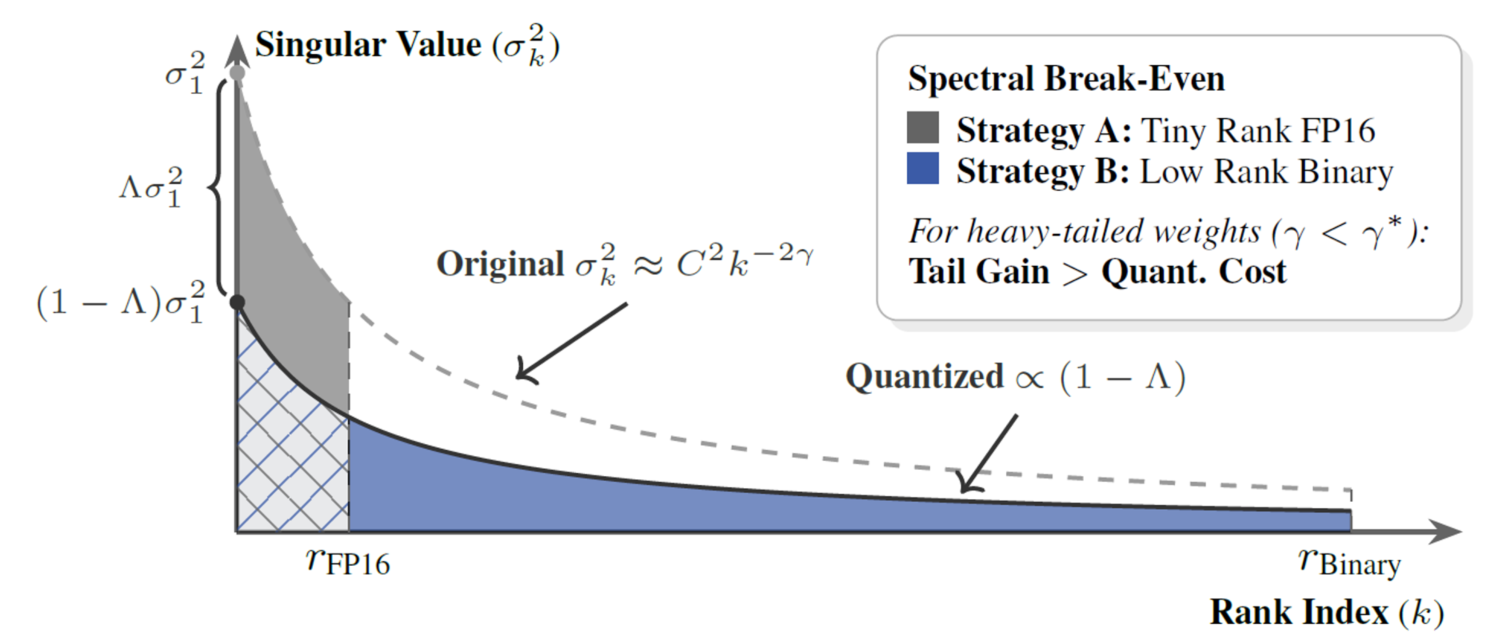
Figure 3. Conceptual illustration of the spectral gain. For heavy-tailed weights (γ < γ*), the tail energy recovered by rank expansion (Strategy B) outweighs the quantization cost, while Tiny-Rank FP16 (Strategy A) discards significant information in the tail.
3.2. Geometry Determines Distortion
How is Λ actually determined? For a latent row vector u approximated by a scaled binary vector, the optimal local distortion has a strikingly simple closed form:
$ λ(u) = 1 − (1/r) · (‖u‖₁ / ‖u‖₂)²$
Minimizing quantization noise is therefore equivalent to maximizing the vector's denseness (the L1/L2 ratio). A sparse, axis-aligned vector like u ≈ [1, 0, …, 0] pushes λ toward its maximum of 1.0; a dense vector whose energy is spread evenly across dimensions drives λ toward zero. Standard SVD unfortunately produces exactly the former — which is why LittleBit-2 intervenes on the geometry.
3.3. Step 1 — Internal Latent Rotation (Coarse Alignment)
The key insight is that the factorization is rotationally invariant: for any orthogonal matrix R,
$ W ≈ \hat U \hat Vᵀ = \hat U(RRᵀ)\hat Vᵀ = (\hat UR)(\hat VR)ᵀ,$
so we can freely rotate the latent factors without changing the reconstructed weight in floating point — while fundamentally reshaping their coordinate distribution. Applying a random orthogonal rotation already helps a lot: by the concentration of measure, the rotated coordinates become Gaussian-like, and the expected distortion drops to the Gaussian limit E[λ] = 1 − 2/π ≈ 0.36. On the representative Llama-2 layer above, this reduces the mean distortion to 0.36 and suppresses the maximum from 0.88 to 0.43. Because the rotation is absorbed into the factors before binarization, it adds no inference cost whatsoever — unlike incoherence-processing methods such as QuIP# [12], QuaRot [13], or SpinQuant [14], which require online Hadamard transforms at inference time.
3.4. Step 2 — Joint-ITQ (Optimal Alignment)
Random rotation enforces isotropy, but a Gaussian is still centered at zero — the most unstable place for a sign function. To go further, LittleBit-2 formulates the alignment as a Joint Orthogonal Procrustes Problem [11]: find the single shared rotation R* that moves the concatenated latent manifold Z = [Û; V̂] as close as possible to the vertices of the binary hypercube:
$ minᵣ,ʙ ‖B − ZR‖ᶠ² s.t. RᵀR = I, B ∈ \{±1\}$
We solve this by alternating minimization — projecting to binary vertices (B = sign(ZR)) and updating the rotation via an SVD of BᵀZ. Optimizing a shared rotation over the concatenated manifold aligns both factors simultaneously while keeping the reconstruction consistent. The optimization provably increases the L1 norm monotonically, guaranteeing λ_ITQ ≤ λ_Rot < λ_SVD.
The effect is visually striking: the unimodal, zero-centered Gaussian is transformed into a bimodal distribution whose two modes sit on the binary vertices ±1. This maximizes the geometric decision margin — latent values are pushed away from the unstable zero-crossing region. On the representative layer, the mean distortion falls to 0.30, surpassing the theoretical Gaussian limit of 0.36. And the whole procedure is a one-time offline step: it converges within 50 iterations in a few seconds per layer (~3 s of overhead on top of the ~4 s SVD baseline).
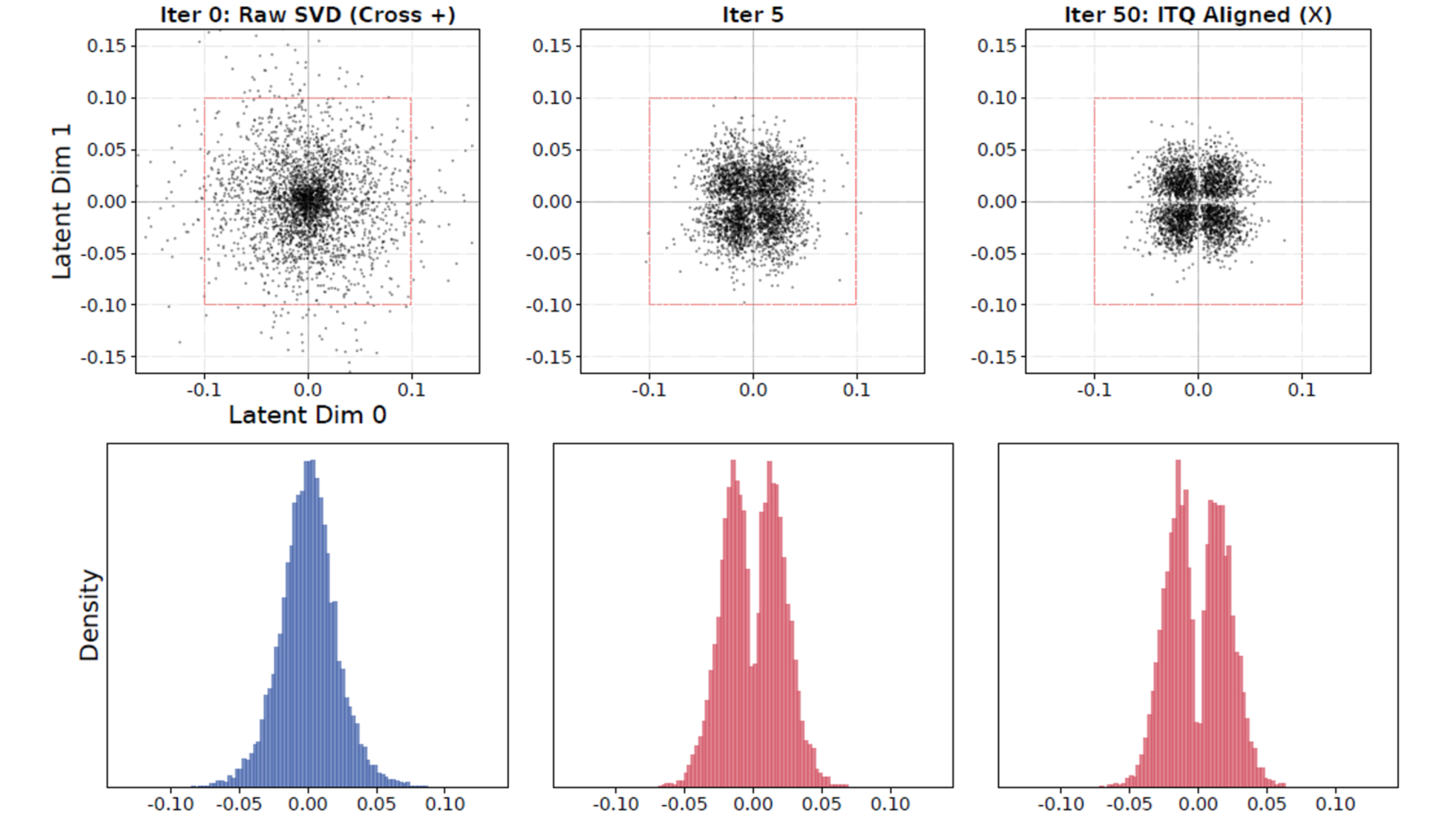
Figure 4. Evolution of latent geometry via Joint-ITQ (Llama-2 7B, 15th layer K projection). Raw SVD factors concentrate probability mass near the zero decision boundary with significant outliers; after 50 iterations, Joint-ITQ yields a bimodal distribution aligned with the binary vertices ±1, maximizing the decision margin.
4. Results: Realizing the Spectral Energy Gain
4.1. Synthetic Validation: Extending the Break-Even Point
We first validated the theory on synthetic 4096×4096 matrices with controlled power-law spectra. The reconstruction error shows a clear phase transition governed by the decay rate γ. Standard LittleBit outperforms Tiny-Rank FP16 only up to γ ≈ 0.36; adding random internal rotation pushes the break-even point to γ ≈ 0.41; and full LittleBit-2 with Joint-ITQ extends it to γ ≈ 0.51. Since 90% of Llama-2 7B layers have γ ∈ [0.19, 0.47], the optimal zone of LittleBit-2 now completely covers the operational regime of modern LLMs.
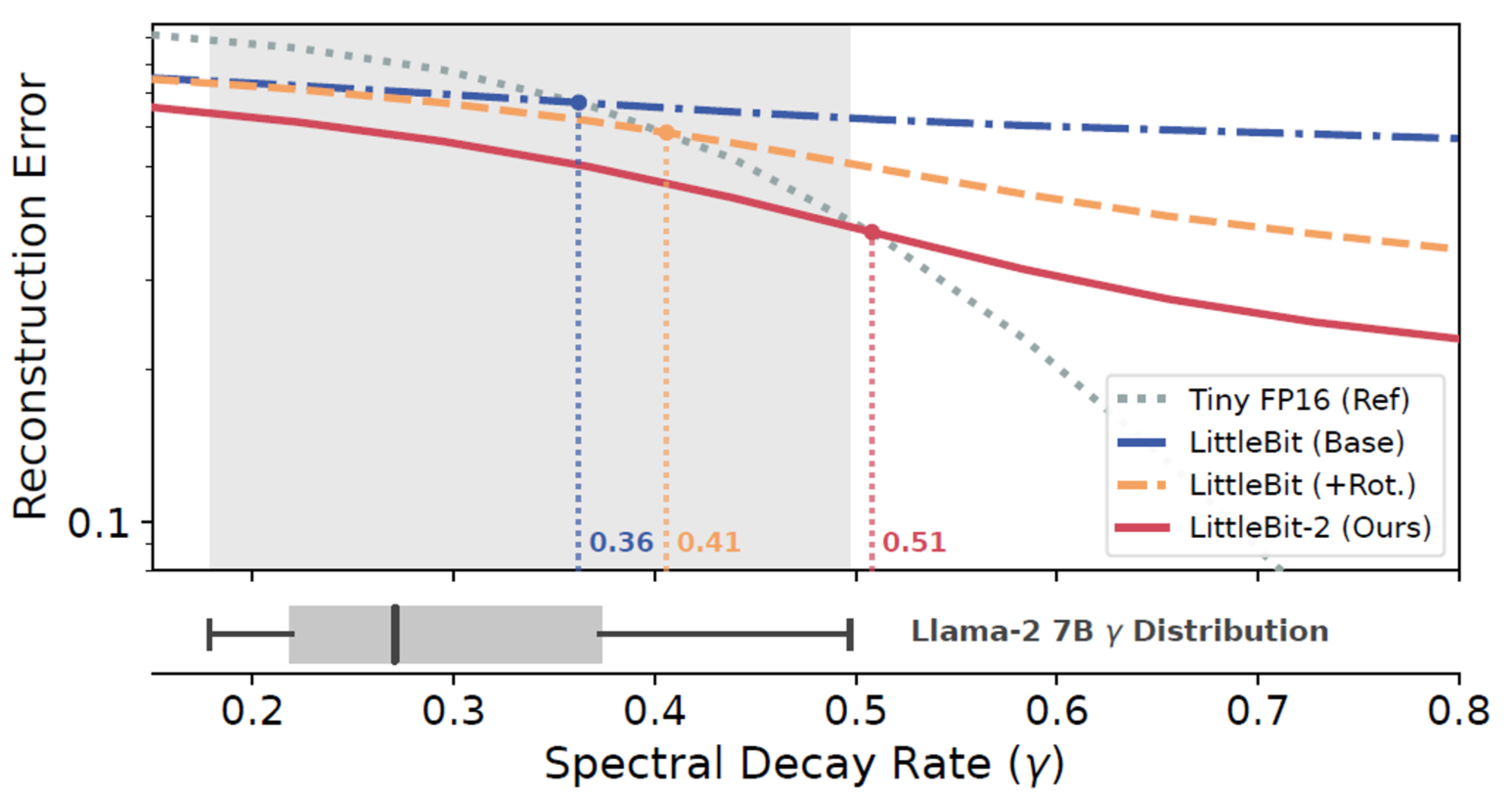
Figure 5. Spectral break-even analysis. (Top) LittleBit-2 progressively extends the range where 1-bit quantization outperforms FP16 truncation (break-even γ: 0.36 → 0.41 → 0.51). (Bottom) The empirical γ distribution of Llama-2 7B weights falls almost entirely within LittleBit-2's optimal reconstruction zone.
4.2. Main Results: State-of-the-Art from 1.0 down to 0.1 bpp
We evaluated LittleBit-2 on Llama-2 7B/13B and Llama-3 8B, measuring WikiText-2 perplexity (PPL) and average zero-shot accuracy over five reasoning benchmarks (HellaSwag, ARC-Easy, ARC-Challenge, PIQA, WinoGrande), against GPTQ [3], EfficientQAT [4], BiLLM [5], ARB-LLM [6], STBLLM [7], OneBit [2], and LittleBit [1] under identical training configurations.
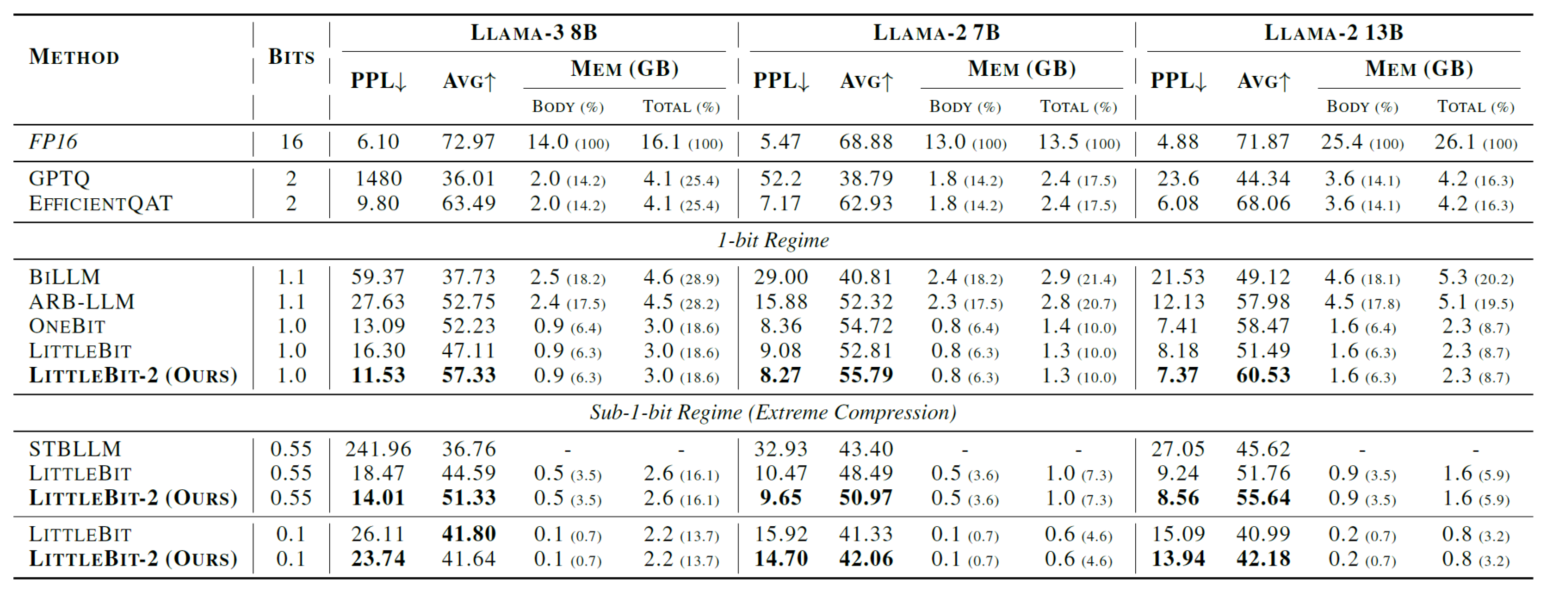
Table 1. Main results on Llama-2 and Llama-3. Perplexity on WikiText-2, average accuracy across five zero-shot tasks, and memory footprints (Body / Total, GB) across the 1-bit and sub-1-bit regimes.
Key highlights:
The gains also generalize beyond Llama. On Gemma-3 27B at 0.1 bpp, where the Tiny-Rank FP16 approximation collapses entirely (PPL > 35), LittleBit-2 maintains functional capability (PPL 16.38, 47.06% average accuracy), and on Qwen3 4B/8B at 1.0 bpp it consistently outperforms the baseline (e.g., 11.73 vs. 13.60 PPL on Qwen3 8B).
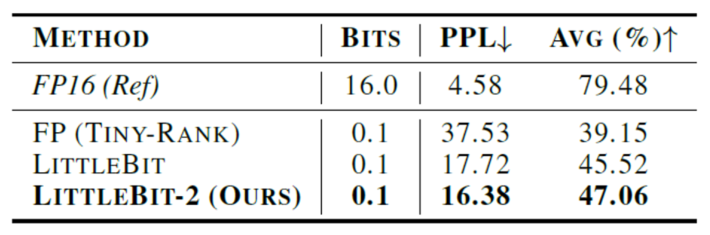
Table 2. Results on Gemma-3 27B in the extreme 0.1 bpp regime. LittleBit-2 remains functional where the Tiny-Rank FP16 approximation collapses.
4.3. Ablation: Where Does the Gain Come From?
A component-wise ablation on Llama-3 8B cleanly dissects the improvements. First, the collapse of Tiny-Rank FP16 at 0.1 bpp (PPL 59.44) versus the stability of the LittleBit base (26.11) empirically validates the Spectral Break-Even Condition: rank expansion beats precision in the heavy-tailed regime. Second, alignment improves progressively — random rotation brings 1.0-bpp PPL from 16.30 down to 12.63 by mitigating outliers, and Joint-ITQ delivers the best result (11.53) by explicitly maximizing the decision margin.
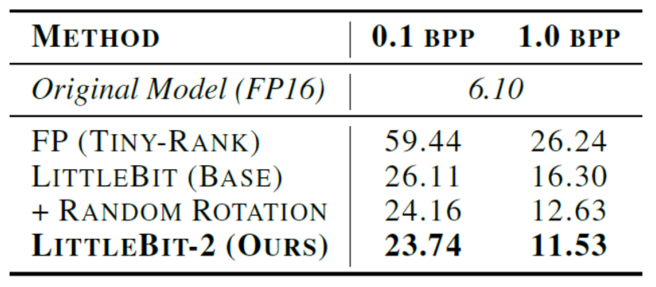
Table 3. Ablation study on Llama-3 8B. Progressive improvement from geometric alignment (Rotation → Joint-ITQ) in both standard (1.0 bpp) and extreme (0.1 bpp) regimes.
5. Discussion: Why Alignment Helps Training, Not Just Initialization
5.1. Training Stability and the Geometric Margin
The benefits of Joint-ITQ extend well beyond a better starting error. Tracking the QAT loss on Llama-2 7B, LittleBit-2 converges fastest and reaches the lowest final loss among all variants. To understand why, we measured the sign-flipping ratio — the percentage of binary parameters changing state per step. The standard LittleBit baseline shows a persistently high flipping rate: many latent parameters are trapped near the decision boundary at zero, oscillating under gradient noise instead of learning. LittleBit-2 reduces this oscillation by roughly 3.8× in the early phase of training. The bimodal separation induced by Joint-ITQ effectively locks the weights against high-frequency gradient noise, stabilizing the optimization landscape from the very first iterations.

Figure 6. Training dynamics on Llama-2 7B. (Left) LittleBit-2 achieves the fastest convergence and lowest final loss. (Right) Joint-ITQ's geometric margin suppresses early-stage sign oscillation by ~3.8× compared to the baseline.
5.2. Inference Efficiency: All Gain, No Cost
Because the rotation is folded into the latent factors during initialization, LittleBit-2 retains the identical inference architecture as LittleBit — and directly inherits its established efficiency: a MatMul-free design that replaces FP16 GEMV with bitwise operations, an 11.6× kernel-level speedup for a Llama-2 70B MLP layer at 0.1 bpp over the cuBLAS FP16 baseline, and a 2.46× end-to-end decoding speedup (82.6 → 203.2 tokens/s) for a 0.1-bpp Llama-2 7B. In short, LittleBit-2 improves quality purely at initialization time, at zero cost to deployment.
6. Conclusion
LittleBit-2 shows that the missing ingredient in sub-1-bit LLM compression was not architecture but geometry. By diagnosing Latent Geometry Misalignment and resolving it with Internal Latent Rotation and Joint-ITQ, LittleBit-2 transforms coherent, quantization-hostile singular vectors into bimodal distributions aligned with the binary hypercube — realizing the Spectral Energy Gain that theory promised. The result is a new state-of-the-art from 1.0 down to 0.1 bpp on Llama-2 and Llama-3, matching leading 1-bit baselines while inheriting LittleBit's MatMul-free inference efficiency unchanged.
Looking forward, we see promising directions in adaptive rank allocation guided by spectral decay, hybrid FP/binary architectures, and extending Latent Geometry Alignment beyond language models to vision and multimodal architectures. Geometrically aligned extreme compression is now a viable path for deploying foundation models on memory-constrained edge devices.
References
[1] Banseok Lee, Dongkyu Kim, Youngcheon You, and Youngmin Kim. LittleBit: Ultra low-bit quantization via latent factorization. Advances in Neural Information Processing Systems (NeurIPS), 2025.
[2] Yuzhuang Xu, Xu Han, Zonghan Yang, Shuo Wang, Qingfu Zhu, Zhiyuan Liu, Weidong Liu, and Wanxiang Che. OneBit: Towards extremely low-bit large language models. Advances in Neural Information Processing Systems (NeurIPS), 37, 2024.
[3] Elias Frantar, Saleh Ashkboos, Torsten Hoefler, and Dan Alistarh. GPTQ: Accurate post-training quantization for generative pre-trained transformers. arXiv preprint arXiv:2210.17323, 2022.
[4] Mengzhao Chen, Wenqi Shao, Peng Xu, Jiahao Wang, Peng Gao, Kaipeng Zhang, and Ping Luo. EfficientQAT: Efficient quantization-aware training for large language models. In Proceedings of the 63rd Annual Meeting of the Association for Computational Linguistics (ACL), 2025.
[5] Wei Huang, Yangdong Liu, Haotong Qin, Ying Li, Shiming Zhang, Xianglong Liu, Michele Magno, and Xiaojuan Qi. BiLLM: Pushing the limit of post-training quantization for LLMs. In Proceedings of International Conference on Machine Learning (ICML), 2024.
[6] Zhiteng Li, Xianglong Yan, Tianao Zhang, Haotong Qin, Dong Xie, Jiang Tian, Linghe Kong, Yulun Zhang, Xiaokang Yang, et al. ARB-LLM: Alternating refined binarizations for large language models. arXiv preprint arXiv:2410.03129, 2024.
[7] Peijie Dong, Lujun Li, Yuedong Zhong, Dayou Du, Ruibo Fan, Yuhan Chen, Zhenheng Tang, Qiang Wang, Wei Xue, Yike Guo, et al. STBLLM: Breaking the 1-bit barrier with structured binary LLMs. In Proceedings of International Conference on Learning Representations (ICLR), 2025.
[8] Hongyu Wang, Shuming Ma, Li Dong, Shaohan Huang, Huaijie Wang, Lingxiao Ma, Fan Yang, Ruiping Wang, Yi Wu, and Furu Wei. BitNet: Scaling 1-bit transformers for large language models. arXiv preprint arXiv:2310.11453, 2023.
[9] Shuming Ma, Hongyu Wang, Lingxiao Ma, Lei Wang, Wenhui Wang, Shaohan Huang, Li Dong, Ruiping Wang, Jilong Xue, and Furu Wei. The era of 1-bit LLMs: All large language models are in 1.58 bits. arXiv preprint arXiv:2402.17764, 2024.
[10] Charles H. Martin and Michael W. Mahoney. Implicit self-regularization in deep neural networks: Evidence from random matrix theory and implications for learning. Journal of Machine Learning Research, 22(165):1–73, 2021.
[11] Yunchao Gong, Svetlana Lazebnik, Albert Gordo, and Florent Perronnin. Iterative quantization: A procrustean approach to learning binary codes for large-scale image retrieval. IEEE Transactions on Pattern Analysis and Machine Intelligence, 35(12):2916–2929, 2012.
[12] Albert Tseng, Jerry Chee, Qingyao Sun, Volodymyr Kuleshov, and Christopher De Sa. QuIP#: Even better LLM quantization with Hadamard incoherence and lattice codebooks. arXiv preprint arXiv:2402.04396, 2024.
[13] Saleh Ashkboos, Amirkeivan Mohtashami, Maximilian L. Croci, Bo Li, Pashmina Cameron, Martin Jaggi, Dan Alistarh, Torsten Hoefler, and James Hensman. QuaRot: Outlier-free 4-bit inference in rotated LLMs. Advances in Neural Information Processing Systems, 37, 2024.
[14] Zechun Liu, Changsheng Zhao, Igor Fedorov, Bilge Soran, Dhruv Choudhary, Raghuraman Krishnamoorthi, Vikas Chandra, Yuandong Tian, and Tijmen Blankevoort. SpinQuant: LLM quantization with learned rotations. arXiv preprint arXiv:2405.16406, 2024.
[15] Carl Eckart and Gale Young. The approximation of one matrix by another of lower rank. Psychometrika, 1(3):211–218, 1936.