Communications
Neural Bits Recovery for FDMA-based Large-coverage Ambient-IoT Network
1 Introduction
Ambient Internet of Things (A-IoT) is expected to become a key technology in the massive IoT market, particularly in asset inventory scenarios, thanks to low deployment costs and wide coverage. However, the characteristics of A-IoT, including extremely low-end passive tags, create significant technological challenges. As the demand for connecting thousands of assets grows, current systems face a "performance cliff." In this post, we explore a novel approach that introduces frequency domain multiple access (FDMA) to passive tags and utilizes Hopfield Neural Networks for error recovery, boosting inventory efficiency by over 100 times in certain scenarios.
2 The Core Problem: Why A-IoT Inventory is Inefficient
In a typical warehouse scenario, a Base Station (BS) attempts to inventory thousands of passive tags using the Slotted ALOHA protocol. The process is straightforward but fragile: the BS announces time slots, tags randomly pick a slot to send a sequence, and successful tags receive an ACK. However, two major failures cripple this system as density increases:
1. Access Failure (The Collision Problem): When multiple tags pick the same slot, their signals overlap, causing a collision. These tags must retry, and as the number of tags increases, collision probability skyrockets.
2. Detection Failure (The Bit Error Problem): Even without collisions, A-IoT tags suffer from poor backscatter channel conditions. Lacking Forward Error Correction (FEC), a Bit Error Rate (BER) of $10^{-2}$ results in only a ~7% success chance for 256-bit ID. Current solutions like Repetition Codes slash data rates without providing sufficient coding gain.
Modeling the Bottleneck: Through mathematical modeling, we determined the optimal number of time slots follows $ Q^*= \frac {(p_1-p_2)⋅x+p_2}{p_1} $, where xx is the tag count and p represent detection rates. The reality check is harsh: inventorying 14,000 tags would require over 46,000 time slots, which is unsustainably slow.
2.1 Solution 1: 2D Resource Allocation with Subcarrier FDMA
Standard A-IoT tags are limited by extremely-low complexity. However, we can achieve Frequency Domain Multiple Access (FDMA) using Miller Codes. By modulating the baseband waveform with a square wave of specific frequency, we can shift the signal in the frequency domain. We call this m-Miller encoding.
Instead of just picking a random time slot, a tag now picks a random time slot AND a random Miller code. This transforms the contention resource space from one-dimensional(1D) to two-dimensional(2D).
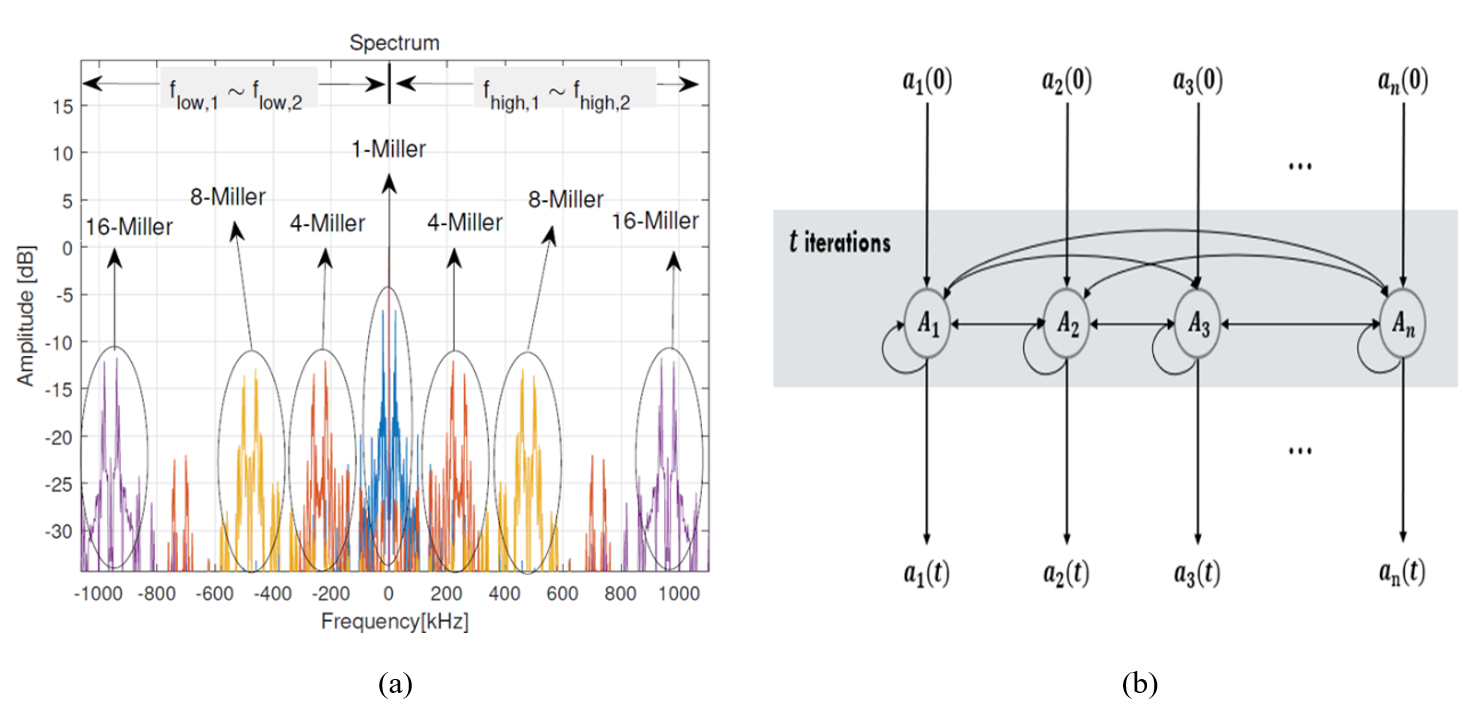
Figure 1. Key Enablers for A-IoT Efficiency. (a) Spectrum of Miller coded signals (m=1,4,8,16), demonstrating clear frequency separation for FDMA. (b) Topology of the Discrete Hopfield Neural Network, where inputs a(0) evolve through recurrent feedback loops over t iterations to recover the output a(t).
2.2 Solution 2: Pattern Recognition for Bits Recovery
Since we cannot put FEC on the tag, we move the intelligence to the Base Station. We treat the reception of a corrupted Asset ID not as a communication error, but as a Pattern Recognition problem. The Base Station already knows the database of valid Asset IDs (patterns). We utilize a Discrete Hopfield Neural Network (DHNN), a fully recurrent single-layer network known for its associative memory.
Why use Hopfield Networks?
3 Results
To validate our proposed designs, we ran extensive simulations summarized in Figure 2. These plots cover signal interference, recovery robustness, and the ultimate inventory efficiency.
3.1 FDMA: Does Non-Orthogonality Break the System?
A common concern with using square-wave Miller codes for subcarrier modulation is that the signals are not perfectly orthogonal—technically, they might interfere with each other. Figure 2(a) puts this fear to rest.
3.2 Bits Recovery: Capacity vs. Robustness
Figure 2(b) quantifies the "associative memory" capability of our Hopfield network. The plot shows the Asset ID detection rate (Y-axis) versus the number of IDs stored in the network (X-axis).
3.3 The Bottom Line: 100x Efficiency Gains
Figures 2(c) and 2(d) tell the most important story. These charts plot the Total Number of Inventory Time Slots (cost, Y-axis) required to inventory a given Number of Devices (throughput, X-axis). To measure efficiency, we draw a horizontal line at a fixed budget of $10^4$ time slots and see how many devices we can handle.
Scenario A: Good Channel Conditions (Figure 2c)
In a favorable environment $ (BER=10^{-3}) $, we focus on the gains from FDMA.
Scenario B: Poor Channel Conditions (Figure 2d) — The Real Challenge
In poor conditions $(BER=10^{-2})$, standard systems collapse because packet errors are fatal.
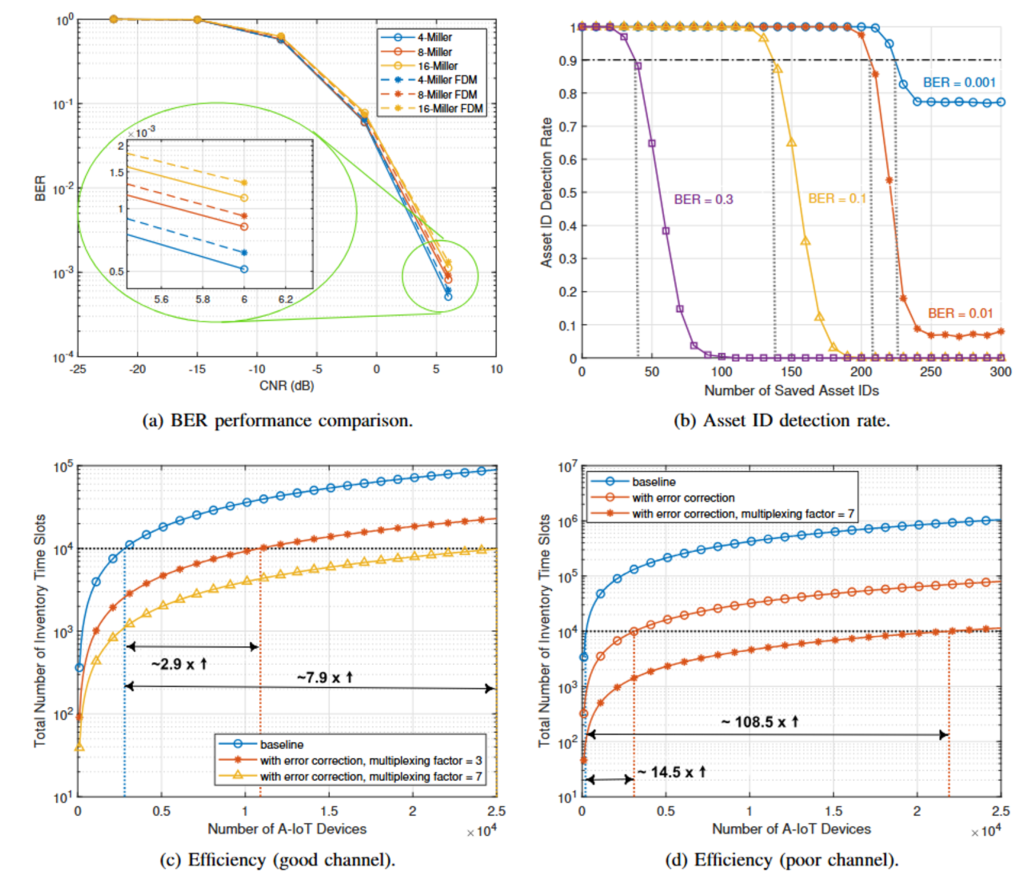
Figure 2. System Performance Evaluation. (a) BER comparison showing negligible interference in the inset. (b) Asset ID detection rates dropping off as storage increases. (c) Efficiency in good channels showing a 7.9x gain. (d) Efficiency in poor channels showing a massive 108.5x gain from the combined solution.
4 Conclusion
Ambient IoT has the potential to automate the physical world, from massive warehouses to retail floors. However, the constraints of passive tags—specifically their inability to handle collisions and correct errors—have been a major barrier to scale. In this work, we demonstrated that we don''t need expensive hardware to solve these problems. By shifting the complexity to the Base Station using Hopfield Networks and employing a clever Miller-code based FDMA scheme on the tags:
The result is a system that significantly improves inventory efficiency—capable of inventorying over 100 times more devices in challenging environments compared to current standards. This approach provides the competitive edge needed to make massive-scale A-IoT a reality.