Communications
Unleashing Uplink Potential: AI-Driven Channel Selectivity Matching via Compressed Channel State Information
1 Introduction
Uplink (UL) throughput stands as a critical Key Performance Indicator (KPI) for 5G-Advanced and 6G wireless communication networks. Nevertheless, UL spectral efficiency enhancements have faced practical bottlenecks. Multi-Input Multi-Output (MIMO) digital precoding serves as a key enabler for boosting UL capacity by accurately matching frequency-selective channel characteristics. However, 3GPP specifications restrict UL transmission to wideband codebook precoding, which only captures large-scale beam directions and lacks fine-grained adaptation across sub-bands. 3GPP Rel-19 RAN workshops highlight that UL sub-band precoding can deliver substantial throughput gains of 13% and 23% in 4-Tx and 8-Tx antenna configurations, respectively. Nevertheless, implementing sub-band non-codebook precoding introduces significant control signaling overhead over the air, growing exponentially with the number of sub-bands and antenna ports. Furthermore, User Equipment (UE) hardware constraints—specifically power amplifier (PA) capability and peak-to-average power ratio (PAPR) limits—present major impediments to real-world deployment.
To address these challenges, this study proposes an AI-driven high-resolution UL precoding framework (SQNC-T). By integrating a Transformer-based autoencoder with trainable Segment Vector Quantization (SVQ), the proposed scheme compresses sub-band non-codebook precoding matrices into ultra-compact signaling codewords while introducing sub-band-wise power equalization (SWE) to satisfy PA capability constraints.
2 Method
2.1 Overall System Model and Procedure
Consider an UL MIMO system featuring PUSCH transmission with digital precoding. In non-codebook precoding, the optimal s-th sub-band precoding matrix $ W_s^{NCB} $ is derived via Eigen Value Decomposition (EVD) of the sub-band averaged channel covariance matrix $ (\overline{H^H H})_s $:
$ (\overline{H^H H})_s=VDV^H, W_s^{NCB}=V \qquad (1) $
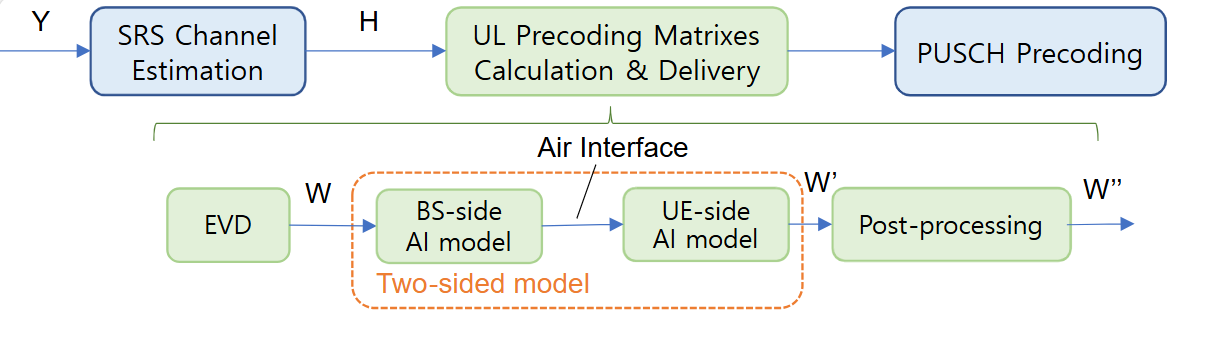
Figure 1. Proposed scheme procedure
In the proposed scheme as illustrated in Fig. 1, the BS estimates channel state information (CSI) from Sounding Reference Signals (SRS), computes optimal non-codebook precoding matrices $ W^{NCB} $, compresses them via a network-side AI Encoder & Quantizer, transmits compact codeword indexes over the air, and reconstructs precoded matrices at the UE side with post-processing power equalization.
2.2 Two-Sided AI Models
To minimize control overhead, two-sided AI models composed of Encoder, Segment Vector Quantization Quantizer, Dequantizer, and Decoder, depicted as Fig. 2, provide two-stage compression. The Encoder extracts spatial-frequency correlations across sub-bands and compresses $ W^{NCB} $ into a low-dimensional latent vector $ L $. The Quantizer splits $ L $ into segmented sub-vectors $ \bar L $ and clusters them into learnable codebook vectors. The Decoder reconstructs the precoding matrices from the SVQ codewords.
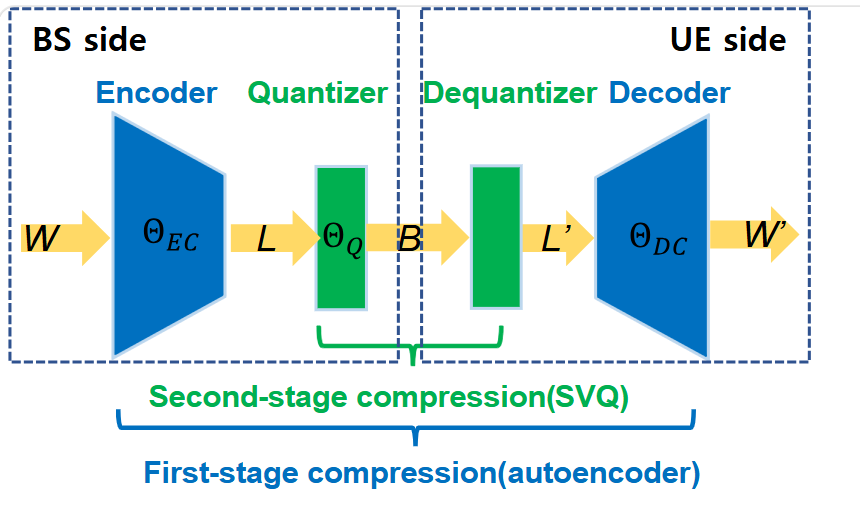
Figure 2. Two-sided AI models
To jointly optimize reconstruction fidelity and quantization accuracy, a multi-task loss function is formulated:
$ \displaystyle \min_{\rm {Θ_{EC},Θ_Q,,Θ_{DC}}} 1-SGCS(W^{NCB},{\widehat W}$$ ^{NCB} )+∑\parallel\bar L-dt(\bar O)‖_2^2 +∑\parallel dt(\bar L)-(\bar O)‖_2^2 . \qquad (2) $
It consists of reconstruction loss $ 1-SGCS(W^{NCB},\widehat W $$^{NCB}) $, encoder loss $ ∑\parallel\bar L-dt(\bar O)‖_2^2 $ and clustering loss $ ∑\parallel dt(\bar L)-(\bar O)‖_2^2$, where $ \widehat W $$^{NCB}$ denotes the reconstructed matrix, $\bar O$ denotes the SVQ codeword with minimum Euclidean distance to $\bar L$. The operator dt(∙) acts as identity in the forward propagation and places the tensor in a leaf node with zero gradient in backward propagation. As illustrated in Fig. 3, encoder loss aims to drive the Encoder output toward the learned SVQ codewords, while clustering loss pushes the SVQ codewords toward the clustering centers of the Encoder’s latent sub-vectors. These two losses together coordinate Encoder and SVQ during training, help to reduce reconstruction loss.
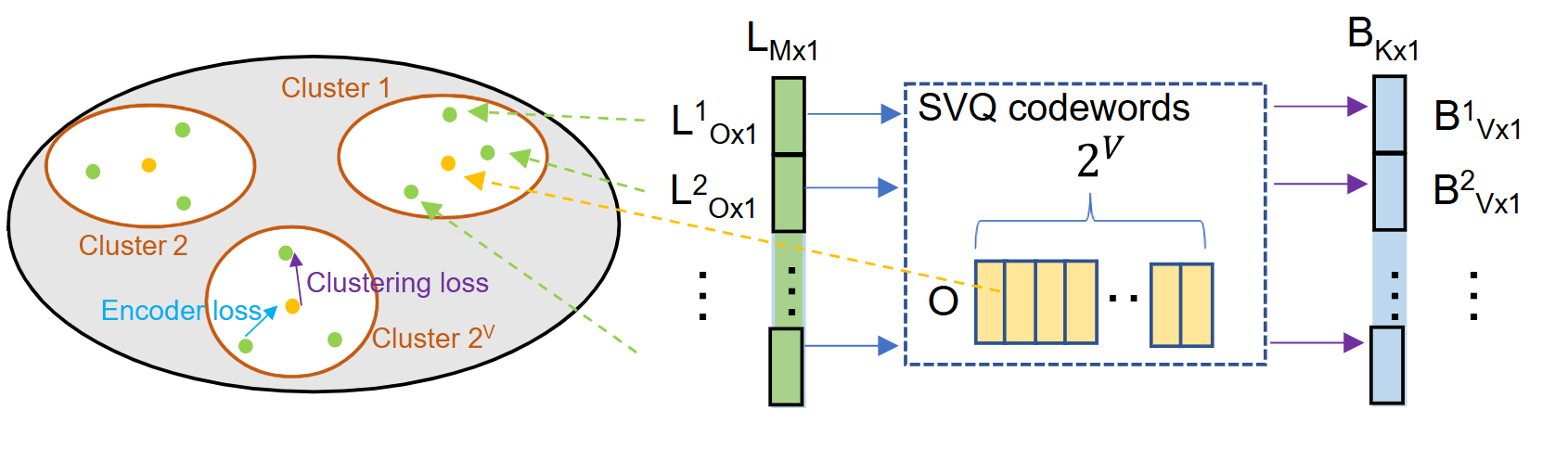
Figure 3. Segment vector quantization with learnable codewords
2.3 Power Equalization for UE PA Capabilities
Practical UEs feature heterogeneous PA architectures categorized under 3GPP capabilities: Capability 1 (full Tx power per port), Capability 2 (reduced power per port), and Capability 3 (partial full power ports), as depicted in Fig. 4. Exemplified as Fig. 5, unconstrained EVD precoding matrices exhibit power imbalances across antenna ports, triggering amplitude scaling that degrades total Tx power.
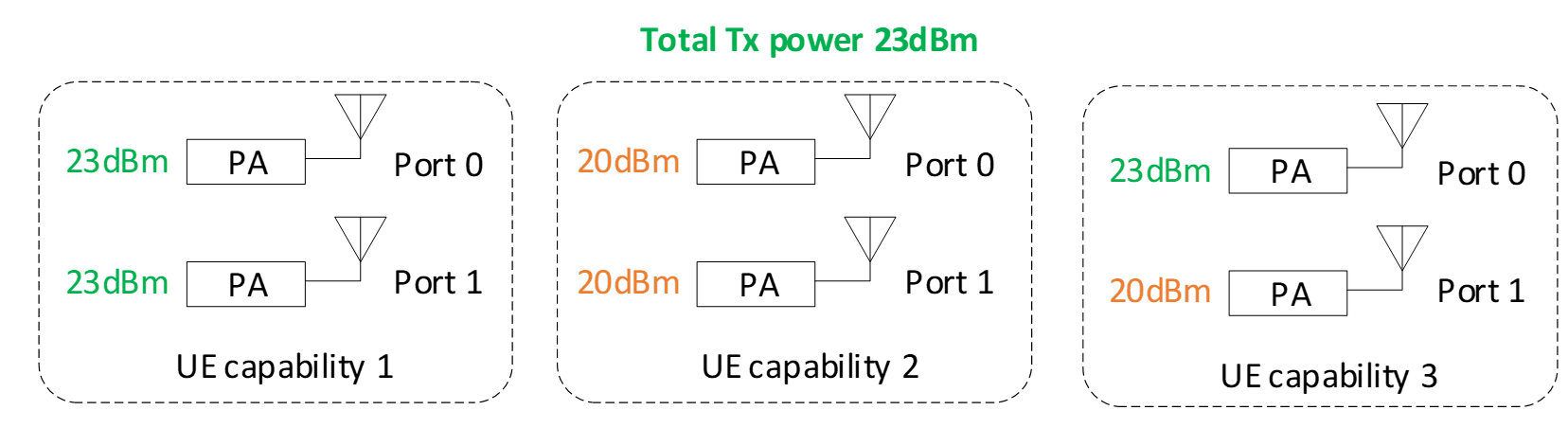
Figure 4. Antenna Port PA capabilities
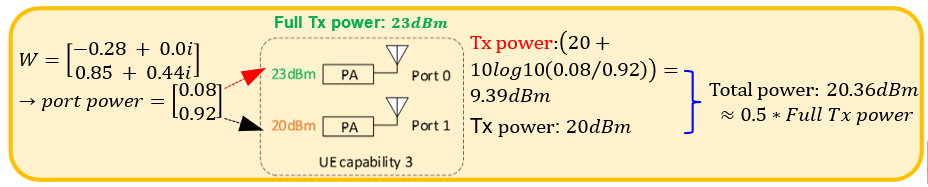
Figure 5. Tx power back-off due to power imbalance
To overcome this, Sub-band-wise Power Equalization (SWE) is introduced to preserve inter-sub-band amplitude and phase profiles while normalizing total port power:
$ \displaystyle W_{L,s}^{NCB}(i,j)=\frac{(W_{L,s}^{NCB}(i,j))}{(‖[W_{L,1}^{NCB}(i,j),…,W_{L,N_{SB-1}}^{NCB} (i,j)]‖_2^2},0≤i≤N_t-1,0≤j≤L-1,0≤s≤N_{SB}-1, \qquad (3) $
where $ L $ is the transmission layer number.
Compared to straightforward Element-wise Power Equalization (EWE) denoted as (4), SWE maintains directional beam accuracy and recovers full Tx power efficiency.
$ \displaystyle W_{L,s}^{NCB} (i,j)=\frac{W_{L,s}^{NCB} (i,j)}{|W_{L,s}^{NCB} (i,j)|},0≤i≤N_t-1,0≤j≤L-1 \qquad (4)$
3 Experiments
3.1 Synthetic-channel-based Evaluation
We demonstrate the superiority of the proposed scheme based on 3GPP-compliant 5G NR link-level simulation (LLS) platforms under 4Tx and 8Tx MIMO configurations (TDLC300-100 channel model, 52 RBs, 13 sub-bands). Four Transformation layers are stacked in Encoder and Decoder to reduce the model complexity, obtaining affordable 7.12M FLOPs for 4Tx and 8.31M FLOPs for 8Tx. The models are trained with 30dB SNR data and evaluated under different SNR conditions to assess generalization capability for precoding matrix distribution.
Throughput Performance: To analyze the PUSCH throughput performance, 4 schemes are evaluated. Standardized wideband codebook precoding (WC) scheme serves as the benchmark. Sub-band codebook precoding (SC) scheme helps assess the gains from sub-band precoding. Sub-band non-codebook precoding (SNC) scheme establishes the throughput upper bound by bypassing the two-sided models and directly using the optimal EVD-based precoding matrices. The proposed approach, sub-band non-codebook powered by Transformer and SVQ (SQNC-T) is compared with WC scheme to demonstrate the throughput gains and with SNC scheme to quantify losses due to AI-powered compression and quantization.
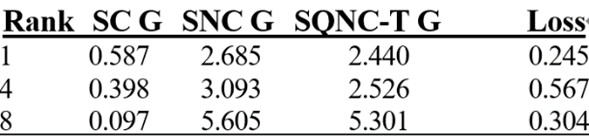
Table 1. PERFORMANCE GAINS COMPARED TO WC FOR 4TX
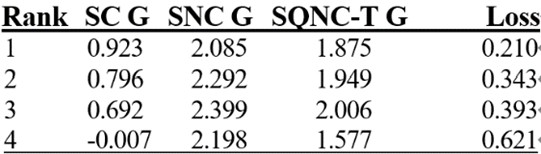
Table 2. PERFORMANCE GAINS COMPARED TO WC FOR 8TX
Table 1 and 2 summarize the performance gains (abbreviated as G) compared to WC scheme and losses between SQNC-T and SQNC schemes (abbreviated as Loss) corresponding to the SNR (dB) at 70% of maximum throughput, respectively for 4Tx and 8Tx scenarios. SQNC-T achieves SNR gains of up to 2.01 dB in 4Tx scenarios and 5.30 dB in 8Tx scenarios compared to legacy WC precoding, while compression and quantization losses remain minimal across all ranks.
Table 3 summarizes the required bit numbers per layer per sub-band for SC, SNC and SQNC-T for 4-Tx and 8-Tx scenarios. Compared to SNC, an impressive compression ratio of 34.68 is attained by proposed SQNC-T.
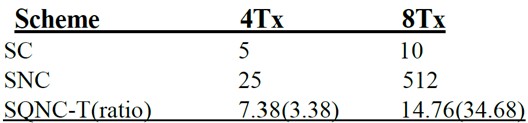
Table 3. OVERHEAD COMPARISON

Table 4. PERFORMANCE GAINS COMPARED TO WC FOR 8TX
Impact of power equalization: Table 4 summarizes the performance gains (abbreviated as G) compared to WC and losses from power equalization methods (shown in the brackets) when considering UE’s PA capability in the 8-Tx scenarios. SWE retains 5.43 dB gain in 8Tx Rank-8 case with only 3.1% performance degradation, vastly outperforming EWE (-41.6% loss).
Impact on PAPR: Figure 6 and 7 compare the cumulative distribution functions (CDF) of PAPR for time and frequency domain transmission signals, demonstrating that the proposed high-resolution precoding method has negligible impact on the PAPR requirements.
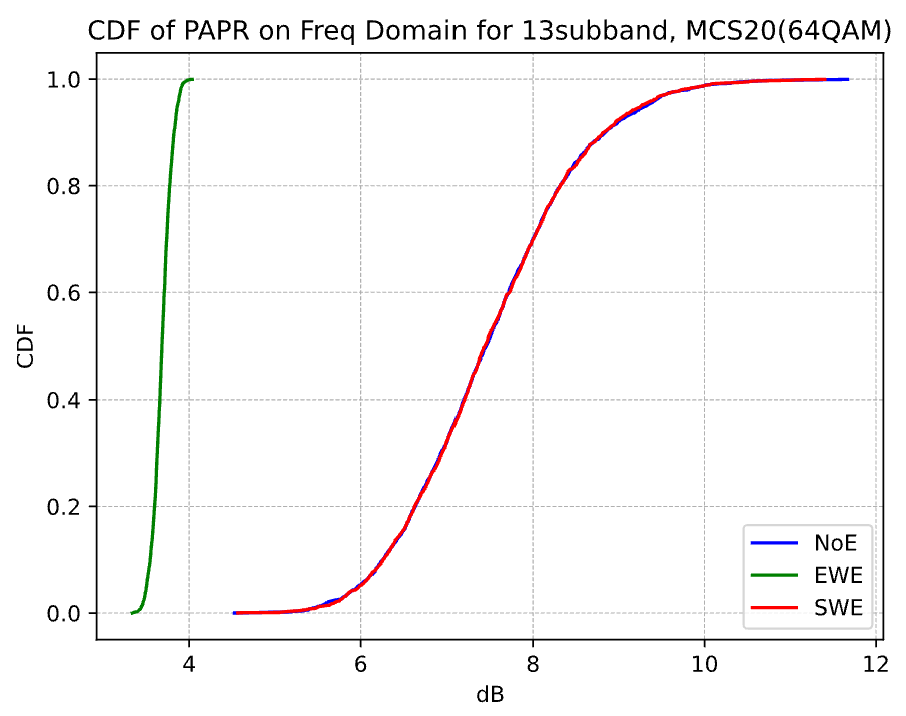
Figure 6. PAPR in frequency domain
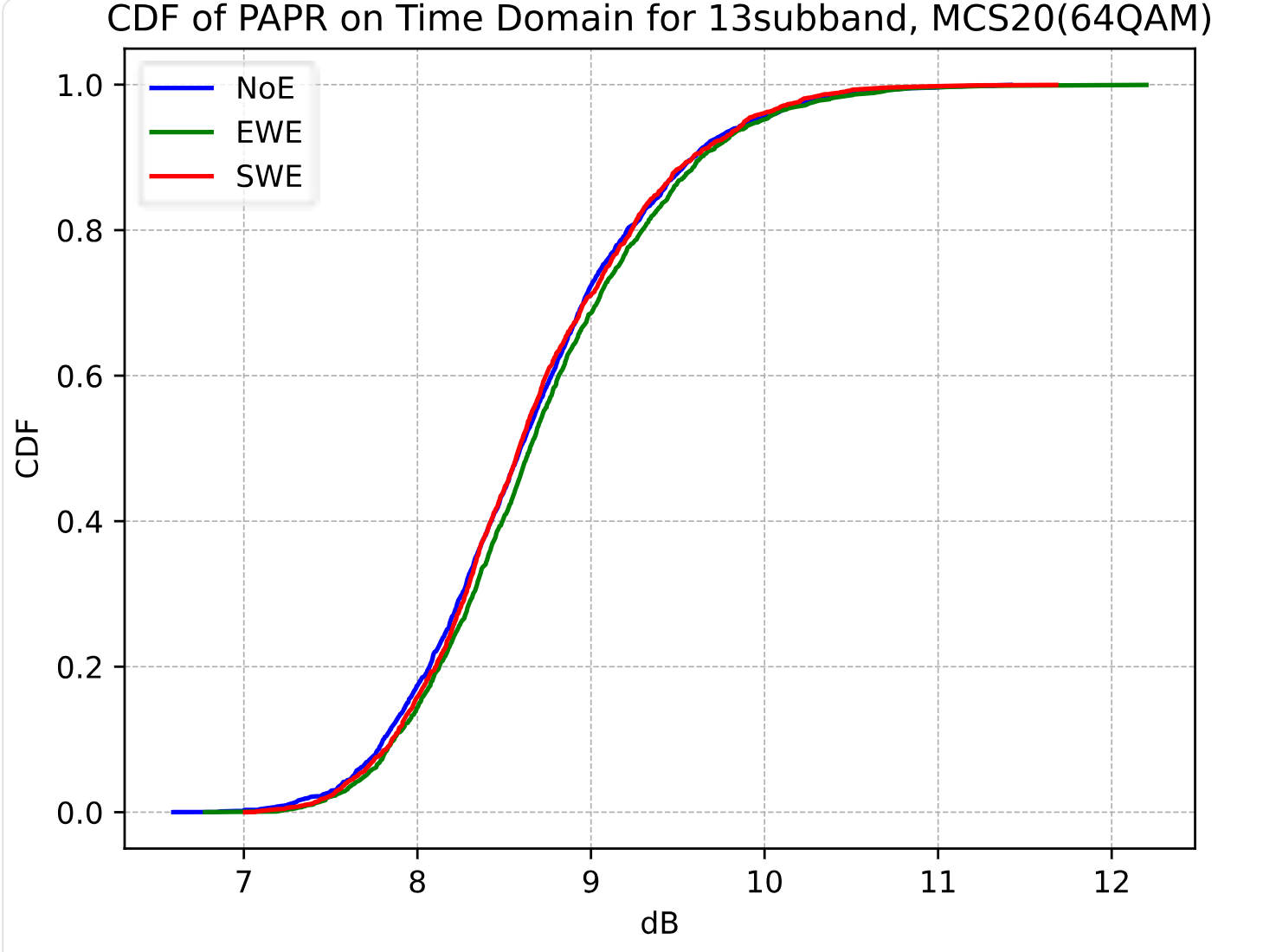
Figure 7. PAPR in time domain
3.2 Field Measurement Verification
To validate practical feasibility, a hardware Proof of Concept (PoC) platform was built in an indoor office environment using NI USRP and PXIe systems (8Tx TxE, 2Rx RxE, 6MHz bandwidth). Field measurements demonstrate an average SGCS of 0.97, confirming high reconstruction accuracy and strong generalization in real-world propagation environments.
4 Conclusion
This paper presented an AI-driven uplink high-resolution precoding framework leveraging Transformer autoencoders and Segment Vector Quantization. The proposed scheme achieves substantial throughput gains (~2dB in 4Tx and ~5dB in 8Tx) with a 34.68x compression ratio, while Sub-band-wise Power Equalization effectively resolves UE PA power constraints. The effectiveness of proposed solutions is further demonstrated through field-measurement-based evaluation.