
Samsung R&D Institute Poland Awarded 1st Place at Interspeech 2026 Challenge
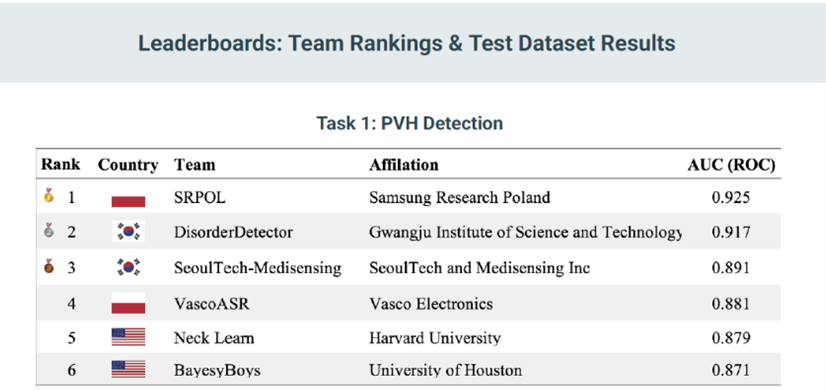
The Audio Intelligence Group at Samsung R&D Institute Poland (SRPOL) achieved a major breakthrough in the international NeckVibe Challenge, securing first place in the detection of Phonotraumatic Vocal Hyperfunction (PVH). The challenge involved nine global teams from institutions including Seoul National University, Gwangju Institute of Science and Technology, and Harvard University, representing Poland, South Korea, India, and the USA.
PVH is a pathologically tense voice, a condition causing vocal fold damage due to improper muscle strain during speech. Specifically, it’s excessive or imbalanced voice box activity during phonation. The SRPOL’s state-of-the-art ensemble-based framework reached a ROC AUC (Area Under the Receiver Operating Characteristic Curve) of 0.925, effectively surpassing previous benchmarks and setting a new state-of-the-art(SOTA) standard for vocal pathology classification. This result underscores the team's ability to outperform global competitors in identifying structural lesions like nodules and polyps through non-invasive technology.
Technical Excellence and Innovation
The solution’s success is rooted in a novel approach to temporal data segmentation, which captures intra-day variations in vocal behavior that traditional full-day aggregation methods often miss. Leveraging a dataset of 582 individuals, the team processed neck-surface accelerometer (ACC) signals from 50 ms frames to analyze key features like fundamental frequency, cepstral peak prominence, spectral tilt, and advanced glottal airflow aerodynamics. By combining lightweight AI models and separating speech from singing data, the team created a highly robust system capable of detecting even transient muscle tension through specialized 5-minute window analysis.
Prospects and Future Work
Our R&D team explores new modalities and signal processing to enable practical health-related features. This year’s first-place at the NeckVibe challenge is the third consecutive win for the SRPOL Audio Intelligence Group (ICASSP 2024, INTERSPEECH 2025) using lightweight AI and signal processing to solve complex health problems. We are currently applying this expertise to detect neurodegenerative diseases by identifying subtle patterns in digital signals. Our ongoing work also includes incubation for neurodevelopmental disorders and attention deficit. Additionally, we are developing gait analysis to monitor movement as a marker for neurological health. These projects focus on turning everyday data into useful tools for early detection and monitoring.