
Samsung R&D Institute Philippines Lecture Series on Human Computer Interaction
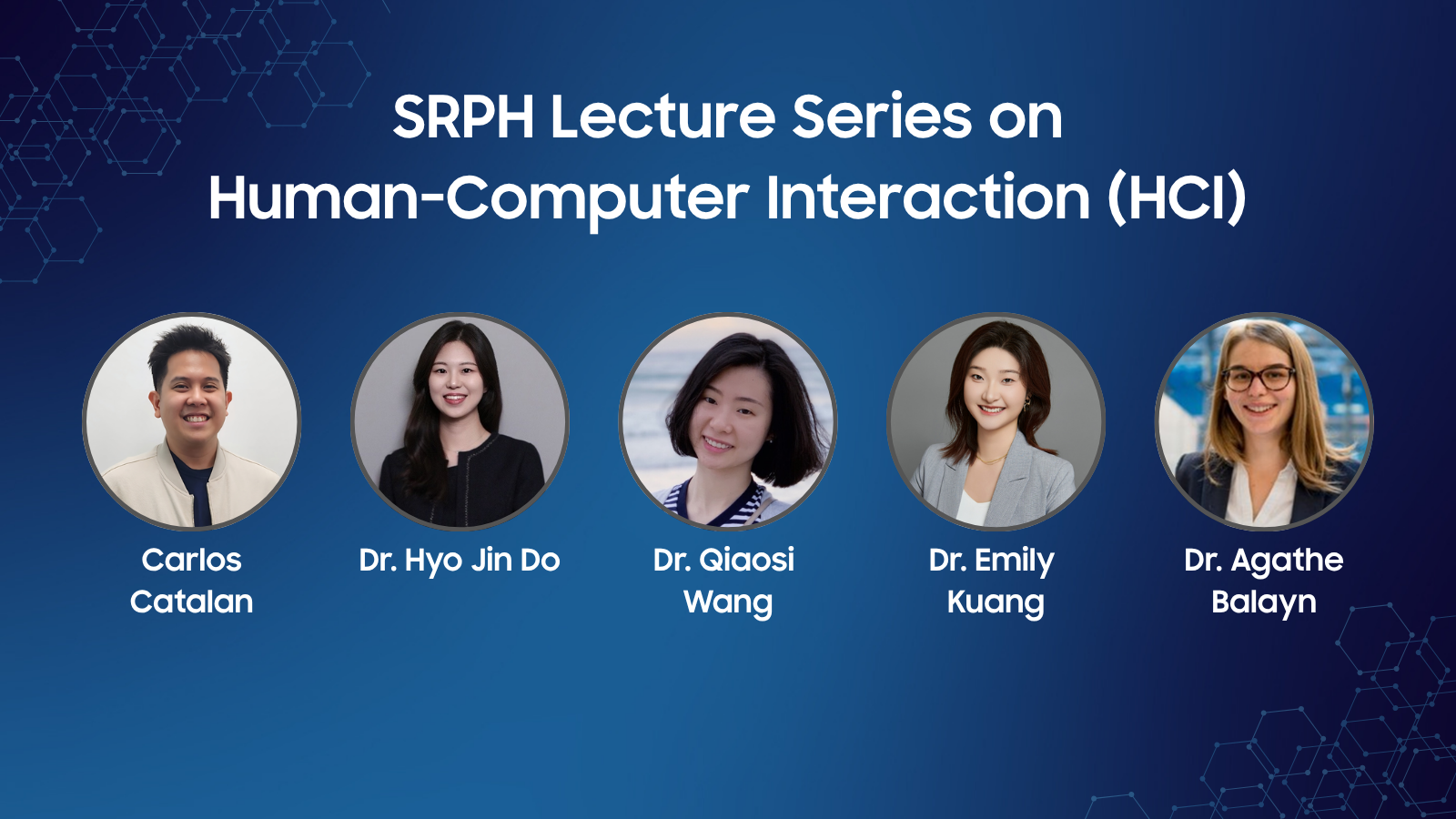
In an effort to build SRPH’s capabilities in Human-Centered AI and provide growth opportunities for its employees, SRPH invited outstanding researchers from around the world to conduct lectures on diverse human-computer interaction (HCI) topics. During the lectures, the researchers shared more than just details about their individual projects and noted promising future directions in the field and engaged in discussions with like-minded engineers. From April to May 2026, over 100 attendees were able to gain valuable insights on the state of human-computer interaction in the field.
Talk 1: Fundamentals of HCI
To set the foundation for the succeeding talks, our very own Carlos Rafael Catalan, a researcher studying Human-Centered AI here at SRPH, provided a lecture discussing the fundamental principles and methods of Human-Computer Interaction. He also shared his ongoing work that was accepted to the workshops on Human-Centered Explainable AI and Generative AI as Tools for Thought at ACM-CHI 2026. His work allowed the attendees to reflect on their usage of AI coding tools, and how explainability methods can be designed in a way that supports end-users, and even how AI itself can be a tool for cognitive scaffolding rather than cognitive offloading.
Talk 2: Human-centered AI evaluation
Dr. Hyo Jin (Gina) Do, PhD, an independent researcher based in the US, discussed “A Human-Centered Approach to Evaluating and Communicating LLM Responses”. First, she presented her work on EvalAssist, an open-source tool designed to scale LLM-as-a-judge evaluations. The tool provides insight into how LLM evaluators refine their evaluation criteria, and how task types influence various judgment strategies evaluators employ. Finally, Gina discussed various ways AI developers can communicate factuality scores to users to enhance user trust while maintaining perceived response quality—a direction she took because she was motivated to address user frustrations and poor decision-making outcomes stemming from LLM hallucinations.
Talk 3: Responsible Human-AI social alignment
Dr. Qiaosi (Chelsea) Wang, PhD, a Carnegie Bosch Postdoctoral Fellow at the Human-Computer Interaction Institute at Carnegie Mellon University, gave her talk “Understanding and Exploring the Design of Responsible Human-AI Social Alignment”. She discussed that AI, as social actors, must be designed in a way that is situated in the social context, dynamically adaptable, and can attune to subjective mental states. She proposed how mutual theory of mind can account for people’s social perceptions of AI, subsequently serving as a framework to address these design requirements. Her work also described how people’s cognitive pathways to perception-driven risks can provide opportunities for designing responsible AI. Lastly, she provided future direction for her work and an overview of human-AI social alignment.
Talk 4: Human-AI collaboration
Dr. Emily Kuang, PhD, is an assistant professor at the COCOA Lab in the Dept. of Electrical Engineering and Computer Science at York University. In her talk “Advancing Human-AI Collaboration in Usability Analysis through Conversational Agents”, she discussed various challenges that come with usability analysis. She also looked at how conversational agents can be more effective as an assistant through a nuanced understanding of human-AI collaboration, one that is informed by representations of AI, interaction modalities, timing of AI suggestions, and perceived expertise.
In her future research agenda, she envisions AI that empowers humans by adapting to users’ expertise and behavior and becoming part of a larger, hybrid, multi-agent system. With this, each member (human or AI) provides diverse insights that maintain trust and detects biases to optimize collaborative outcomes.
Talk 5: AI Governance and policies
Dr. Agathe Balayn, PhD, is a postdoctoral researcher at Microsoft Research’s FATE group, and an incoming assistant professor at TU Eindhoven. In her talk on AI Governance and Policies, she discussed that AI has the capability for both good and harm, and how HCI research can foster the design of responsible AI (RAI) at different levels to satisfy different stakeholders and use cases.
At the AI developer level, RAI toolkits raise awareness and foster RAI work, but can quickly fall through the cracks due to a variety of individual attitudes. At the organizational level, internal organizational dynamics such as misaligned incentives and resource constraints constitute obstacles to RAI implementation. At the affected stakeholder level, she discussed how end users need recourse mechanisms, proper oversight, and explanations to foster trust and fairness. These insights combine to inform public and private policymakers at the governance level to effectively design RAI policies.
Human at the center
The lecture series is an important step for Samsung to design and develop AI that advances the human condition. We believe in the power of AI, but also understand that the responsibility to use and develop AI ethically extends to both engineers and non-tech personnel. Even with advances in AI, SRPH maintains the need for practices that always put the human at the center.
We would like to thank all the invited speakers for taking the time to share their work with us.