
Samsung R&D Institute India–Bangalore Becomes India’s Second-Highest Contributor to the CVPR 2026 Main Track
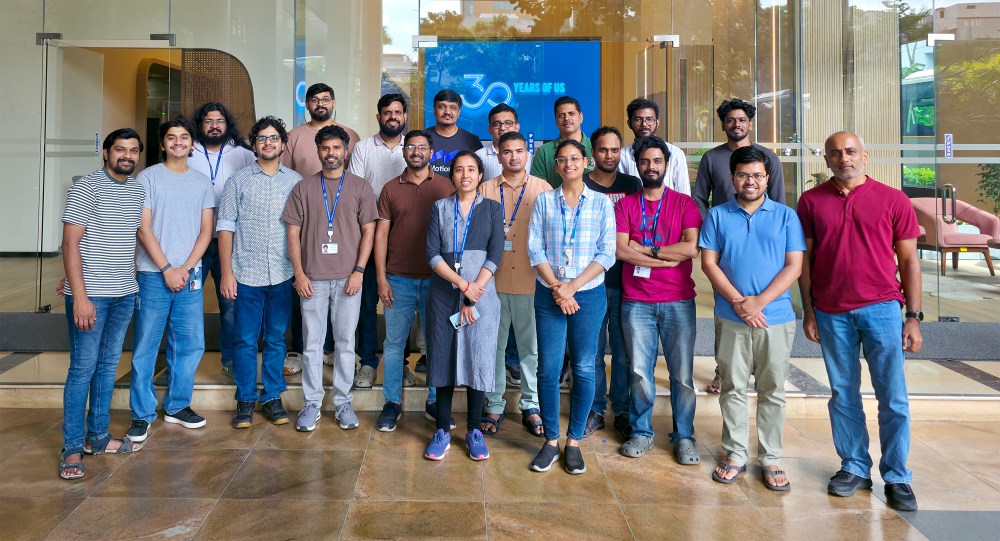
Samsung R&D Institute India–Bangalore (SRI-B), one of Samsung's largest R&D centers outside South Korea, has achieved a significant research milestone by emerging as the second-highest contributor from India to the CVPR 2026 Main Track, the flagship research track of the prestigious IEEE/CVF Conference on Computer Vision and Pattern Recognition (CVPR), one of the world's leading conferences in artificial intelligence and computer vision.
SRI-B's accepted papers account for 12.76% of India's total of 47 accepted papers in the CVPR 2026 Main Track, highlighting the institute's growing contribution to India's AI research landscape. Held in Denver, Colorado, USA, the CVPR 2026 Main Track witnessed unprecedented global participation, receiving a record 16,092 paper submissions, of which 4,090 papers were accepted, resulting in an acceptance rate of 25.41%. Widely regarded as the premier global conference for computer vision and artificial intelligence, CVPR is among the world's most influential scientific publishing venues, with its proceedings consistently ranking among the highest cited across scientific disciplines.
Samsung recorded 28 accepted papers in the CVPR 2026 Main Track across its global research ecosystem. Of these, six papers originated from SRI-B, representing more than one-fifth of Samsung's global Main Track acceptances and underscoring India's growing contribution to Samsung's worldwide AI research efforts.
"This achievement reflects the depth of AI research being carried out at SRI-B and reinforces India's growing role in shaping the future of computer vision and artificial intelligence. Having six papers accepted to the CVPR 2026 Main Track, one of the world's most competitive AI research forums, is a testament to the passion of our researchers, our long-term investment in fundamental research, and Samsung's commitment to building globally impactful technologies from India. We are proud that our teams are contributing innovations that advance the global AI community while creating meaningful real-world impact." Mohan Rao, Managing Director & Corporate Vice President, Samsung R&D Institute India–Bangalore
The six papers accepted to the CVPR 2026 Main Track span diverse areas of artificial intelligence and computer vision, including video denoising, text-to-3D model generation, image restoration, eye tracking, knowledge distillation, and 3D reconstruction, addressing challenges across mobile imaging, privacy-preserving AI, foundation models and immersive digital experiences.
Advancing AI Research Across Diverse Domains
Efficient Real-Time Raw-to-Raw Denoising for Extreme Low-Light Ultra HD Video on Mobile Device presents an efficient AI-based video denoising solution that significantly enhances Ultra HD video captured under extremely low-light conditions while operating in real time on mobile devices. The research was authored by Charantej Reddy Pochimireddy, Subhasmita Sahoo, Apoorva Verma, Palavalli Shyam, Swapnil Malviya, Sarvesh, and Raj Narayana Gadde.
HandDreamer: Zero-Shot Text to 3D Hand Model Generation using Corrective Hand Shape Guidance introduces a novel AI framework capable of generating realistic 3D hand models directly from text prompts without requiring prior examples, enabling new possibilities in augmented reality, virtual reality and digital content creation. The paper was authored by Green Rosh, Prateek Kukreja, Vishakha S.R., and Pawan Prasad B.H.
NanoSD: Edge Efficient Foundation Model for Real-Time Image Restoration proposes an edge-efficient foundation model that restores degraded images in real time while operating on resource-constrained devices, making advanced image restoration more accessible on consumer devices. The research was contributed by Subhajit Sanyal, Srinivas Soumitri Miriyala, Akshay Bankar, Manjunath Arveti, Sowmya Vajrala, Shreyas Pandith, Sravanth Kodavanti, Abhishek Ameta, Harshit, and Amit Unde.
PrivateEyes: Gaze-Preserving Anonymization for Data Sharing introduces a privacy-preserving AI framework that anonymizes personal identity while retaining gaze information essential for research, enabling secure sharing of eye-tracking datasets without compromising data utility. The work was led by Surabhi Gupta along with Dinesh Prabhu Muthumariappan, Biplab Das, Anoop Kolar Rajagopal, Kiran Iyer, and Donghwan Seo.
Grid Distillation: Compositional Image Distillation via Structured Generative Grids presents a structured knowledge distillation approach that enables generative image models to learn more efficiently, improving both image quality and computational scalability. The paper was authored by Biplab Das, Shouvik Das, and Viswanath Gopalakrishnan.
Turbo-GS: Accelerating 3D Gaussian Fitting for High-Resolution Radiance Fields introduces a significantly faster approach for high-resolution 3D scene reconstruction using Gaussian splatting techniques, enabling more efficient creation of immersive digital experiences. The paper, authored by Ankit Dhiman, Tao Lu, and Srinath Ravi, was selected as a Highlight Paper, placing it among the top 15% of papers accepted to the CVPR 2026 Main Track.
The CVPR 2026 Main Track marked a defining moment for the AI community, reflecting the rapid evolution of computer vision from perception-focused models to agentic AI capable of reasoning, planning and autonomous decision-making. The conference also showcased breakthroughs in embodied AI, multimodal learning, autonomous robotics and efficient foundation models, highlighting the expanding role of computer vision in shaping the next generation of intelligent technologies.
SRI-B's strong performance at the CVPR 2026 Main Track reinforces Samsung's commitment to advancing world-class AI research from India while contributing innovations that address meaningful real-world challenges and shape the future of intelligent technologies.